

A printing plate card is the actual metal image carrier used to produce a trading card, typically one plate per CMYK color, sometimes released to collectors as a factory 1-of-1 or paired with an autograph. These plates matter to collectors because they connect a card directly to the manufacturing process itself, and their value depends heavily on player, condition, and which plate you’re holding.
TL;DR:
- The value of printing plates mainly depends on player popularity, autograph inclusion, and visual clarity, with signed star plates commanding the highest prices.
- Most cards are produced with four CMYK plates, but extra spot and varnish plates can increase the total, and yellow plates often appear nearly blank despite being fully etched.
- Genuine plates are typically aluminum and reflect the specific print run, with rarity influenced by design complexity, release size, and surviving condition.
- Authenticity factors include manufacturer backstamps and consistent etching details, while reproductions often show uniform etching or blurred images under magnification.
- Proper storage, handling with gloves, and avoiding high humidity or sunlight are crucial for maintaining a plate’s condition and value over time.
Table of Contents
- What Are Printing Plates and How Many Exist Per Card?
- How Printing Plates Are Made and Used in Offset Printing
- Why Do Collectors Care About Printing Plate Cards?
- Where Do Collectors Find Printing Plates?
- How Do You Grade the Condition of a Printing Plate?
- How Should You Store and Display Printing Plates?
- Should You Chase Full Plate Rainbows or Single Standouts?
- What Materials Are Printing Plates Made From?
- What Makes a Printing Plate Genuinely Rare?
- How Do You Spot a Fake or Reproduction Printing Plate?
- An Editorial Take on Plate Collecting’s Blind Spot
- Find Rare Autographs and Redemption Cards at NextGenCards.shop
- Sources
- FAQ
What Are Printing Plates and How Many Exist Per Card?
A printing plate is a thin metal sheet that carries the image data used to transfer ink during offset printing. Every full-color trading card is built from a set of these plates, and the standard setup uses four: one each for cyan, magenta, yellow, and black, the four colors that combine to create the full-color image you see on the finished card. Manufacturers frequently pull these plates from the press after a print run and release them individually as collectible items.
That’s the CMYK basics. But not every card stops at four plates.
- Cyan, magenta, yellow, black: the four standard plates that build any full-color photo or graphic
- Spot color plates: extra plates added for a metallic ink, a specific brand color, or a foil accent that CMYK alone can’t reproduce
- Varnish plates: used to apply a clear gloss coating over specific areas, adding one more plate to the stack
- Yellow plates: often look nearly blank to the naked eye because yellow ink lays down lightly on many photographic designs, even though the etching is fully present.
That last point trips up a lot of new collectors. A yellow plate isn’t defective just because it looks pale, faint, or nearly empty when you hold it up.
The “1-of-1” label also deserves a second look. Yes, each individual plate that comes off a press for a given print run is technically unique. But most card designs get printed across multiple separate plate sets over the course of production, meaning several “1-of-1” cyan plates can exist for the same card design if the run required more than one set of plates. Genuine plate collectors know to ask sellers which specific set a plate came from, not just trust the 1-of-1 sticker.
How Printing Plates Are Made and Used in Offset Printing
Plate production starts long before a card ever touches a press. A designer’s final artwork gets digitally separated into its CMYK channels, plus any spot colors the design calls for. Those separations are then imaged directly onto metal plates through a computer-to-plate (CTP) system, a process that transfers each color separation onto its own plate with no film step in between.
Once imaged, plates get mounted onto cylinders on the press itself. This is where offset lithography earns its name: ink from the plate transfers first to a rubber blanket cylinder, then from that blanket onto the paper or card stock. The plate never touches the substrate directly, which is one reason plate mechanics can be understood as a three-cylinder relationship between plate, blanket, and impression cylinder. That indirect transfer is also why a plate looks monochrome and slightly abstract off-press. You’re looking at just one color’s worth of image data, not the finished composite.
Collectors will encounter a few different plate families in the wild:
- Aluminum CTP plates: the most common modern choice, durable and suited to long production runs
- Polyester laser plates: cheaper and used for shorter runs or lower-volume jobs
- Conventional PS (presensitized) plates: an older analog technology still used by some smaller shops
- Processless plates: skip the chemical processing step entirely, which speeds up makeready time and reduces plate-to-plate variability on press
Registration, meaning how precisely each plate’s image aligns with the others, determines whether the finished card looks crisp or shows visible color fringing. A well-registered set is part of what makes an etched plate satisfying to examine under light.
Pro Tip: Hold a plate at a low angle under a single light source rather than overhead lighting. Etched detail that’s invisible under flat light often becomes clearly visible once you catch the raking angle correctly.
Why Do Collectors Care About Printing Plate Cards?
Plate collecting is a genuinely niche corner of the hobby, and understanding what drives value keeps expectations realistic before you spend money chasing one.
- Player popularity drives price more than anything else. A plate from a star rookie or a legend commands far more interest than the same plate style from a role player, regardless of how clean the etching looks.
- Autograph or sticker presence changes the math entirely. Manufacturers occasionally distribute plates with a signed sticker or direct autograph attached, and that signature typically drives significantly higher demand than an unsigned plate of the same player.
- Front versus back matters. A plate tied to the front image, especially a clear player photo, usually outperforms a back-of-card text plate in collector interest.
- Etching clarity affects visual appeal. Black and magenta plates tend to show the most recognizable detail; a plate where you can clearly make out a face or logo will always draw more attention than a murky one.
- Technical rarity doesn’t equal effective scarcity. A plate can be a true 1-of-1 from its specific press run and still be one of several similar plates that exist across multiple production sets for that same card design.
Realized prices swing widely because of these factors. An unsigned yellow plate of a bench player might sell for the cost of a coffee, while a signed black plate of a franchise rookie can reach four figures depending on demand. Reviewing how autograph cards vary in value helps frame why the same signature premium applies to plates as much as it does to standard autograph inserts.
Where Do Collectors Find Printing Plates?
Plates reach the secondary market through a handful of predictable channels, and knowing them helps you avoid overpaying or getting fooled by a mislabeled item.
- Pack pulls: some manufacturers insert plates directly into wax or hobby boxes, and they typically feel noticeably heavier and stiffer than a standard card in the pack
- Manufacturer promos and set-aside releases: companies sometimes distribute plates through redemption programs or connect them to companion booklets that document the print run
- Auction houses and verified dealers: the most reliable source for higher-value signed or star-player plates, since reputable auction houses typically vet provenance before listing
- Hobby forums and collector groups: useful for tracking down specific designs, though buyer diligence matters more here than anywhere else
Before buying, check for a backstamp or authenticity sticker from the manufacturer, ask the seller for provenance details (which set, which production run), and look at seller reputation and return history. A plate with no documentation isn’t automatically fake, but it’s a bigger gamble.
How Do You Grade the Condition of a Printing Plate?
Grading a plate isn’t like grading a standard card, and applying the same corner-and-edge instincts you’d use on a rookie card will lead you astray.
Examine the surface for print lines, ink residue, or the wax and gum buildup that shows up on older vintage plates. Factory imperfections, light smudges, faint registration marks, minor edge roughness from the cutting process, are generally accepted as part of a plate’s natural production history rather than treated as condition defects the way they would be on a standard card.
- Check all four corners under magnification before buying
- Look specifically for wax, gum, or oxidation residue on the surface
- Confirm which plate color you’re actually holding, since yellow plates can be mistaken for blank or damaged plates
- Request seller photos under raking light if listing photos look flat or unclear
When a plate carries real financial weight, meaning a signed star player or a high-demand design, third-party authentication is worth the cost. It removes the guesswork around provenance disputes later.
Pro Tip: If a yellow plate looks suspiciously blank, compare it side by side with a known magenta or black plate from the same card design. The etching depth should match even if the visible ink tone doesn’t.
How Should You Store and Display Printing Plates?
Metal plates need different care than cardboard, and a few cheap habits go a long way toward keeping condition intact.
- Store plates in non-acidic sleeves or sealed shadowboxes designed for metal, and add an anti-tarnish pack inside sealed display cases to slow oxidation.
- Handle plates with clean cotton gloves whenever possible, and keep them away from direct sunlight and high humidity, both of which accelerate corrosion on bare aluminum.
- Ship plates padded and rigid, never loose in a standard bubble mailer, since metal edges can bend or dent more easily than most collectors expect.
- For display purposes, prioritize plates with strong tonal contrast, black or magenta plates showing a recognizable face or logo, since these read far better from a distance than a pale yellow plate. Reviewing general trading card storage basics is a useful starting point even though metal plates need extra precautions beyond standard cardboard.
Should You Chase Full Plate Rainbows or Single Standouts?
The “rainbow” chase, collecting every color plate from a single card design, sounds appealing but rarely makes financial sense for most collectors.
The 1-of-1 framing on plates is genuinely misleading if you don’t understand it fully. Because a single card design can be printed across multiple separate plate sets during a production run, “1-of-1” describes one specific plate from one specific run, not proof that only one plate of that color exists anywhere for that design. Chasing a complete four-color rainbow means tracking down plates that may have originated from entirely different print runs, at a real cost in time and money that rarely pays off unless the player is a genuine star.
- Prioritize provenance and documentation over completing a full color set
- Weigh autograph presence heavily. A signed single plate usually beats an unsigned full rainbow in resale value
- Buy for condition first if resale matters to you, and buy for visual appeal first if display is the goal
- Accept that rarity claims on plates are often technically true but practically overstated
The same scarcity psychology that drives pricing in other collectible markets applies here: perceived scarcity moves price just as much as verified scarcity does, so a clear head about what you’re actually buying protects your wallet.
What Materials Are Printing Plates Made From?
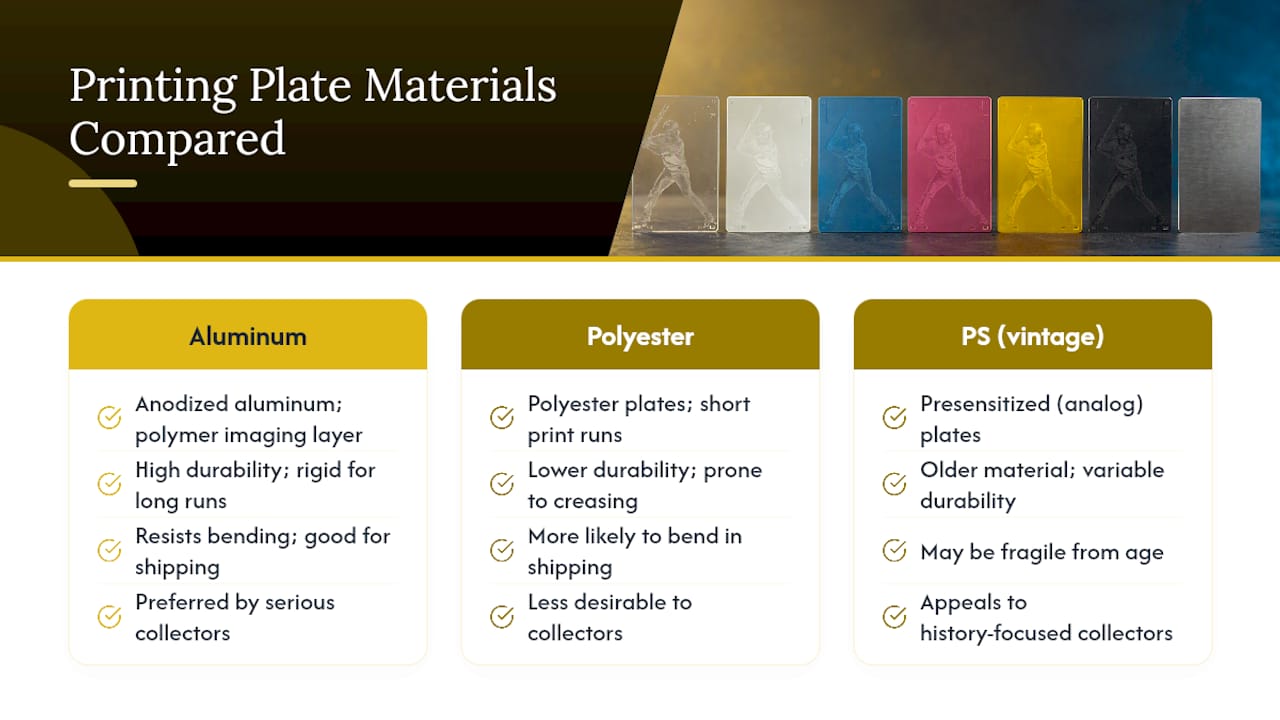
Most plates you’ll encounter in the hobby are anodized aluminum with a polymer imaging layer, the same material used broadly across offset lithography. Aluminum strikes a practical balance for printers: it’s light enough to mount and remove from press cylinders repeatedly, yet rigid enough to hold fine etched detail through a long run.
Polyester plates show up occasionally, especially from shorter print runs or smaller print shops handling limited-release insert sets. They’re cheaper to produce but generally less durable, more prone to bending or creasing, and less desirable to serious plate collectors as a result. Older conventional PS plates, the presensitized analog type, occasionally surface from vintage card runs and carry their own appeal for collectors interested in printing history rather than just the finished image.
Material matters directly to collectibility. Aluminum plates hold up better to handling and display over years, resist bending better during shipping, and generally photograph and display with cleaner contrast than polyester alternatives. If you’re comparing two otherwise similar plates, one aluminum and one polyester, expect the aluminum piece to command a modest premium purely on durability grounds, separate from whatever player or autograph value it carries. Processless aluminum plates, increasingly common in modern production, also tend to show more consistent dot structure and etching clarity since they skip a chemical processing step that can introduce variability.
What Makes a Printing Plate Genuinely Rare?
Rarity on printing plates is more layered than most collectors initially assume, and understanding the layers keeps you from overpaying based on marketing language alone.
Original production run size sets the ceiling. A card design printed for a massive flagship release will typically require more separate plate sets than a small, limited insert series, meaning more individual plates technically exist even though each one still carries a 1-of-1 designation from its specific run. A tightly limited release, by contrast, might only need a single plate set, making every surviving plate from that design a true and singular survivor.
Limited or short-print insert sets tend to produce the scarcest plates in practical terms, simply because fewer plate sets were ever needed to complete the print job. Redemption-driven or promotional releases add another layer: manufacturers sometimes intentionally hold back plates for later distribution through programs tied to specific redemption cards, which can concentrate demand around a narrow release window.
The honest takeaway is that rarity on a plate is a combination of how many plate sets a design required, how many of those plates survived intact, and how many ever entered the collector market at all versus being scrapped or recycled after the print run. A plate can be simultaneously “rare” in the technical 1-of-1 sense and not particularly scarce in practice, if the design required many separate print runs to complete its full production order.
How Do You Spot a Fake or Reproduction Printing Plate?
Authenticity concerns on plates differ from standard card counterfeiting, since the raw material itself, thin etched metal, isn’t something most counterfeiters bother replicating convincingly.
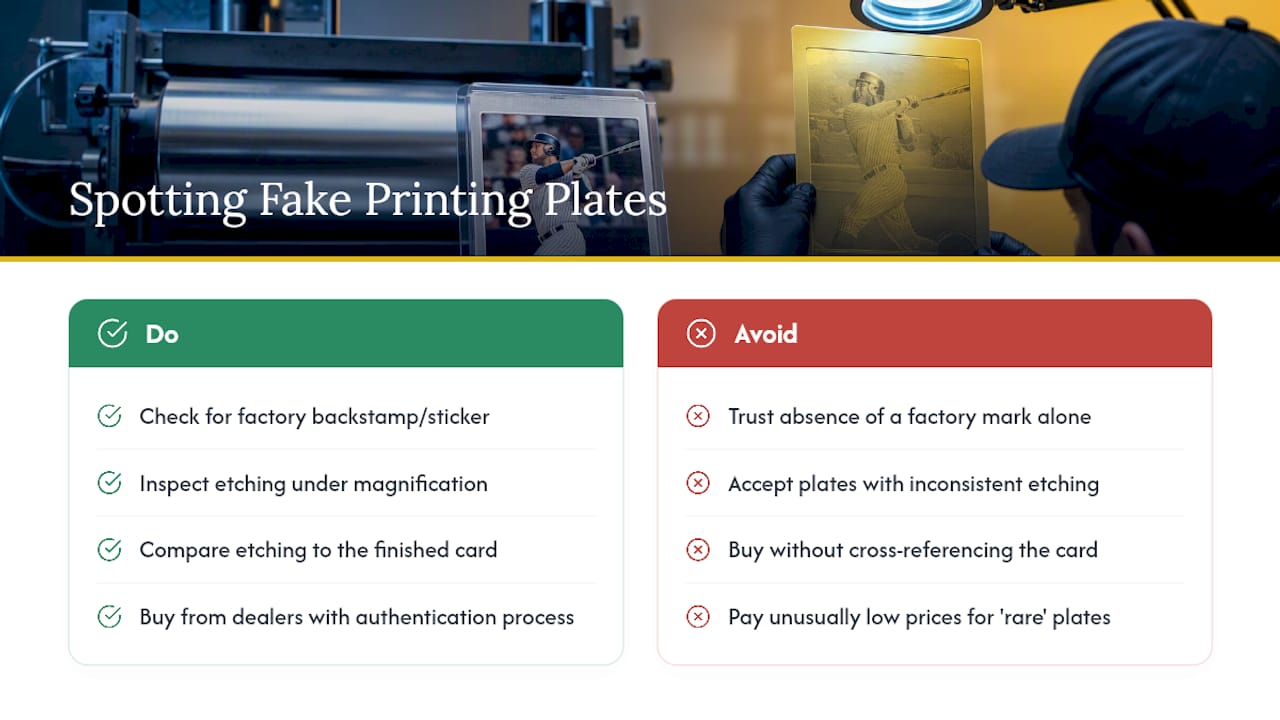
Start with the backstamp or manufacturer sticker. Legitimate plates distributed by major card manufacturers typically carry an authenticity marking, a foil sticker, or an embossed stamp identifying the plate as a genuine factory release tied to a specific product line. The absence of any marking isn’t automatic proof of a fake, but it does mean you’re relying entirely on seller provenance and documentation.
Examine the etching itself under magnification. A genuine plate shows fine, consistent etched detail that matches the printed card’s actual image when compared side by side. Reproductions or altered plates sometimes show inconsistent etching depth, blurred detail that doesn’t match the actual card release, or etching that looks too uniform and mechanical compared to a plate that’s actually been through a press run.
Cross-reference the plate against the finished card whenever possible. If a seller claims a plate corresponds to a specific card, the etched image should logically align with what appears on that printed card, accounting for the fact that plates are typically a mirror image or single-color version of the final artwork. Buy from auction houses or dealers with an established authentication process, and treat unusually low prices on supposedly rare, signed, or star-player plates as a signal to slow down and ask more questions before paying.
An Editorial Take on Plate Collecting’s Blind Spot
Most hobby content treats printing plates as a curiosity, a weird cousin of the standard card that exists mostly to fill out a checklist. That framing undersells what plates actually represent, and it also oversells their investment potential in the same breath, which is a strange contradiction once you notice it.
Here’s the blind spot: collectors chase the “1-of-1” language on plates as if it guarantees scarcity, when the real driver of value is almost always the same three things that drive value on any other card, player, signature, and condition, filtered through a niche market with fewer buyers. A plate isn’t inherently more valuable than a numbered parallel just because it’s metal instead of cardboard. What it offers instead is something a printed card can’t, a literal physical artifact from the moment a card design became reality on a press.
That’s worth paying for when the player and the documentation line up. It’s not worth paying for on faith alone. The collectors who do well in this corner of the hobby are the ones who treat plates as a specialized, patient purchase rather than a shortcut to rarity, and who accept that a plate’s story matters as much as its metal.
— Richard
Find Rare Autographs and Redemption Cards at NextGenCards.shop
If tracking down authentic plates and redemption cards feels like a scattered search across forums and unverified sellers, some online stores consolidate that hunt into one curated inventory built specifically for serious collectors. Rather than sorting through generic bulk listings, collectors can browse rookie autographs, patch relics, and rare redemption cards that are vetted for authenticity.
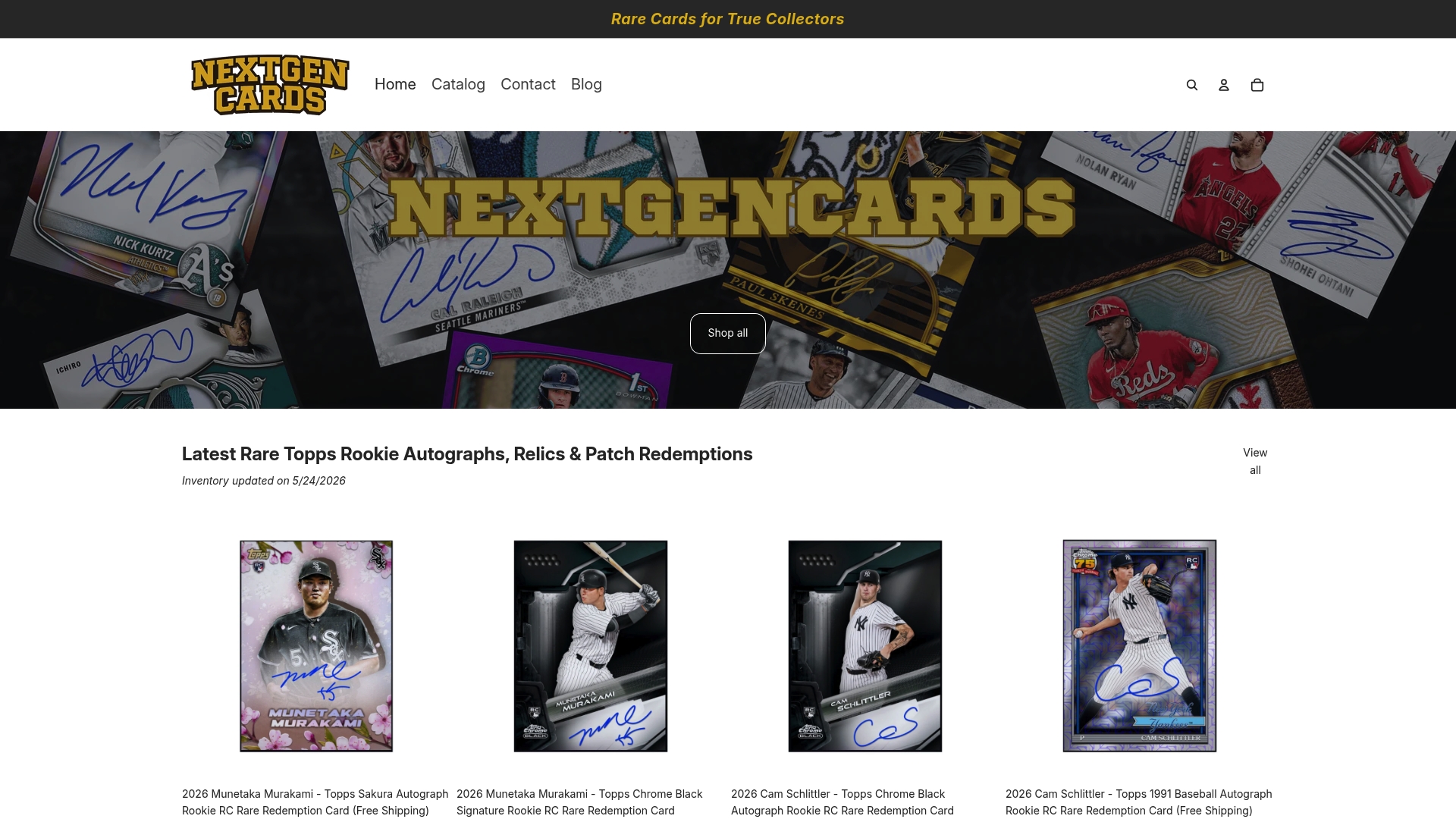
Current listings include standout pieces like the Skenes, Cole, and Strasburg triple autograph redemption card, the Jalen Brunson All Star Game jersey patch autograph, and the Junior Caminero Bowman Chrome Green Signature rookie card, which ships free. Many items on the site include free shipping, and the shop’s straightforward navigation makes it easy to filter by player, sport, or card type without wading through unrelated inventory. Browse the full rookie autograph and relic collection and add your next verified piece today.
Sources
- Baseballcardpedia
- What are printing plates and how are they made — Printcraft
- Printing press and plate mechanics — IST/Imaging Resource
- The Ultimate Guide to Baseball Card Printing Plates - Cardboard Nerds
- What are printing plates — Printingsuppliesdirect blog
FAQ
Are Printing Plate Cards Worth Anything?
Value varies widely and depends mainly on player popularity, autograph presence, and etching clarity; an unsigned plate of a minor player may sell cheaply, while a signed plate of a star rookie can reach significant sums.
What Are the Three Types of Printing Plates?
Collectors typically encounter aluminum CTP plates, polyester laser plates, and conventional PS (presensitized) plates, with processless aluminum plates increasingly common in modern production.
How Many Printing Plates Are Used Per Card?
Standard full-color cards use four plates, one each for cyan, magenta, yellow, and black; designs with metallic ink or varnish coating require additional spot plates.
Why Do Yellow Printing Plates Look Blank?
Yellow ink often lays down lightly on photographic card designs, making the etched detail on a yellow plate appear faint or nearly invisible under standard lighting, even though the etching is fully present.
0 comments