

A photo variation card is an intentionally produced sports trading card that features a different player image than the standard base card in the same set, swapping the photo, nickname plate, or a front design element while keeping the card number and other set elements intact. The industry term is “image variation,” though collectors use both names interchangeably. Three quick differentiators to lock in before anything else:
- vs. Parallels: A parallel uses the same photo as the base card but changes the surface finish, border color, or foil pattern. An image variation changes the actual picture or design element on the front.
- vs. SP/SSP: Short prints describe a print-run scarcity designation. An image variation is a design change; it can also carry an SP or SSP label, but the two concepts are separate. A card can be a variation without being an SP, and an SP can exist without a photo change.
- vs. Manufacturing errors: Error cards result from unintended production mistakes. Image variations are deliberate, planned by the manufacturer, and recognized in official set checklists.
First thing to check: flip the card over and read the small production code at the end of the copyright line. Base cards and their variations use different three-digit code endings, and that code is the fastest confirmation you have.
Table of Contents
- What counts as a photo variation card?
- Common photo variation types you’ll actually encounter
- How to tell if a card is an image variation
- How rare are photo variations, and where do they show up?
- How image variations affect market value and grading
- Where to find and how to trade photo variations
- What hobby research tells collectors about image variations
- Key Takeaways
- A collector’s honest take on chasing image variations
- Useful sources for verifying image variations
What counts as a photo variation card?
An image variation meets a specific standard: the front of the card shows a different photograph, a different nickname, or a deliberately swapped design element compared to the base version of the same card number. The change is intentional, planned during production, and documented in official set notes or collector checklists.
- Different photo: The most common type. The base card might show a player at bat; the variation shows the same player celebrating or in a dugout pose.
- Nickname or banner swap: Some sets replace the standard name plate with a nickname or alternate text treatment.
- Purposeful design swap: Certain releases change a background element or layout component while keeping the player’s number and team the same.
Parallels do not qualify under this definition. A parallel card carries the identical front photo but changes the card’s surface, foil, or border color to indicate a different tier. Collectors sometimes confuse the two because both can be scarce, but the distinction is straightforward: look at the photo, not the finish.
SP and SSP labels describe how many copies were printed relative to base cards, not what the front looks like. A card can be both an image variation and an SSP simultaneously, which is common in sets like Topps Heritage and Topps Stadium Club. When that happens, the card is scarce because of print-run limits and visually distinct because of the photo change.
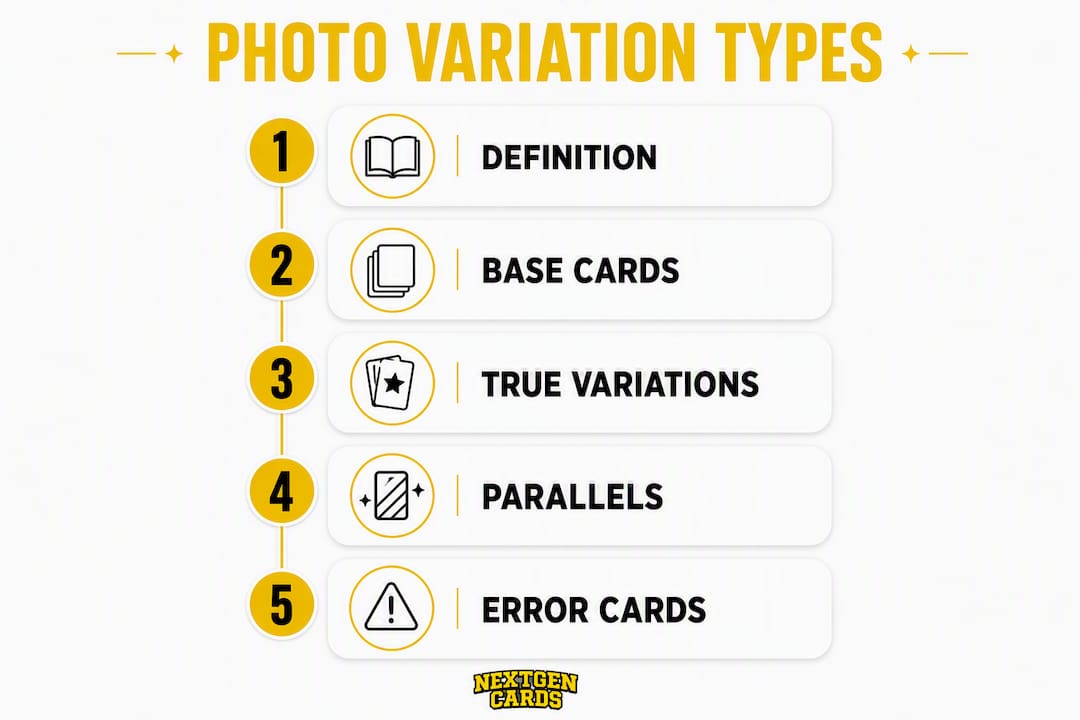
Error cards are the third category collectors mix up with variations. An error card results from an unintended production mistake, such as a wrong team logo or a misspelled name. Manufacturers may or may not correct errors, and grading services like Beckett and PSA treat errors differently from intentional variations. Beckett and PSA population reports list recognized image variations as distinct card entries, which is one of the clearest signals that a card is a legitimate variation rather than a mistake.
Sets with well-documented image variations include Topps Heritage, Topps Chrome, and Topps Stadium Club. Each handles variations slightly differently in terms of labeling and odds, but all three use the same underlying concept: a planned photo or design swap on a specific card number.
Pro Tip: If you suspect a card is a variation rather than an error, check whether the same “alternate” version appears consistently across multiple copies pulled from different packs. Intentional variations show up repeatedly with the same alternate image; production errors tend to be isolated and inconsistent.
Common photo variation types you’ll actually encounter
Collectors run into several recurring variation formats across major Topps releases. Knowing the categories helps you recognize them quickly in the field.
- Alternate action shot: The most frequent type. The base card shows one game moment; the variation shows a different play, pose, or angle from the same season. Topps Chrome Image Variations regularly use this format.
- Celebration or dugout photo: Some variations swap a game-action shot for a celebration, handshake, or candid dugout moment. These tend to be popular because the image feels more personal.
- Nickname plate: Topps Heritage has used nickname variations where the standard name plate is replaced with a player’s well-known nickname. The card number stays the same; only the text treatment changes.
- Throwback or retro layout: Certain releases incorporate a vintage-style design element on the variation, referencing an older card design or uniform era.
- Black-and-white photo: Some sets produce a B&W version of a color base photo as the variation, giving the card a classic aesthetic.
- True Photo Variations: These strip away much of the standard layout to showcase the image in a poster-style presentation. True Photo Variations often trade at a premium because the aesthetic appeal is stronger and the design departure is more dramatic than a simple photo swap.
Topps Heritage image variations are among the most collected because Heritage’s retro design makes photo swaps feel especially distinct. Topps Chrome Image Variations are widely hunted because Chrome’s refractor finish makes the alternate image pop. Topps Stadium Club Image Variations lean into the set’s photography-first identity, often featuring striking action shots that make the variation feel like an upgrade over the base.
When a variation is labeled SP or SSP in set notes, the manufacturer is signaling that it was printed at a lower frequency than the base card. Some sets simply call them “image variations” without an SP designation, meaning they may be seeded at a lower rate but are not formally short-printed. Beckett analysts describe image variations as a design choice that rewards collectors with more expressive photography, turning pack inspection into a discovery experience.
Thematic variations, such as All-Star motifs or alternate banner designs, appear in sets that tie the variation to a specific career moment or award. These are distinct from single-player photo swaps and often carry additional collector interest because of the narrative they attach to the card.
How to tell if a card is an image variation
Use this checklist when you’re at the table, sorting a lot, or evaluating a listing.
-
Compare the front image to a verified base card. Look at the player’s pose, background, uniform details, and framing. If any of those differ from the standard version of that card number, you have a candidate. Pay attention to props, batting stances, and whether the player is in motion or stationary.
-
Flip the card and read the production code. At the end of the copyright line on the back, there is a small code. The last three digits indicate the card type. For example, in 2021 Topps Series 1, base cards ended in 213, SPs in 230, SSPs in 231, and Ultra SPs in 232. Each set uses its own code system, so cross-reference against a set-specific guide.
-
Confirm against the official set checklist or a Beckett set gallery. Topps and hobby resources like Beckett publish variation lists that name which card numbers have known image variations. If your card’s number appears on that list with the alternate image you’re holding, you have a confirmed variation.
-
Check the packaging context and known odds. Hobby boxes, jumbo packs, retail value packs, mega boxes, and Fanatics channels each seed variations at different rates. Knowing which box type a card came from helps confirm whether finding a variation there is plausible. A card pulled from a retail blaster that supposedly carries hobby-only odds deserves extra scrutiny.
-
For ambiguous cases, consult grading population reports or collector forums. PSA and BGS population reports list recognized variations as separate entries. If a card appears in the pop report as a distinct variation, that’s authoritative confirmation. Collector forums and Discord communities often have set experts who can verify edge cases quickly.
Pro Tip: When sorting bulk lots or evaluating listings remotely, build a quick photo reference sheet of base vs. variation images for the sets you’re working through. A side-by-side phone camera comparison against a known base card takes under 30 seconds and catches most variations before you commit to a purchase.
How rare are photo variations, and where do they show up?
Rarity varies significantly by product and by whether a variation carries an SP or SSP designation. Some image variations are seeded at rates that make them genuinely difficult to pull; others appear frequently enough that most hobby boxes will contain one.
The clearest illustration comes from documented box-type odds. 2026 Topps Chrome Baseball image variations are distributed at the following rates by box type:
| Box Type | Approximate Odds per Variation |
|---|---|
| Hobby | 1:103 packs |
| Jumbo | 1:152 packs |
| Value | 1:902 packs |
| Mega | 1:1,655 packs |
| Delight | 1:10 packs |
| Fanatics | 1:2,507 packs |
For 2024 Topps Stadium Club, SSP image variations were found at 1:252 in hobby packs and 1:2,263 in blaster boxes, a gap that makes hobby the clear hunting ground for serious collectors.
Scarcity in focus: A Fanatics channel odds of 1:2,507 packs means a collector opening a standard case would have a very small statistical chance of pulling a single image variation. That level of scarcity pushes serious collectors toward the secondary market rather than sealed product.
Hobby packs and jumbo configurations consistently offer the best odds across most Topps releases. Retail formats like value packs, mega boxes, and Fanatics channels seed variations far more sparingly, which is why retail pulls of rare variations generate significant attention in collector communities. Understanding the odds by box type is the single most practical factor in deciding whether to chase a variation through sealed product or buy it directly on the secondary market.
For rare rookie variations, the calculus shifts further toward buying singles. When a variation features a high-profile prospect and carries SSP odds, the expected cost of pulling it through sealed product often exceeds what a single copy trades for on eBay.
How image variations affect market value and grading
Image variations can command meaningful premiums over base cards, but the size of that premium depends on three factors: the player’s current market demand, the scarcity of the specific variation, and the aesthetic appeal of the alternate image. A True Photo Variation of a star player at a career milestone moment will trade at a different level than a subtle pose swap of a bench player.
Collector demand ultimately defines market legitimacy. Manufacturers designate variations, but the hobby’s willingness to chase and pay for a card establishes its actual value. That dynamic means collector enthusiasm is a real pricing variable, not just a secondary consideration.
Grading and authentication considerations:
- PSA and BGS population reports list recognized image variations as distinct entries. A low pop count on a specific variation can support a higher grade premium, since fewer graded examples exist.
- Submit high-centered, well-cut examples. Variations with poster-style crops or reduced borders can be more sensitive to centering issues than standard base cards with wider margins.
- Note the variation type on your submission. Graders need to confirm the card is a recognized variation, not a base card. Including the set checklist reference or CMP code in your submission notes helps avoid misidentification.
- Use completed eBay listings to set realistic price expectations before submitting. Filter by “Sold” listings and search the specific card number plus “image variation” or “photo variation” to see actual transaction prices.
- Beckett price guides carry separate listings for recognized variations in major sets, giving you a published reference point alongside raw market data.
True Photo Variations, because of their poster-style presentation and stronger visual impact, often trade at a higher premium than subtle image swaps. If you’re deciding which variations to submit for grading, prioritize those with the most dramatic visual departure from the base card and the strongest player demand.
Where to find and how to trade photo variations
The primary hunting grounds for image variations are hobby box breaks, set-specific galleries, and the secondary market.
Hobby breaks are the most direct path to pulling variations from sealed product, particularly for sets where hobby odds are significantly better than retail. Following break results on YouTube or Whatnot gives you real-time data on pull rates before you commit to buying a spot.
eBay completed listings are the most reliable tool for both finding and pricing variations. Filter by “Sold” and search using the card number, player name, set name, and “image variation” or “photo variation.” That combination surfaces actual transaction prices rather than wishful asking prices. Beckett set galleries and odds pages are the best starting point for confirming which card numbers have documented variations before you search.
When evaluating a listing:
- Request clear photos of both the front and the back production code.
- Verify the seller’s description matches the known variation for that card number.
- Red flags include listings that describe a card as a “variation” without showing the back code, or where the alternate image doesn’t match any documented version in set checklists.
Sealed product vs. singles: If known odds put a variation at 1:900 or rarer in the box type you’d buy, purchasing the single on the secondary market is almost always more cost-effective. Reserve sealed product hunting for sets where hobby odds are reasonable (under 1:200) and you want the full break experience.
Pro Tip: When listing a variation for sale, photograph the front and back clearly, state the card number, name the set and year, and include the known odds for the box type it came from. Buyers pay more confidently when they can verify the variation themselves without asking follow-up questions.
What hobby research tells collectors about image variations
The documented odds across Topps releases reveal a clear pattern: hobby configurations are engineered to reward collectors who invest in the premium product tier. The 2026 Topps Chrome odds (Hobby 1:103 vs. Fanatics 1:2,507) represent a 24-fold difference in pull frequency between the best and worst channels for the same variation. That gap is not accidental. It’s a deliberate distribution strategy that makes hobby boxes the logical choice for collectors actively hunting variations.
For 2024 Topps Stadium Club, the hobby-to-blaster gap (1:252 vs. 1:2,263) follows the same logic. Stadium Club’s photography-first identity makes its image variations particularly desirable, and the odds structure reflects that demand.
Beckett analysts note that image variations are designed to reward careful collectors with more expressive photography, effectively turning pack inspection into a discovery experience. That design philosophy means manufacturers select alternate images that are meaningfully different from the base, not just minor reframings, which is why True Photo Variations and celebration shots tend to generate the strongest collector response.
Manufacturer designation establishes which cards are official variations, but collector demand determines which ones actually matter in the market. A variation of a breakout rookie will trade at a premium regardless of its technical scarcity designation. A variation of a lesser-known player may sit unsold even at hobby odds. The practical implication: prioritize variations of players with active collector bases and clear career momentum, and use completed listing data to confirm demand before chasing or grading a specific card.
Key Takeaways
Photo variation cards are intentionally produced with a different front image than the base card, confirmed by the back production code, and distributed at rates that vary dramatically by box type and set.
| Point | Details |
|---|---|
| Core definition | A photo variation swaps the player image or design element on the front; the card number stays the same. |
| Back code confirmation | Check the last three digits of the copyright-line code; base and variation cards use different endings. |
| Rarity by box type | Hobby odds are consistently the best; Fanatics and retail formats can be significantly scarcer than hobby. For 2026 Topps Chrome Baseball, image variations are seeded at rates like Hobby 1:103, Jumbo 1:152, Value 1:902, Mega 1:1,655, Delight 1:10, Fanatics 1:2,507. |
| Grading priority | Submit well-centered, clean examples; note the variation type and CMP code in your submission. |
| Secondary market first | When odds exceed 1:900 in your target box type, buying the single on eBay is usually more cost-effective than pulling it from sealed product. |
A collector’s honest take on chasing image variations
Chasing image variations changed how I approach set releases. Before paying attention to production codes and box-type odds, I’d open retail and wonder why I never pulled anything interesting. Once you understand that a Fanatics channel might require 2,507 packs per variation, the math on retail hunting becomes obvious fast.
The habit that’s made the biggest difference: photographing every variation I pull, front and back, immediately after opening. That photo record serves double duty. It’s documentation for grading submissions and a reference library for evaluating future listings. When a card comes up for sale and the seller’s photo looks slightly off compared to my archived version of the same variation, that’s a signal worth acting on.
If you’re building a collection around scarce, high-quality cards, Nextgencards carries rookie autographs and relics from current and iconic MLB, NBA, and NFL players, including the kind of authenticated, limited-edition cards that serious collectors actually want to own. The inventory is curated for collectors who know what they’re looking for, not a generic catalog.
Useful sources for verifying image variations
These are the resources worth bookmarking for ongoing research.
- Beckett variation guides: Beckett publishes set-specific variation guides with image galleries and documented odds by box type. Start here for any major Topps release to confirm which card numbers have known variations and what the pull rates are.
- Topps Ripped (Topps glossary): The official Topps definition resource. Useful for confirming manufacturer terminology and how Topps categorizes variations within their own product lines.
- Ludex Heritage variation guide: Provides card-by-card variation listings for Topps Heritage releases, including CMP code differences. Particularly useful for Heritage collectors who need a complete checklist.
- All About Sports Cards visual checklist: An example of a collector-built visual checklist with CMP code comparisons. Shows exactly how back-code verification works in practice, using a historical Topps Series 1 release as the reference.
- PSA and BGS population reports: Search by card name and set to find whether a variation is listed as a distinct entry. A separate pop report entry confirms grader recognition. Use PSA’s online pop report tool or BGS’s equivalent for current counts.
- eBay completed/sold listings: Filter by “Sold” and search the card number plus “image variation” or “photo variation” to see real transaction prices. This is the most accurate real-time pricing tool available to collectors.
- Beckett 2024 Stadium Club guide: Documents SSP image variation odds for Stadium Club by pack type, useful as a reference when evaluating hobby vs. retail hunting strategy for that set.
0 comments