

A bat knob card is a trading card containing the physical end of a game-used baseball bat, typically issued as a 1/1 or low-numbered relic, and consistently ranks among the most sought-after pieces in the hobby. These are not photographic novelties — they hold a literal piece of the game inside the card stock.
Before you buy or bid, three things matter most:
- Authenticate first. Confirm manufacturer authentication, a certificate of authenticity (COA), or grading by PSA or BGS (Beckett) before committing to any price.
- Grade changes value. A graded, slabbed bat knob relic commands a measurable premium over an identical ungraded copy, especially for 1/1 pieces.
- Buy from vetted sources. Specialty dealers, official auction channels, and established marketplaces reduce provenance risk far more than private sales.
If you want to browse curated, authenticated bat knob inventory right now, Nextgencards carries a selection of rare relics and authenticated cards worth exploring.
Key Takeaways
Bat knob cards are the highest-provenance relic format in the hobby, and their value depends on authentication, player tier, and format more than any other single factor.
| Point | Details |
|---|---|
| Authentication is non-negotiable | Always confirm a COA, serial number, and grading (PSA/BGS) before purchasing any bat knob relic. |
| Card-design 1/1s are the modern pinnacle | Topps’s 2025 Tier One program shows manufacturers now engineer bat-knob relics as planned, premium chase pieces. |
| Pricing requires three signals | Combine population reports, pre-release bounties, and comparable authenticated sales to value a 1/1 bat-knob piece. |
| Storage demands specialized cases | Embedded bat knob relics require ultra-thick screwdown cases or graded slabs — standard magnetic holders will not fit. |
| Nextgencards offers vetted options | Nextgencards carries curated, authenticated relic inventory with provenance documentation and direct collector support. |
Table of Contents
- What are bat knob cards and how did they evolve?
- Why collectors prize bat knob cards above other relics
- How bat knob cards are produced and what types you’ll find
- Authentication and grading: what every buyer needs to verify
- Where to buy and sell bat knob cards in the U.S.
- How bat knob card values break down
- Buyer’s checklist and red flags to know before you purchase
- How to store and display bat knob cards safely
- What the industry is saying about modern bat knob innovations
- A dealer’s perspective on vetting and sourcing these cards
- Nextgencards carries curated bat knob and relic inventory for serious collectors
- Sources
What are bat knob cards and how did they evolve?
The story of bat knob cards starts well before the modern 1/1 era. Early versions were photographic — card manufacturers printed images that happened to capture the knob end of a player’s bat, sometimes revealing inscriptions the player never intended to share publicly. The most famous example is the 1989 Fleer Bill Ripken card, where an obscene phrase written on the knob appeared clearly in the photo. That card became a cultural touchstone in the hobby, sparking a collector subculture around “naughty knob” variations that still carries non-monetary cachet today.
The next major leap came with embedded relics. Card manufacturers began cutting the actual end of game-used bats and sealing the piece into thick card stock, giving collectors a tangible connection to the game. The 2012 Topps Tier One program formalized this with a documented tracker and public sales records, embedding whole bat ends into one-of-one inserts and establishing the embedded bat-knob relic as a legitimate chase category. Cardboard Connection’s 2012 Topps Tier One guide remains one of the most referenced historical documents for early embedded knob pulls and secondary-market prices.
The modern era pushed further. SI Collectibles reported that MLB players actually used bats fitted with a trading-card design during live games, and those card-design bat knobs were later cut and inserted into 1/1 relic cards. Topps then publicly previewed 2025 Topps Tier One Baseball game-used bat-knob autograph relics as planned, manufacturer-backed 1/1 chase pieces, signaling that this category has moved from accidental novelty to intentional premium product.
Key milestones at a glance:
- Pre-1990s: Photographic knob captures on standard cards (accidental, not manufactured relics)
- 1989: Bill Ripken Fleer “naughty knob” card creates hobby lore and a collector subculture
- 2012: Topps Tier One embeds whole bat ends into documented 1/1 inserts with public sales trackers
- 2020s: Card-design bat knobs used in actual games, then cut into authenticated 1/1 relic cards and autograph combos
Why collectors prize bat knob cards above other relics
Scarcity is the primary driver. Most embedded bat knob relics are printed as 1/1s or in very short runs, meaning there is no second copy to wait for. When a collector misses a pull, the only path to ownership is the secondary market, which concentrates demand and pushes prices up.
Provenance adds another layer. A bat knob card tied to a documented box break, a redemption receipt, or manufacturer authentication carries a story that a generic jersey swatch cannot match. The physical chain of custody — from the player’s hands to the bat, from the bat to the card — is what separates a bat knob relic from most other memorabilia inserts.
Player association matters enormously. A knob from a Hall of Fame-caliber player or a current superstar commands a premium that a mid-tier player’s identical card simply cannot reach. Autographed versions amplify this further, combining two high-value elements into one piece.
Cultural value is real, even when it resists pricing. Hobby historians note that pieces like the Ripken “naughty knob” cards carry collector interest that amplifies demand independent of pure scarcity. A card with a story attached — an inscription, a quirky provenance, a documented game moment — often trades above what raw rarity alone would suggest.
How bat knob cards are produced and what types you’ll find
Production follows a clear sequence for modern embedded relics. A player uses a game-issued bat during an official MLB game. The bat is then authenticated (by MLB or the manufacturer), the knob end is cut, and the piece is embedded into thick card stock or a custom holder. For autograph versions, the player signs either the card surface or a label affixed near the relic window. Card-design bat knobs add one more step: the bat itself is fitted with a printed trading-card design before the game, so the knob carries the card’s artwork when cut.
The four main types collectors encounter:
- Photographic/printed knob cards: Standard-thickness cards where the knob appears in the player photo. No embedded relic. Value is driven by the image’s content and cultural history.
- Embedded bat-end relics: The actual knob end is sealed into thick card stock, usually 1/1 or very low-numbered. These require specialized cases.
- Embedded knob with autograph: Combines the relic with an on-card or sticker signature. The highest-demand production type in the modern market.
- Card-design bat-knob 1/1s: The newest and most collectible format. The bat knob carries the card’s own printed design, making the relic and the card visually unified — a concept Topps has built into its Tier One program.
Pro Tip: When inspecting a listing, request high-resolution images of the relic window’s edges. Legitimate embedded knobs show clean, factory-sealed seaming. Irregular edges, visible adhesive, or misaligned card-design printing are immediate red flags.
Authentication and grading: what every buyer needs to verify
Authentication is not optional for high-value bat knob pieces. The two primary grading bodies collectors rely on are PSA (Professional Sports Authenticator) and BGS (Beckett Grading Services). Both assign numeric grades to the card’s condition and encapsulate it in a tamper-evident slab. For bat knob relics, the slab also protects the embedded piece from physical damage.
Here is a step-by-step authentication checklist:
- Confirm a COA or manufacturer statement. Topps, Panini, and other manufacturers include authentication documentation for game-used relics. Verify the statement matches the card’s serial number.
- Check serial numbering and holograms. Legitimate 1/1 bat knob cards carry a printed serial number (often “1/1”) and a manufacturer hologram or sticker. Both should be present and undamaged.
- Request box-break or redemption documentation. A card pulled from a documented box break has a verifiable chain of custody. Redemption cards add another layer: the original redemption slip ties the card to a specific transaction.
- Review photos of the bat prior to cutting. Some manufacturers and dealers retain or publish images of the bat before the knob was removed. This is the gold standard for provenance.
- Use PSA or BGS population reports. For a 1/1, the population report should show exactly one graded copy. If a report shows multiple copies of a card claimed to be 1/1, something is wrong.
Population reports are particularly useful for verifying 1/1 claims. PSA’s online registry and BGS’s population data are publicly searchable by card set and player. A certificate number on a graded slab can be cross-referenced directly on the grading company’s website. For ungraded pieces, this step is even more critical — the absence of a slab means you are relying entirely on the seller’s documentation.
Where to buy and sell bat knob cards in the U.S.
Five primary channels serve the U.S. market, each with distinct tradeoffs:
- Specialty dealers (e.g., Nextgencards): Curated inventory, vetted provenance, and direct customer support. Prices reflect the dealer’s authentication work, but you get reduced risk and a clearer return path.
- MLB Auctions: Official MLB channel for authenticated game-used memorabilia. High trust, competitive bidding, and official authentication. Best for verified game-used pieces with MLB provenance.
- eBay: The largest secondary-market volume. Completed listings provide real-time price data. Buyer protection exists, but provenance verification falls on the buyer. Best used for price research alongside direct purchases.
- Hobby shows and box breaks: Live pulls carry inherent provenance (witnessed extraction), but secondary sales at shows vary widely in documentation quality.
- Private sales and bounties: Fastest for known 1/1s when a buyer has already posted a public offer. Highest risk for fraud; no platform protection.
| Channel | Authentication/Provenance | Graded vs. Ungraded | Rarity/Print-Run Handling | Typical Price Range |
|---|---|---|---|---|
| Specialty dealer | Vetted by dealer; COA expected | Both available; graded preferred | 1/1s and low-runs curated | Moderate to high |
| Auction house | Official MLB or brand authentication | Primarily ungraded game-used | Strong for 1/1 and unique pieces | High to very high |
| Online marketplace | Buyer-verified; varies by seller | Both; graded commands premium | Full range; completed listings help | Entry to high |
| Show/box break | Witnessed pull; documentation varies | Mostly ungraded at point of sale | Low-run and 1/1 pulls common | Entry to mid |
| Private sale | Seller-provided only; highest risk | Either; no platform protection | 1/1s often traded via bounty | Negotiated |
Nextgencards’s authenticated relic inventory sits in the specialty dealer column: curated pieces with documented provenance, reducing the due-diligence burden that eBay or private sales place on the buyer.
How bat knob card values break down
Pricing in this category spans a wide range, and the tier a card falls into depends on player, format, authentication, and condition.
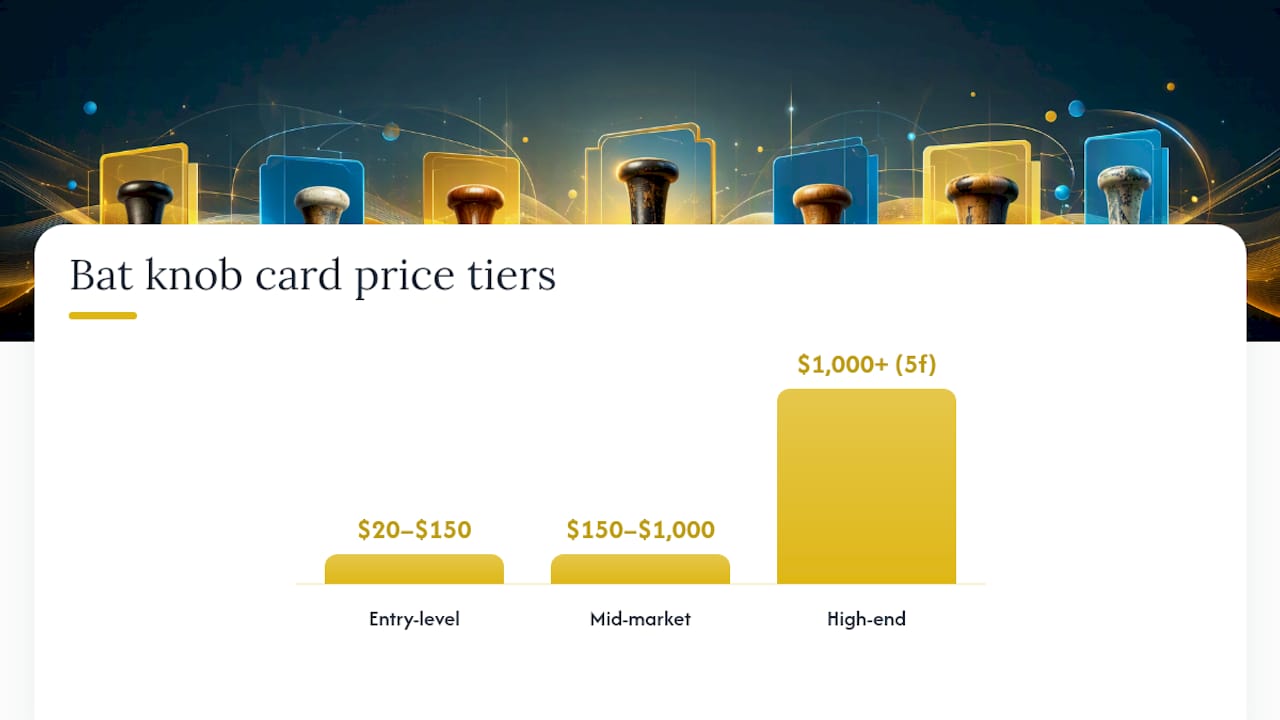
Entry-level: Photographic knob cards and low-grade embedded relics from non-star players typically trade in the $20–$150 range. These are accessible starting points for collectors building familiarity with the category.
Mid-market: Authenticated embedded knob relics from recognizable players, especially numbered parallels or redemption-backed pieces, generally fall in the $150–$1,000 range depending on condition and grading.
High-end: Superstar 1/1 bat-knob relics, particularly autographed or card-design versions, regularly exceed $1,000 and can reach five figures for elite players. The 2012 Topps Tier One program documented early secondary-market sales that established these pieces as serious collector targets.
For current pricing on recent releases, SportsCardsPro’s 2025 Topps Tier One Bat Knob tracker maintains up-to-date sale records and set data. eBay’s completed-listing filter and MLB Auctions’ results archive are the other two primary verification tools.
Key valuation factors:
- Player tier: Hall of Famers and active superstars carry the largest premiums.
- Autograph presence: An on-card signature can multiply value two to five times over the unsigned version.
- Grading: PSA 10 or BGS 9.5 slabs command premiums over raw copies, even for 1/1s.
- Pre-release bounties: For high-profile 1/1 pieces, public bounty offers from known collectors often set the floor before the card even hits the secondary market.
The broader relic market context matters too. A Shohei Ohtani 1/1 dual Gold Logoman card sold for over $10 million, illustrating how superstar 1/1 pieces can reach extraordinary prices and reset collector expectations across the entire relic category.
Buyer’s checklist and red flags to know before you purchase
A clean listing for a bat knob card should clear every item on this checklist before you commit funds:
- Clear, high-resolution photos of the front, back, relic window edges, and any hologram or serial number
- COA or manufacturer authentication statement matching the card’s serial number
- Provenance documentation: box-break video, redemption slip, or team/manufacturer records
- Confirmed serial numbering (especially critical for 1/1 claims)
- Seller return policy stated explicitly
- Seller rating and transaction history on the platform
Five red flags that should stop a purchase:
- No provenance. A seller who cannot explain where the card came from has no chain of custody to offer.
- Poor or limited photos. Legitimate sellers of high-value relics provide multiple angles. Reluctance to share images is a warning sign.
- “Uncut” claims without verification. Some sellers describe pieces as containing an uncut whole knob without documentation. Demand photographic evidence.
- Price that seems too low for a known 1/1 or superstar. Genuine scarcity does not produce bargain prices. A suspiciously low ask on a documented 1/1 warrants extra scrutiny.
- Seller refuses video or third-party verification. A reputable seller has no reason to decline a video call showing the card or a third-party authentication referral.
Pro Tip: Always ask for a short video of the card in hand before wiring payment or completing a private transaction. A video timestamp confirms the card exists as described and is in the seller’s possession at that moment.
How to store and display bat knob cards safely
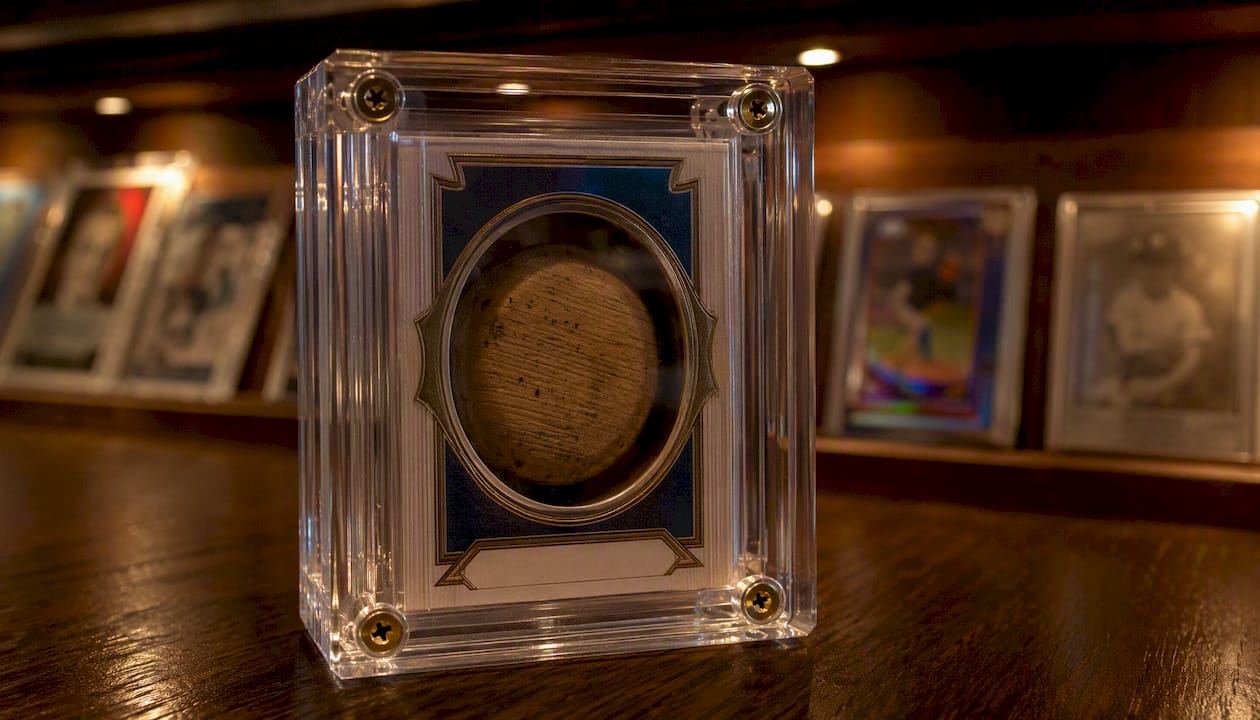
Standard magnetic holders will not work for most embedded bat knob relics. The thickness of the card stock, combined with the raised relic window, exceeds what a standard 35pt or even 55pt magnetic holder can accommodate. Cardboard Connection’s documentation of the 2012 Topps Tier One program confirms that these cards require specialized storage from the moment of acquisition.
Recommended storage approach:
- Ultra-thick screwdown cases: Designed for cards exceeding 100pt thickness. Screwdowns provide a secure, pressure-free fit for bulky relics.
- Graded slabs: For the highest-value pieces, PSA or BGS encapsulation offers the best physical protection and the added benefit of authentication documentation built into the holder.
- Archival storage for ungraded pieces: If a card is not slabbed, store it in an acid-free, UV-resistant sleeve inside a rigid case. Avoid soft sleeves alone for any embedded relic.
- Climate control: Stable temperature (65–70°F) and relative humidity (45–55%) prevent warping of thick card stock and protect the embedded relic material.
Display carries its own risks. Direct sunlight causes fading and can degrade adhesives used in the card’s construction. UV-filtering display cases are the minimum standard for any piece on permanent display. Never use pressure adhesives near the relic window, and avoid stacking multiple thick cards without rigid separators between them.
Pro Tip: Photograph your bat knob cards alongside their COA and any provenance documents before storing them. A timestamped photo set creates a resale record and supports any insurance claim if the card is lost or damaged.
What the industry is saying about modern bat knob innovations
The hobby trade press has framed bat knob cards as the natural evolution of the relic card category. Where early relics offered a swatch of jersey or a sliver of bat wood, the bat knob format delivers the most identifiable, player-specific part of the bat — the piece a player grips, marks, and personalizes. SI Collectibles describes this as a deeper provenance link, one that resonates with collectors who want more than a generic material sample.
The card-design bat-knob concept takes this further. When a player uses a bat fitted with their own Topps card design during a real game, the resulting 1/1 relic is simultaneously a piece of memorabilia and a self-referential collector object. Topps’s decision to build this into the 2025 Tier One release as a planned, marketed product — not an accidental discovery — signals that manufacturers now treat bat knob relics as a premium tier worth engineering around.
Pre-release bounties have become a pricing mechanism in their own right. Before a high-profile 1/1 bat-knob card even surfaces publicly, known collectors post public offers, effectively setting a price floor that influences every subsequent bid. This dynamic is unique to the 1/1 relic market and makes traditional comparable-sales analysis less reliable on its own.
Key industry observations:
- Manufacturer authentication and grading-backed provenance maintain higher long-term premiums than unauthenticated pieces, a pattern consistent across the broader relic market.
- Cultural history — the “naughty knob” tradition, inscriptions, and documented game moments — adds collector interest that can amplify demand even when it does not move mass-market prices.
- The 2025 Topps Tier One program represents the clearest example yet of a manufacturer designing the bat-knob relic into the product from the start, rather than treating it as an incidental pull.
A dealer’s perspective on vetting and sourcing these cards
The first thing a serious dealer does with any bat knob card is verify the provenance chain, not the grade. A PSA 10 slab on a piece with no documented origin is worth less than an ungraded card with a clear box-break video, a redemption slip, and photos of the bat before cutting. Condition matters, but provenance is the foundation.
When sourcing, the standard is high-resolution photos or video of the bat prior to cutting, confirmation of the authentication statement, and a documented chain of custody from the manufacturer or auction house to the current seller. For card-design bat knobs specifically, the card’s printed design should be visible on the knob surface in pre-cut photos — that visual match is the clearest proof of authenticity.
Pricing and negotiation follow a straightforward logic. Superstar players and unique inscriptions command premiums that are not negotiable in a strong market. For mid-tier players or less-documented pieces, pre-release bounties and recent comparable sales from SportsCardsPro or MLB Auctions provide the most reliable baseline. A seller who cannot point to comparable authenticated sales is either mispricing or misrepresenting the card.
Buyers should expect a reputable dealer to stand behind their inventory with a clear return policy and direct contact for authentication questions. That accountability is the practical difference between a vetted dealer and a private seller.
Nextgencards carries curated bat knob and relic inventory for serious collectors
Collectors who want authenticated bat knob cards without the due-diligence burden of eBay or private sales will find Nextgencards a direct alternative. The store specializes in rare relics, rookie autographs, and authenticated memorabilia, with provenance documentation and graded options available across its inventory.
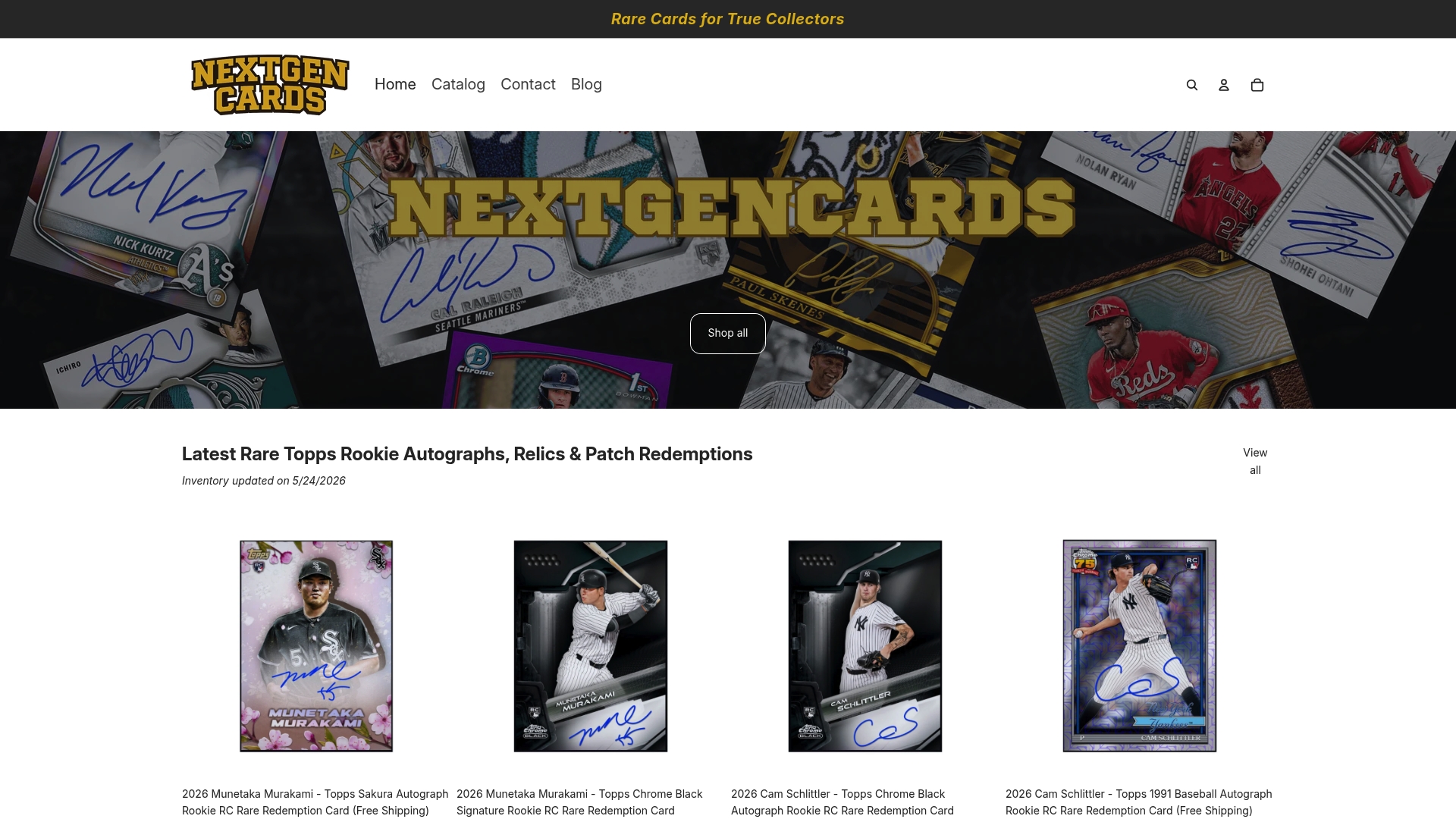
Every listing at Nextgencards reflects the same vetting standard described in this guide: clear provenance, authentication documentation, and shipping protection for high-value pieces. The relic and autograph collection includes options across player tiers and formats, from numbered parallels to 1/1 chase pieces. Free shipping is available on select items, and the team is reachable for authentication questions before you commit to a purchase.
Browse the current inventory at Nextgencards to find authenticated bat knob and relic cards, or contact the team directly for a vetting consultation on a specific piece you are considering.
Sources
These are the primary resources referenced throughout this guide, each serving a distinct purpose in your research and verification workflow:
- 2012 Topps Tier One Bat Knobs Guide, Gallery and Sales Tracker
- Prices for 2025 Topps Tier One Bat Knob Baseball Cards
- Official MLB Auctions: Authenticated Memorabilia | MLB Auctions
0 comments