

A case hit is a chase insert card expected about once per sealed case of a product, typically corresponding to several hobby boxes depending on the release. It’s rarer than a box hit, and collectors chase them because pulling one is a real, statistically uncommon event tied to manufacturer-printed odds rather than hype. The moment you land one, check the product checklist, confirm the odds, and look up recent sold prices before deciding what it’s worth.
TL;DR:
- Most case hits appear roughly once per 6 to 12 boxes, but the actual number can vary depending on case configuration and odds variance.
- The rarity of a case hit is determined by manufacturer-printed odds and production design, not by serial numbering or visible card features.
- You should verify a case hit by checking official checklists, printed odds, and running the case math to confirm it aligns with the expected chance of one per case.
- Buying a full sealed case offers the best control over pulling a case hit but requires high upfront cost, while joining breaks shifts trust to the breaker’s reputation.
- Due to counterfeit risks, inspect card stock, autographs, and relics carefully, and always cross-check seller claims with manufacturer data before purchase or grading.
Table of Contents
- Case Hit Meaning: How It Differs From a Box Hit or SSP
- How Do You Calculate Case Hit Odds?
- How Many Case Hits Are in a Case, Really?
- Well-Known Case Hits Collectors Chase
- How Do You Know If You Got a Case Hit? A Verification Checklist
- Why Rarity Doesn’t Guarantee a High Price
- Buying a Sealed Case vs. Joining a Break
- How Nextgencards Supports Case Hit Collectors
- How to Spot a Counterfeit Case Hit
- Timing the Market: When to Sell a Case Hit
- A Collector’s Take on Chasing Case Hits
- Where to Find Authenticated Case Hit Style Cards
- Sources
- FAQ
Case Hit Meaning: How It Differs From a Box Hit or SSP
A case hit is defined at the case level, not the pack or box level. Manufacturers build most modern releases with a tiered hit structure, and where a card sits in that structure determines the vocabulary collectors use to describe it.
A box hit is generally expected about once per box, sometimes advertised as “1 autograph or relic per box.” A case hit is a rarer tier appearing around once per sealed case, meaning you would typically need to open every box in that case to have a realistic shot at pulling it. An SSP, short for super short print, describes a card’s print run rarity, usually tied to a low serial number, and it can exist independently of case-hit status. A card can be both an SSP and a case hit, but the two labels measure different things: one measures how many copies exist, the other measures how often the card shows up per case.
A few terms worth locking down before you start comparing listings:
- Box hit: an insert or autograph guaranteed at roughly one per box.
- Case hit: a rarer insert appearing at roughly one per sealed case, according to Sports Illustrated Collectibles.
- Chase insert: any card a release is specifically designed to make collectors hunt for, whether or not it’s numbered.
- Parallel: a color or finish variation of a base card or insert, usually with its own separate odds.
- SSP: a card with an extremely low print run, identified by serial numbering rather than case-level odds.
Here’s the part that trips up newer collectors: most case hits carry no serial number at all. Their scarcity comes entirely from insertion odds, which is why you can’t judge a case hit’s rarity just by looking at the card. You have to check the numbers the manufacturer actually published.
How Do You Calculate Case Hit Odds?
The math behind “one per case” isn’t a marketing slogan. It comes from multiplying two figures the manufacturer already publishes: packs per box and boxes per case. According to Figoca’s breakdown of case hit math, converting printed per-pack odds into a case-level expectation follows a simple sequence.
- Find the packs-per-box count. Say a hobby box contains 24 packs.
- Find the boxes-per-case count. A typical case might hold 12 boxes.
- Multiply the two. That gives you 288 packs per case.
- Apply the printed odds. If the insert’s odds are listed as 1:288 packs, that product is built to deliver almost exactly one copy per case.
- Adjust for smaller cases. A 6-box case with 24 packs per box only has 144 packs total, so the same 1:288 odds would suggest roughly one hit every two cases, not one per case.
Printed odds usually appear on the box itself or in the manufacturer’s official checklist, phrased as “1:X packs” or “1:X boxes.” The number tells you the statistical average, not a promise. A case is built around expected value, and expected value is not a guarantee. Some cases produce two case hits. Some produce zero. That variance is exactly why breakers and collectors talk about “hot” and “cold” cases, and why the math only tells you what to expect on average across many cases, not what any single case will contain.
How Many Case Hits Are in a Case, Really?
Most modern hobby products ship in cases of 6, 8, or 12 boxes, and the “one per case” framing assumes the manufacturer designed the product around whichever case size it actually sells. That’s the baseline expectation, not a certainty.
Some releases state the case-hit rate outright on the box or in the official checklist, which removes the guesswork entirely. Others only publish per-pack or per-box odds, leaving you to run the multiplication from the previous section to figure out where the case-level threshold actually lands.
A few realities worth keeping in mind before you assume a fixed number:
- A single case can produce more than one case hit if the product design overlaps chase-tier odds, according to Figoca’s analysis of case-level frequency.
- A case can also produce zero case hits, since the odds describe an average across many cases, not a guarantee for any one of them.
- Case configuration (6 vs. 8 vs. 12 boxes) changes what “one per case” actually means for that specific release.
- Products with multiple parallel-tier chase cards sometimes blur the line between a true case hit and a merely rare insert.
Don’t take a seller’s “guaranteed case hit” claim at face value. Cross-check it against the manufacturer’s own numbers first.
Well-Known Case Hits Collectors Chase
Certain insert names have become shorthand for “the big one” in specific product lines, and recognizing them helps you understand what people mean when they post a pull on social media or a forum.
- Kaboom!: a Panini insert that’s become one of the hobby’s most recognizable case-hit names, prized for its scarcity and colorful design.
- Downtown: another Panini insert, tied to specific in-game achievements (like a home run or a deep three-pointer), and widely regarded as a marquee chase card.
- Color Blast: a Topps insert style that appears across multiple sports, often built at a rarity tier that qualifies as a case-level or near-case-level pull.
Case-hit status isn’t universal. It depends entirely on the specific release and manufacturer. Kaboom! and Downtown function as case hits in the products they appear in, but a similarly named insert in a different product year might carry different odds entirely. Always check the specific release’s checklist rather than assuming a name automatically means the same rarity tier every year. And remember: most of these cards are unnumbered, so odds, not serial numbers, are your only real rarity signal.
How Do You Know If You Got a Case Hit? A Verification Checklist
Pulling something that looks special is exciting, but excitement isn’t verification. Here’s the sequence worth following before you post it, price it, or sell it.
- Pull the official checklist. Every major release has one, either printed on the box or posted by the manufacturer online. Confirm the card’s name appears on the chase tier, not just as a standard insert.
- Check the printed odds. Look for the “1:X” notation on the box or pack wrapper, and note whether it’s expressed per pack or per box.
- Run the case math. Multiply packs per box by boxes per case, then compare that number against the printed odds to see if it lines up with a true “one per case” rate.
- Search recent sold listings. eBay’s sold filter, breaker recap threads, and price-guide sites give you a realistic sense of what similar copies actually closed for, not what sellers are asking.
- Consider professional grading for high-value pulls. Grading tends to improve liquidity and resale price for confirmed case hits, especially ones tied to star rookies.
Pro Tip: Before you grade anything, cross-reference the grading service’s population report for that exact card and year. If dozens of copies already exist at a high grade, your card’s rarity tier doesn’t automatically translate into rarity at resale.
Why Rarity Doesn’t Guarantee a High Price
A case hit being scarce and a case hit being valuable are two different claims, and conflating them is the single most common mistake new collectors make. Rarity sets the ceiling. Demand sets the actual price.
Three factors do most of the work in determining what a confirmed case hit actually sells for:
- Player profile. A case hit tied to a superstar rookie will consistently outsell an identically rare card tied to a role player.
- Condition. Corner wear, surface scratches, or a slightly off-center cut can knock a meaningful percentage off the final price, especially on ungraded cards.
- Market timing. Demand for a specific player or product spikes around milestones, trades, and playoff runs, then cools off.
Sports Illustrated Collectibles notes that verification against actual sales data matters more than the case-hit label itself, since plenty of confirmed case hits still sell for modest sums when the player or product isn’t in demand. Before listing anything high-value, check recent comparable sales, decide whether professional grading is worth the turnaround time and fee, and choose a grading service with a population report you can actually cross-reference for that exact card.
Buying a Sealed Case vs. Joining a Break
Chasing a case hit comes down to a choice between three main paths, and each carries a different risk profile.

Buying a full sealed case gives you the best odds of controlling the outcome, since you’re opening every box yourself, but it also requires the largest upfront cost and the most storage space. Joining a group break lets you buy into a much smaller slice of that same case, which is far more affordable, but it shifts the trust question to the breaker: you’re relying on their reputation and video documentation to know the box was actually opened fairly. Buying individual boxes or packs is the cheapest entry point, but it comes with the highest odds of getting nothing chase-worthy at all.
One risk specific to case buying is the dead case: once a case’s designated case hit has already been pulled from one box, the remaining sealed boxes from that same case typically lose their chase appeal, even though they’re still factory sealed. Always ask a seller whether the case hit has already come out before paying a premium for “unsearched” boxes.
- Buy full cases only from sellers who can confirm the case hasn’t already produced its case hit.
- Join breaks only with breakers who post clear video of box openings and case codes.
- Store high-value pulls in a rigid card saver or a graded slab, not a soft sleeve, before shipping or long-term storage.
Pro Tip: Insure any pull worth more than a few hundred dollars separately through your shipping carrier or a dedicated collectibles insurance rider, since standard homeowner’s policies often cap collectible coverage well below actual market value.
How Nextgencards Supports Case Hit Collectors
This store focuses on authenticated rookie autographs, patch relics, and rare redemption cards, categories often associated with case hits. Listings come from a curated inventory rather than a wide marketplace feed, which is helpful when verifying a card’s rarity claim.
If you’re trying to understand what kind of relic sits behind a given insert, the types of sports card relics guide breaks down the material and construction differences. For comparing a case hit’s tier against other high-value insert categories, the most valuable sports card inserts guide is a useful next stop. The retailer also offers free shipping on select items and support for collectors listing or authenticating high-value pulls.
How to Spot a Counterfeit Case Hit
Counterfeit chase cards have become a real problem as case-hit prices climb, and most fakes fail in the same handful of places once you know where to look.
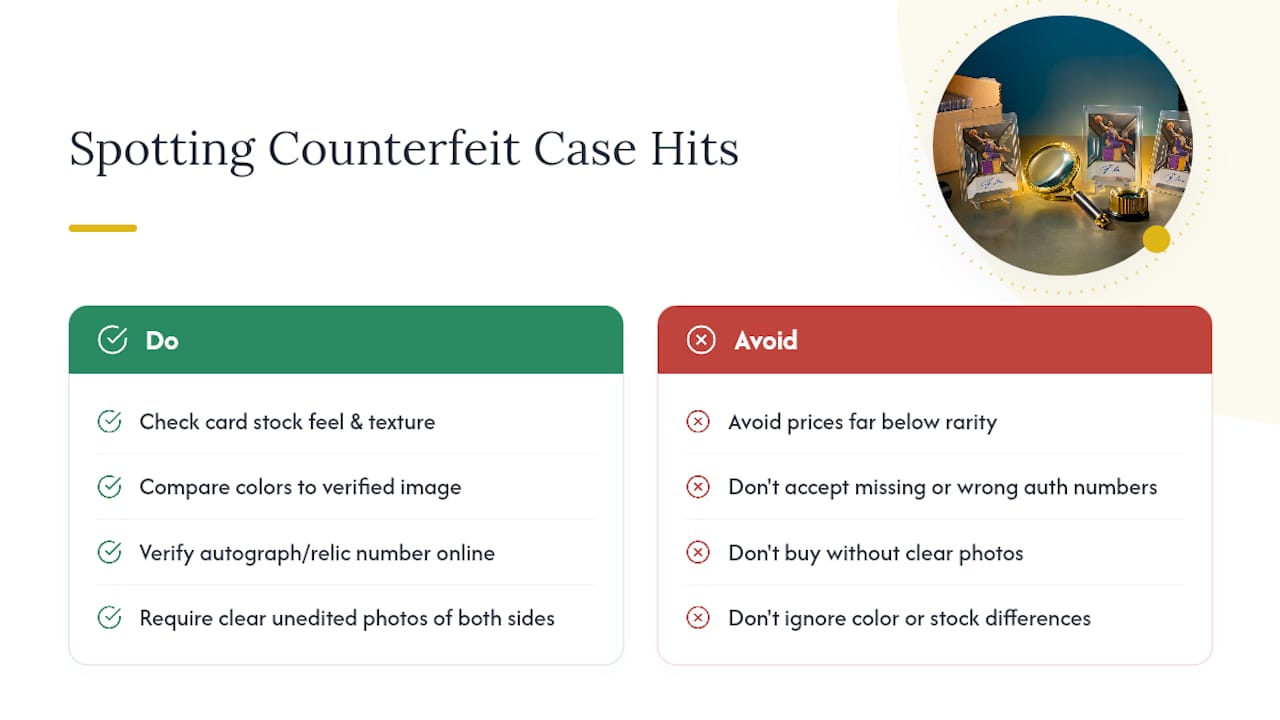
Check the card stock first. Authentic Topps and Panini inserts have a consistent thickness and a specific texture on the back, and counterfeits often feel slightly thinner, glossier, or noticeably lighter in the hand. Compare the color saturation against a verified image of the same insert; counterfeit printing frequently runs a shade off, especially on foil or color-blast style inserts where the effect is hard to replicate with consumer-grade printers.
Autograph and relic authenticity deserves its own scrutiny. Genuine redemption and autograph cards carry manufacturer-specific security features (hologram stickers, specific ink patina, or an authentication number tied to the manufacturer’s own database). If a seller can’t produce that number, or the number doesn’t match the manufacturer’s lookup tool, treat the card as unverified until proven otherwise.
Cross-check the serial number format if the card is numbered at all, since fonts and placement are notoriously hard for counterfeiters to match exactly. Buy exclusively from sellers who provide clear, unedited photos of both sides of the card, and be especially cautious with high-demand names, since counterfeiters target whatever player is generating the most search volume that month. When the price seems too low for a card with that reported rarity, that gap is usually the biggest warning sign of all.
Timing the Market: When to Sell a Case Hit
Case-hit prices move with the same demand cycles that drive the rest of the sports card market, and selling at the wrong moment can cost you a meaningful chunk of value even on a genuinely rare card.
Player performance drives most short-term price swings. A rookie who’s mashing home runs in April or putting up triple-doubles in a playoff run will see demand for their cards spike within days, and case hits tied to that player often ride the same wave. Selling into that spike, rather than waiting for the season to cool off, is usually the stronger play for anyone holding a single high-value card rather than a long-term investment position.
Broader market cycles matter too. The overall hobby has historically cooled during the off-season for a given sport and heated up again around opening day, the draft, or the postseason. Watch for major milestones on the horizon (a Hall of Fame vote, a record chase, a championship run) since those events tend to pull buyers into the market ahead of time. Selling a few weeks before a widely anticipated milestone, rather than after it’s already happened and priced in, often captures more of the upside.
Liquidity also shifts with grading turnaround times. If a grading service is running a multi-month backlog, raw cards can actually sell faster than waiting for a slab, even at a lower price, simply because buyers value certainty and speed differently depending on the moment.
A Collector’s Take on Chasing Case Hits
The excitement of a big pull is real, and nothing about verification should dampen that. But excitement is a terrible pricing tool. The collectors who consistently come out ahead are the ones who check the odds and recent sales before they get emotionally attached to a number in their head. Grade the genuinely high-value pulls. Enjoy the rest for what they are: a good story, not necessarily a payday.
— Richard
Where to Find Authenticated Case Hit Style Cards
This site offers an alternative to unverified marketplace listings for chase-tier cards by providing a curated, authenticated inventory instead of a mixed feed of unscreened sellers, which is important when a card’s value depends on rarity claims that can’t be personally inspected.
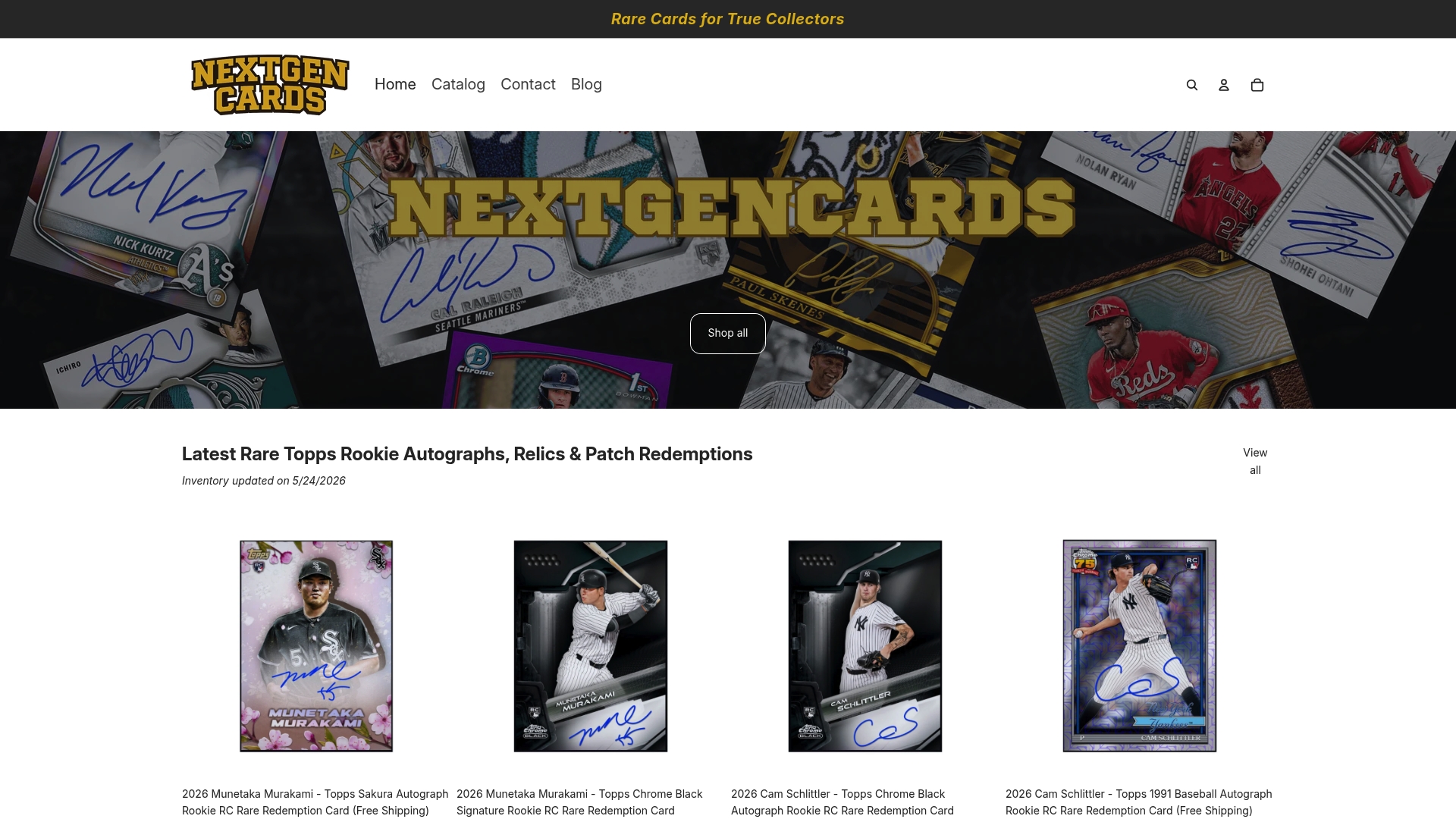
The current catalog includes several rare redemption and autograph pieces built around the same chase-tier appeal covered in this guide: the 2024 Junior Caminero Bowman Chrome Green Signature Rookie redemption card ships free, as does the 2026 Jacob Misiorowski All Star Game Autograph Rookie redemption card. Collectors chasing multi-signature pieces can look at the 2024 Skenes, Cole, and Strasburg Triple Autograph redemption card, while basketball collectors have the 2026 Jalen Brunson All Star Game Jersey Patch Autograph card and the 2026 Jalen Brunson Full Court Jersey Patch Autograph card, also with free shipping. Browse the full rookie autograph and relic collection to check current availability before a specific pull sells out.
Sources
- What is a case hit? | Sports Illustrated Collectibles
- What Is a Case Hit? Kaboom!, Downtown & the Hobby’s Biggest Chase Cards | ChronicCards
- What Is a Case Hit in Sports Cards? (Simple Explanation) | Figoca
FAQ
How Do You Know If You Got a Case Hit?
Check the manufacturer’s official checklist to confirm the card sits in the chase tier, then compare the printed odds against the case math (packs per box multiplied by boxes per case) to see if it lines up with roughly one per case.
Why Do They Call It a Case Hit?
The name reflects where the rarity is defined: at the case level rather than the box or pack level, since the card is built to appear roughly once per sealed case, not just once per box.
How Rare Are Case Hit Cards?
Case hits sit above box hits in rarity, typically appearing once per 6 to 12 hobby boxes depending on the case configuration, and most are unnumbered, with scarcity driven entirely by insertion odds.
How Many Case Hits Are in a Case?
Most releases are built for one case hit per case on average, but that’s an average across many cases, not a guarantee. Some cases produce more than one, and some produce none at all.
Does Nextgencards Sell Authenticated Case Hit Style Cards?
Yes. Nextgencards lists authenticated rookie autographs, patch relics, and rare redemption cards in the same chase categories collectors associate with case hits, including several with free shipping on select items.
0 comments