

Yes, you can get a redemption replaced — but only under specific conditions. Topps will replace any Topps-produced card from the current year that its quality control team determines was damaged or defective, provided you file your initial claim within 30 days of purchase. Panini and Upper Deck operate their own programs with different windows and evidence requirements. If you pulled a visibly damaged rookie autograph or a misprint from a sealed box, this guide covers exactly what to do next.
Fastest path to file a Topps replacement claim:
- Inspect the card immediately on receipt and photograph every angle before touching it further.
- Locate your original receipt or invoice — without it, Topps will reject the claim outright.
- Package the damaged card securely with a letter of explanation and a copy of your receipt.
- Ship to Topps using a tracked, insured service and retain your proof of delivery.
- Contact Topps support through their official help center to confirm the current mailing address before sending anything.
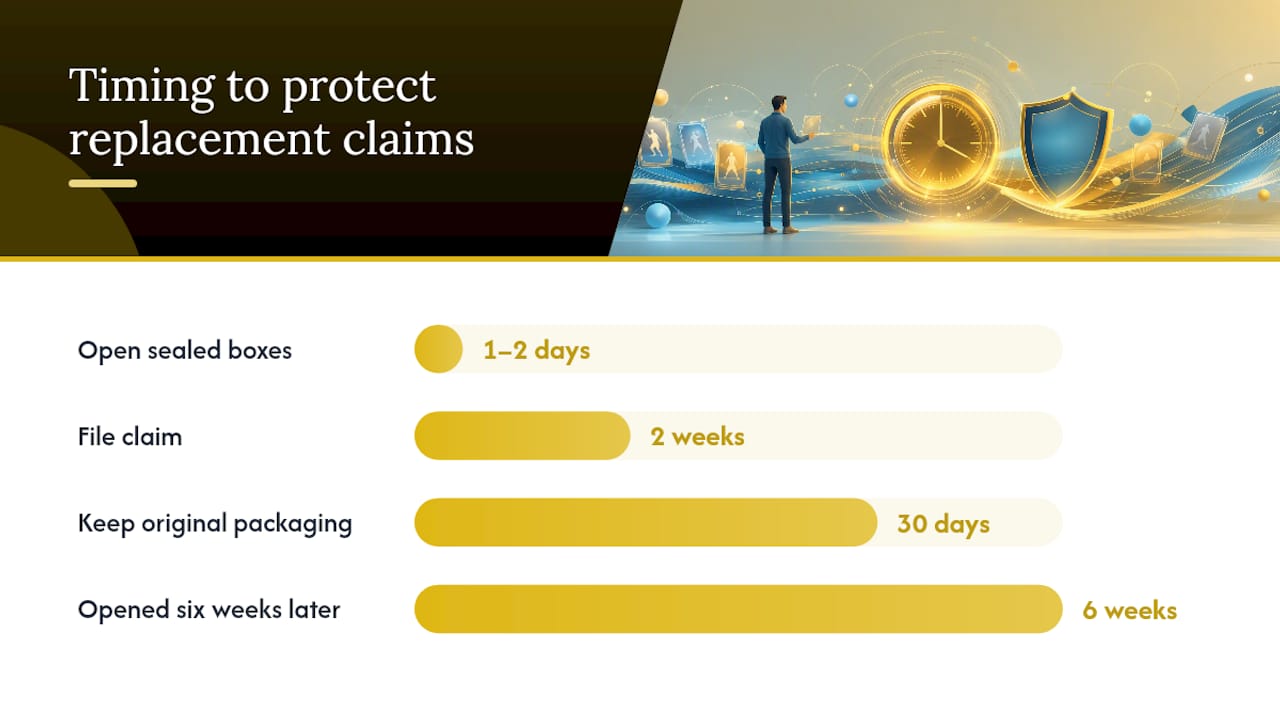
Pro Tip: Open sealed boxes within days of receipt, not weeks. The 30-day claim window starts at purchase, not at the moment you discover the defect. Collectors who leave hobby boxes sealed for months often find themselves outside the eligibility window before they ever see the card.
Key Takeaways
Filing a Topps replacement claim requires the damaged card, a receipt, and a letter of explanation submitted within 30 days of purchase, shipped with tracking and insurance at the collector’s expense.
| Point | Details |
|---|---|
| 30-day claim window | Topps requires initial QC submissions within 30 days of purchase — missing this deadline ends eligibility. |
| Three required documents | Every Topps claim must include the damaged card, a letter of explanation, and a copy of the receipt or invoice. |
| Collector pays return shipping | Topps does not reimburse return shipping; use a tracked, insured service and retain proof of delivery. |
| Replacements may not be identical | If the exact card is unavailable, Topps may substitute an equal-value card at its discretion. |
| Check expiration status on legacy redemptions | Topps’ 2024 rule changes adjusted expiration windows; verify current status before assuming a prior-year redemption is still valid. |
Table of Contents
- What does Topps’ official redemption replacement policy actually say?
- Who qualifies: manufacturing defects versus normal hobby imperfections
- How to file a Topps replacement claim, step by step
- What you need to send and who pays for shipping
- How long does a replacement take, and when does a redemption expire?
- How do Panini and Upper Deck handle replacements differently?
- What to do if your replacement claim is denied
- Collector best practices to protect your replacement eligibility
- A note from Nextgencards on redemption cards
- Sources
What does Topps’ official redemption replacement policy actually say?
Topps frames its quality commitment clearly: the company strives to produce cards in mint condition but does not guarantee mint as a final delivered state. That distinction matters for how you frame a claim. Topps’ official replacement terms limit eligibility to current-year Topps-produced cards that QC determines are damaged or defective. Prior-year products, third-party releases, and cards showing only minor surface variance do not qualify.
Topps’ stated position: The company will replace cards it produced in the current year when QC confirms damage or defect. Mint condition is an aspiration, not a contractual guarantee. Initial QC requests must be submitted within 30 days of purchase, and the same 30-day window applies to subsequent reviews of the same order.
The 30-day window is the most consequential rule in the policy. Miss it, and Topps has no obligation to review your claim regardless of how obvious the defect appears.
In 2024, Topps announced changes to its redemption rules, including adjustments to expiration windows for outstanding redemption cards. Community coverage flagged these changes as significant, particularly for collectors holding legacy redemptions that were issued under older terms. The back-dating of certain policy changes drew criticism because it retroactively affected cards collectors had already purchased and were waiting to fulfill. If you hold any unredeemed cards from prior years, check the current Topps policy page directly for the expiration date that now applies to your specific redemption.
One more point worth knowing: Topps does not guarantee that a replacement will be the identical card. If the exact card is unavailable, Topps may substitute an equal-value card at its discretion. For a scarce rookie autograph or a numbered parallel, that substitution clause is worth understanding before you ship anything.
Pro Tip: Screenshot or save a PDF of the Topps policy page before you file. Policy pages update without notice, and having the version you relied on at the time of filing gives you a reference point if a dispute arises later.
Who qualifies: manufacturing defects versus normal hobby imperfections
Not every flaw on a card triggers replacement eligibility. Topps draws a line between manufacturing defects and what the industry calls “hobby imperfections” — minor variations that occur naturally in the production process and are considered acceptable within the hobby.
Defects that typically qualify for QC review:
- Severe misprints (missing color layers, doubled images, off-register printing)
- Cards arrived visibly bent, creased, or cracked inside sealed, undamaged packaging
- Autograph ink that is smeared, absent, or clearly incomplete due to a production error
- Patch or relic windows that are empty or contain the wrong material
- Cards with manufacturing damage to the stock itself (splits, tears originating from production)
Issues that generally do not qualify:
- Minor surface scratches or print lines common to the card stock
- Slight centering variance within normal production tolerances
- Finish differences between cards in the same set (gloss variation, texture inconsistency)
- Wear introduced after the card left the pack (handling marks, fingerprints)
- Subjective grade expectations — a card that grades PSA 8 instead of PSA 10 is not a defect
The current-year limitation is a hard disqualifier regardless of defect severity. A badly misprinted card from two years ago will not be replaced under Topps’ current policy. The 30-day window is equally firm — a claim filed on day 31 is outside the eligibility period.
For borderline cases, the practical test is objectivity. Topps’ QC team responds to clear, documentable defects, not to collector disappointment about condition. If you can photograph the defect clearly against a neutral background and describe it in one factual sentence, it is worth filing. If the “defect” requires subjective interpretation or comparison to a grading standard, the claim is likely to be denied.
Pro Tip: Before filing, compare your card to images of the same card on collector forums or trading platforms. If other copies show the same characteristic, it is a production trait, not a defect. Document the comparison and include it in your letter of explanation if you still believe the issue is a manufacturing error.
How to file a Topps replacement claim, step by step
Filing correctly the first time saves weeks. Topps’ replacement submission process requires specific items and a specific sequence.
Step-by-step filing checklist:
- Inspect immediately. Open the package and examine every card on receipt. Do not handle the damaged card beyond what is needed for photography.
- Photograph thoroughly. Capture front, back, all four edges, and any specific defect area. Use natural light and a neutral background. Photograph the outer packaging and inner packaging materials as well.
- Log your order information. Write down or save your order number, purchase date, seller name, and the card’s full product name and serial number if applicable.
- Prepare your letter of explanation. Write a brief, factual description of the defect. State the card name, set, year, and the specific damage. Keep it objective — one paragraph is sufficient.
- Gather your receipt or invoice. This is the single most common reason claims are rejected. Locate the original purchase receipt from Topps directly or from your authorized retailer. A screenshot of a digital order confirmation is acceptable.
- Package the damaged card safely. Use a rigid card saver or top loader, then a padded envelope or small box. Do not send a card loose or in a soft sleeve only.
- Confirm the current Topps mailing address. Check the official Topps help center before shipping — mailing addresses for QC submissions can change.
- Ship with tracking and insurance. Use USPS Priority Mail with insurance, or a comparable tracked service. Retain the tracking number and delivery confirmation receipt.
- Contact Topps support. Notify Topps through their official help center that a QC submission is incoming. Include your order number and tracking number in that communication.
- Follow up at the two-week mark. If you have not received confirmation of receipt within 14 days of the delivery scan, contact support with your tracking number.
Quick reference checklist (copy this before you ship):
- Damaged card in rigid holder
- Letter of explanation (factual, one paragraph)
- Copy of original receipt or invoice
- Order number noted on the letter
- Tracked, insured shipping label
- Tracking number saved separately
- Topps support notified with tracking info
What you need to send and who pays for shipping
The evidence requirements for a Topps replacement claim are specific. According to Topps’ official damaged-card policy, every submission must include three items: the damaged card itself, a letter of explanation, and a copy of the receipt or invoice. Missing any one of these three items is grounds for rejection without review.
Complete evidence checklist:
- The damaged card. Topps requires the physical card — not just photos. The card is examined by QC staff and returned to you if deemed ineligible.
- Letter of explanation. One to two paragraphs describing the defect factually. Include the card name, set, year, and a description of the specific damage.
- Receipt or invoice copy. The original point-of-sale receipt or a printed/saved digital invoice. Topps requires proof that the card was purchased from an authorized source.
- Photos (strongly recommended). While not always listed as a mandatory item, including clear photographs of the defect and the packaging significantly strengthens the claim.
- Order number. Write it on the letter and on the outside of the package.
On shipping costs: Topps does not reimburse return shipping. You pay to send the card to Topps, and Topps covers the cost of shipping the replacement back to you. Topps also states it is not responsible for lost or misdirected mail, which makes insured, trackable shipping non-negotiable for anything of real value. For high-value redemption items — a numbered rookie autograph, a patch card, a scarce parallel — use USPS Priority Mail with declared value insurance, or a comparable carrier service that provides end-to-end tracking.
For guidance on how rare cards should be packaged for transit, Nextgencards’ shipping guide for rare cards covers the packaging standards that protect high-value pieces in transit.
Pro Tip: Before sealing the return package, photograph the card inside its holder, the open package with all documents visible, and the sealed package with the shipping label. If the package is lost or arrives damaged, those photos are your only evidence of what was sent.
How long does a replacement take, and when does a redemption expire?
Topps ships replacement cards within approximately 2–4 weeks of receiving your submission, according to its official policy. That window begins when Topps physically receives the package, not when you ship it. QC review happens within that same window, so the 2–4 week estimate covers both the review and the outbound shipment of the replacement.
Typical timeline breakdown:
- Initial claim window: 30 days from purchase date (Topps)
- QC review and replacement shipping: approximately 2–4 weeks from Topps’ receipt of your package
- Follow-up threshold: if no confirmation within 14 days of delivery scan, contact support
For MTGO and Daybreak’s Magic: The Gathering Online program, the timeline and terms differ significantly. Under MTGO’s redemption policy, redemptions are considered final once processed. Replacements are offered only for items damaged on shipment or defective on receipt, and replacement requests must be filed within 60 days of shipment. Daybreak reserves the right to deny replacement requests at its discretion, and no replacements are issued for lost or stolen sets.
The concept of an “expired” redemption applies differently across programs. Under Topps’ 2024 rule changes, expiration windows were adjusted and, in some cases, back-dated, meaning cards that collectors expected to remain valid were reclassified as expired under the new terms. If you hold a Topps redemption card from a prior year, verify its current expiration status directly on the Topps redemption portal before assuming it is still redeemable.
| Program | Initial claim window | Replacement shipping | Notes |
|---|---|---|---|
| Topps (damaged card) | 30 days from purchase | ~2–4 weeks from receipt | Current-year products only |
| MTGO / Daybreak | 60 days from shipment | Not publicly specified | Damaged/defective on receipt only |
How do Panini and Upper Deck handle replacements differently?
Panini and Upper Deck each maintain their own replacement and redemption programs, and neither operates identically to Topps. Collectors dealing with a damaged card or unfulfilled redemption from either manufacturer should consult the official policy pages directly, as terms update periodically.
Panini’s general approach:
- Panini’s replacement program typically covers manufacturing defects on current-year products, similar to Topps’ framework.
- Panini redemption cards have their own expiration windows, which have historically been shorter than Topps’ windows for some product lines.
- Panini generally requires proof of purchase and the original damaged card, consistent with industry practice.
- Replacements may be equal-value substitutes if the exact card is no longer available — a common clause across all major manufacturers.
- For full current terms, visit Panini’s official customer service portal directly.
Upper Deck’s general approach:
- Upper Deck has historically maintained stricter eligibility criteria, with some programs limiting replacements to cards purchased directly from Upper Deck or authorized dealers.
- Upper Deck redemption programs often specify a fixed fulfillment window, after which unredeemed cards may be converted to a points credit or an alternative item rather than the original card.
- Evidence requirements are broadly similar to Topps: damaged card, proof of purchase, and a written explanation.
- For current Upper Deck policy, check the Upper Deck customer service page for the specific product line in question.
Key differences versus Topps:
- Topps’ 30-day initial claim window is among the tighter windows in the industry. Some Panini programs allow longer initial review periods.
- Upper Deck’s conversion-to-credit approach for expired redemptions differs from Topps’ substitution model.
- MTGO/Daybreak’s 60-day window for damaged shipments is more generous than Topps’ 30-day window but applies only to a narrower category of damage.
The consistent thread across all three manufacturers: document everything, ship with tracking and insurance, and file early.
What to do if your replacement claim is denied
A denial from Topps is not always final. The most common denial reasons are: the claim was filed outside the 30-day window, the submission was missing the receipt or the physical card, or QC determined the issue was a hobby imperfection rather than a manufacturing defect. Knowing which reason applies shapes the appeal.
Common denial reasons and responses:
- Outside the time window: This is the hardest denial to appeal. If you have documentation showing the purchase date was within 30 days and Topps’ records show otherwise, contact support with that documentation immediately.
- Missing proof of purchase: Locate the original receipt. If you purchased from a retailer, contact them for a duplicate invoice. Resubmit with the complete package.
- Judged a hobby imperfection: This is where your pre-filing research matters. If you documented comparisons showing the defect is not present on other copies of the same card, include that evidence in your appeal.
- Card not returned: Topps will return the original card if it deems the claim ineligible. If your card was not returned, contact support with your tracking number and delivery confirmation.
Appeal checklist:
- Write a revised letter of explanation that directly addresses the stated denial reason.
- Add any additional photographic evidence you did not include in the original submission.
- Include your original tracking number and delivery confirmation as proof the submission was received.
- Contact Topps support through the official help center and reference your original case or ticket number.
- Keep a complete log of every communication: date, channel, representative name if provided, and summary of the response.
If the appeal is unsuccessful and the card has significant value, secondary-market options exist. Purchasing an equivalent card from a trusted seller is sometimes the most practical path, particularly for older redemptions where the manufacturer no longer holds inventory. Nextgencards’ curated inventory of rookie autographs and relics includes authenticated Topps cards that can serve as direct replacements for collectors who need to fill a gap in their collection.
Pro Tip: If you escalate an appeal, send it via email rather than a chat or phone call. Written records are your chain of custody. Reference every prior communication by date and ticket number, and attach all evidence as clearly labeled attachments.
Collector best practices to protect your replacement eligibility
The collectors who succeed with replacement claims are almost always the ones who built good habits before anything went wrong. These practices cost nothing and preserve every option.
- Inspect on receipt, every time. Open sealed boxes within a day or two of delivery. Check every card before storing the box or discarding packaging.
- Photograph the sealed package before opening. Capture the shipping label, any visible damage to the outer box, and the inner packaging. These images establish condition at delivery.
- Photograph every card front and back. A quick photo log of each card in a box takes minutes and creates a timestamped record of condition at opening.
- Store receipts digitally. Scan or photograph every receipt and save it to a dedicated folder labeled by product and purchase date. Retailers can sometimes provide duplicate invoices, but not always.
- Use proper storage immediately. Place cards in penny sleeves and top loaders or card savers directly after inspection. Proper card storage practices prevent condition issues that could be mistaken for pre-existing damage.
- Keep original packaging for at least 30 days. The box, inner packaging, and any inserts may be requested as part of a claim.
- Record your order number and purchase date in a log. A simple spreadsheet with product name, order number, purchase date, and seller name is enough.
- Buy from authorized sellers when possible. Purchases from authorized retailers come with receipts that Topps accepts. Purchases from private resellers may not include documentation that satisfies Topps’ proof-of-purchase requirement. For guidance on buying from online sellers and preserving provenance, Nextgencards’ buyer’s confidence guide covers what to look for.
The difference between a successful and unsuccessful claim often comes down to one document. A collector who opens a box, finds a misprinted rookie autograph, photographs it immediately, and files within two weeks with a receipt in hand has a strong claim. A collector who opens the same box six weeks after purchase, discards the packaging, and cannot locate the receipt has no viable path to replacement — regardless of how obvious the defect is.
Pro Tip: If you purchased a redemption card from a reseller rather than directly from Topps, ask the seller for their original invoice at the time of purchase. Some sellers will provide it; many will not. Knowing your documentation situation before a problem arises lets you decide whether to buy with that limitation in mind.
A note from Nextgencards on redemption cards
At Nextgencards, every redemption card in our inventory is sourced, verified, and shipped with the collector’s claim eligibility in mind. We include original documentation where available and package high-value redemption items with the same care we’d want for our own collection. When you purchase a rare Topps rookie autograph or redemption card from us, you receive a card that has been handled to preserve its condition from our hands to yours.
If you purchased a redemption card from Nextgencards and need to file a manufacturer claim, our support team can help you locate purchase documentation and walk you through the filing process. Reach out through our website’s contact page with your order number and we’ll respond promptly.
For collectors who need a replacement card and cannot get satisfaction through the manufacturer’s program, our curated collection of rookie autographs and relics includes authenticated Topps cards across MLB, NBA, and NFL — a direct path to filling a gap in your collection with a card you can hold today.
Sources
Before filing any claim, verify the current policy directly on the manufacturer’s official page. Policy terms update, and the version in effect on the day you file is the one that governs your claim.
- What card condition is guaranteed by Topps? – Topps Total Football
- Release & Redemption | Magic: The Gathering Online
- Topps announces new rules for redemption cards
Check the “last updated” date on each official page before relying on it. Collector forums such as Blowout Cards and Freedom Cardboard carry shared community experiences with manufacturer claims, but forum posts are not official policy and should be treated as anecdotal context only.
0 comments