

A milestone card is a sports trading card that commemorates a verifiable career achievement or historic moment, such as a player’s 3,000th hit, 500th home run, or record-breaking single-game performance. Topps defines milestone cards as inserts, commemorative sets, or limited-run parallels that feature specific dates, stats, or thematic labels tied to the achievement. They can be autographed, jersey-relic, or serial-numbered editions. PSA and Beckett both grade and authenticate these issues, which is why serious collectors treat graded milestone cards as the benchmark for verified value.
Table of Contents
- What do milestone cards actually commemorate?
- How are milestone cards produced and what types should you know?
- Why do milestone cards command higher market values?
- How do you identify and authenticate a milestone card?
- What is the smartest strategy for buying and holding milestone cards?
- How should you store and protect milestone cards?
- How did milestone cards originate and evolve?
- How have milestone cards shaped the broader trading card market?
- Common misconceptions collectors have about milestone cards
- Key Takeaways
- Why milestone cards belong at the center of any serious collection
- Nextgencards has the milestone cards serious collectors are looking for
- Useful sources
What do milestone cards actually commemorate?
Milestone cards cover a wide range of achievement categories. Knowing the types helps you spot them quickly in set checklists, breaks, and marketplace listings.
- Career totals: 3,000 hits, 500 home runs, 600 goals, 3,000 strikeouts. These are the most common milestone triggers and typically generate the largest print runs.
- Single-game records: A record-breaking performance in one game, such as a pitcher’s 20-strikeout outing or a quarterback’s single-game passing record. Cards often include the exact date and opponent.
- Awards and honors: MVP seasons, scoring titles, Cy Young Awards, and Hall of Fame inductions. Award-year cards frequently appear as short-printed inserts within the same product.
- Firsts and retirements: A player’s first career hit, debut game, or final season. These overlap with MLB debut cards and retirement tributes like the 2001 Fleer Ripken Commemorative, which was produced in both standard and limited glossy sets, including exclusive game-used cards.
The milestone label appears in different places depending on the product: an insert title on the card front, a parallel name in the set checklist, a serial-number plate stamped on the card edge, or an on-card inscription in the player’s handwriting.
How are milestone cards produced and what types should you know?
Understanding the production structure tells you which formats carry the most premium and which are mass-market commemoratives.
- Base inserts. The entry point. Manufacturers include milestone-themed inserts in standard hobby and retail packs. Print runs can reach tens of thousands, so these carry modest premiums over base cards.
- Serial-numbered parallels. The same design printed in a limited run, stamped with a number (e.g., /25, /10, /1). Lower the number, higher the demand. A 1-of-1 “superfractor” or “black” parallel tied to a milestone is among the most sought-after cards in any release.
- Autograph editions. On-card signatures from the player add significant value. Upper Deck’s GR8 Moments release for Alex Ovechkin’s all-time NHL goals record included autograph parallels as chase elements, demonstrating how manufacturers structure milestone drops to sustain collector engagement.
- Game-used relic and patch cards. A swatch of jersey, bat, or equipment embedded in the card. When the relic is tied directly to the milestone game, provenance drives a substantial premium over a generic relic insert.
- Redemption cards. Physical cards redeemed through a manufacturer portal for a future autograph or relic. Topps, Upper Deck, and Panini all use redemptions for milestone releases when the card cannot be produced in time for the product’s release date. Learn more about how major card companies structure releases before chasing a drop.
Why do milestone cards command higher market values?
The core value mechanism is straightforward: a public, verifiable event creates narrative demand, and when that narrative is paired with genuine scarcity, prices accelerate. Market analysis confirms that historic milestone seasons can significantly increase rookie and premium card values, sometimes producing multiple-times appreciation after a major honor or record.
Milestone-linked collectibles respond fastest in markets when provenance and limited supply are both present. Authenticated relics tied to the milestone event outperform mass-produced commemorative inserts in both speed and magnitude of price movement.
Supply tiers matter enormously here. The Pete Alonso Citi Field milestone giveaway illustrates the point: the release included thousands of base giveaway cards, smaller graded short-print runs, and even smaller game-used relic tiers. Each tier commands a different price, and collectors who understand the tier structure buy at the right level.
| Market Signal | Effect on Value |
|---|---|
| Serial-numbered parallel (/25 or lower) | Significant premium over base insert |
| On-card autograph + milestone label | Highest single-card premium in most releases |
| Authenticated game-used relic (milestone event) | Outperforms non-provenanced inserts |
| Mass-produced base insert | Modest premium; driven by player popularity |
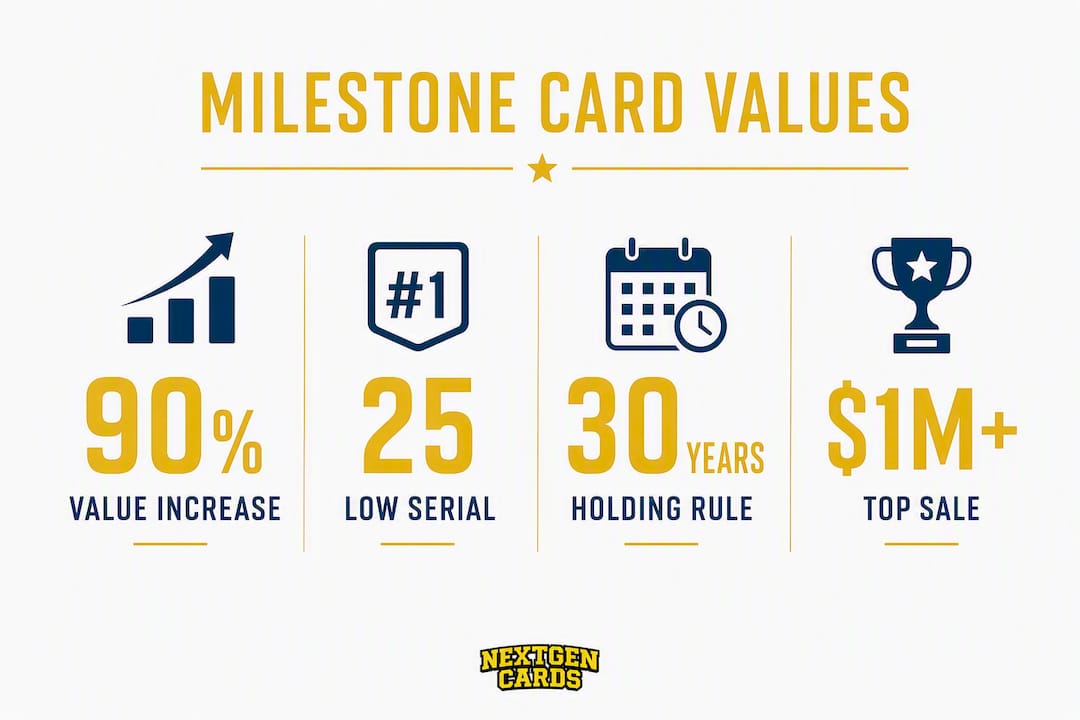
For long-term holders, the 30-Year Rule offers a useful timing lens: demand and prices often jump roughly 30 years after a major achievement as nostalgia cycles and generational buying power align. Cards from iconic early-1990s seasons, for example, are now entering that window.
How do you identify and authenticate a milestone card?
Verification protects you from overpaying for a lookalike or a mass-produced variation dressed up as a scarce issue.
- Check the card front for milestone wording. The insert title, parallel name, or on-card inscription should explicitly reference the achievement, stat, or date.
- Locate the serial-number plate. Stamped on the card edge or front, it confirms the print run. No stamp means no serial number, which typically means a larger, less scarce print run.
- Photo-match the relic. For game-used cards, compare the jersey swatch color, number, and wear pattern against game photos from the milestone event.
- Verify redemption tracking numbers. Unexchanged redemption cards carry a code traceable through the manufacturer’s portal, confirming the card’s legitimacy.
- Request a certificate of authenticity. Manufacturers like Topps and Upper Deck include COAs for premium autograph and relic releases.
- Submit to PSA or Beckett for grading. A graded slab from either house confirms authenticity, documents condition, and provides a population report showing how many copies have been graded at each grade level. Population data is one of the most reliable scarcity signals available.
Pro Tip: Before paying a premium for any “game-used” milestone relic, ask the seller for photo-matching documentation or a manufacturer statement linking the swatch to the specific game. Without it, you are buying a commemorative insert at a relic price.
What is the smartest strategy for buying and holding milestone cards?
- Check production numbers first. A card numbered /500 is not scarce. Target /25 or lower for genuine rarity, and /10 or lower for top-tier premiums.
- Set a maximum buy price before bidding. Milestone announcements trigger short-term spikes. Prices often soften 30–60 days after the initial news cycle, giving patient buyers a better entry point.
- Prioritize documented relics and on-card autographs. These formats hold value better than sticker autographs or non-provenanced inserts when the market cools.
- Use the 30-Year Rule for long holds. Cards tied to achievements from the mid-1990s are entering their nostalgia window now. Cards from the 2000s are worth watching for the next decade.
- Beware deceptive variation structures. The 2008 Topps Moments & Milestones set contains dozens or hundreds of variations tied to statistical milestones. Many variations mean a specific card may not be as rare as it appears. Always verify whether you are holding one of a few or one of thousands.
Pro Tip: For redemption cards, track the manufacturer’s fulfillment timeline. An unexchanged redemption for a high-demand autograph can trade at a premium before fulfillment, then dip once the physical card ships and supply hits the market simultaneously.
How should you store and protect milestone cards?
Condition directly affects grading outcomes and long-term value, so storage decisions are not cosmetic.
- Penny sleeves first, then top-loaders. Every card should go into a penny sleeve before a rigid top-loader. This prevents surface scratches from plastic-on-cardboard contact.
- Magnetic cases for high-value cards. One-touch magnetic holders provide superior corner and edge protection for cards worth $100 or more.
- Climate control matters. Store cards in a space with stable temperature (65–70°F) and low humidity (45–55% relative humidity). Fluctuations cause warping and surface damage that PSA and Beckett penalize heavily.
- Remove display cards before submission. Cards left in UV-exposed frames or open displays accumulate fading and surface wear. Pull them for grading before condition deteriorates further.
- Vault vs. display decision. For serial-numbered milestone cards or authenticated relics, vaulting in a graded slab is the right call. Display is appropriate for lower-value commemorative inserts where the sentimental experience outweighs the grading premium.
How did milestone cards originate and evolve?
The concept of commemorating player achievements on cardboard predates the modern hobby. Early 20th-century tobacco and caramel sets occasionally highlighted statistical leaders, but the dedicated milestone card as a distinct product category emerged in the late 1980s and early 1990s alongside the insert era. As manufacturers competed for collector attention, they began issuing short-printed inserts tied to specific career landmarks. By the mid-1990s, serial numbering became standard, and milestone cards gained a scarcity dimension that base cards lacked. The 2000s brought game-used relics and on-card autographs into milestone releases, raising the ceiling on what a single card could command. Today, manufacturers like Topps, Upper Deck, and Panini issue milestone drops within days of a record-breaking event, sometimes using print-to-demand technology to capture the moment while collector interest peaks.

How have milestone cards shaped the broader trading card market?
Milestone cards have pushed the entire hobby toward narrative-driven collecting. Before the insert era, card value was largely driven by player tier and condition. Milestone releases introduced the concept of a card tied to a specific, dateable moment, which gave collectors a story to attach to their investment. That shift attracted a broader audience, including sports fans who might not otherwise collect. It also accelerated the grading industry: PSA and Beckett both grew substantially as collectors needed authenticated, condition-verified slabs to trade milestone cards with confidence. The provenance premium that authenticated game-used milestone relics command has made documentation a standard expectation in high-end transactions, raising the bar for the entire market.
Common misconceptions collectors have about milestone cards
Several persistent myths cost collectors real money.
“Any card from a milestone season is a milestone card.” Not true. A standard base card printed the same year as a record-breaking season is not a milestone card unless it explicitly commemorates the achievement with milestone-specific labeling, a dedicated insert designation, or a manufacturer statement.
“Low serial numbers always mean high value.” Serial numbers confirm scarcity, but scarcity alone does not create value. A /10 parallel of a player with no collector demand will not outperform a /100 parallel of a generational talent at a career peak.
“Milestone cards always appreciate.” Short-term spikes are common, but not every milestone card holds its post-announcement price. Mass-produced commemorative inserts often return to near-base levels within months. Authenticated relics and low-numbered autographs are far more durable.
“The set name guarantees rarity.” Sets with “Moments & Milestones” in the title can contain hundreds of variations, as the 2008 Topps release demonstrates. The set name is not a rarity guarantee; the serial number and format are.
Key Takeaways
Milestone cards combine a verifiable career narrative with physical scarcity, and that combination is what separates them from standard inserts in both collector demand and long-term market performance.
| Point | Details |
|---|---|
| Core definition | A milestone card commemorates a specific, verifiable career achievement, issued as an insert, autograph, relic, or serial-numbered parallel. |
| Value mechanics | Narrative demand plus scarcity drives price; authenticated relics tied to the milestone event outperform mass-produced commemoratives. |
| Authentication priority | Verify milestone wording, serial-number plate, and relic provenance; submit to PSA or Beckett for graded confirmation and population data. |
| Buying strategy | Target /25 or lower for genuine scarcity; set a max buy price before announcements; use the 30-Year Rule for long-hold decisions. |
| Nextgencards inventory | Nextgencards carries authenticated milestone-style autographs, relics, and redemption cards from Topps and other major manufacturers. |
Why milestone cards belong at the center of any serious collection
Most collectors understand that scarcity matters. Fewer appreciate how much the narrative behind a card amplifies that scarcity. A serial-numbered parallel numbered to 25 is scarce by definition. But a serial-numbered parallel numbered to 25 that documents the exact game a player broke an all-time record? That card carries a story every future owner will repeat. That story is what sustains demand across decades, not just across news cycles.
The collectors who consistently build strong portfolios are not chasing every milestone drop. They are selective: they verify production numbers, demand provenance documentation for relics, and understand the difference between a manufacturer’s marketing label and genuine scarcity. The 30-Year Rule is not a guarantee; it is a framework for thinking about when nostalgia and buying power converge. Used alongside grading data from PSA and Beckett, it gives serious collectors a real timing edge.
The misconception that worries me most is the one about set names. A product called “Moments & Milestones” sounds exclusive. It often is not. Read the checklist before you bid.
Nextgencards has the milestone cards serious collectors are looking for
Collectors who know exactly what they want — authenticated autographs, game-used relics, and serial-numbered parallels tied to real career achievements — will find Nextgencards built for that search. The shop’s curated inventory focuses on rare Topps rookie autographs, patch and relic cards, and redemption cards featuring current and iconic MLB, NBA, and NFL players, with free shipping on select items.
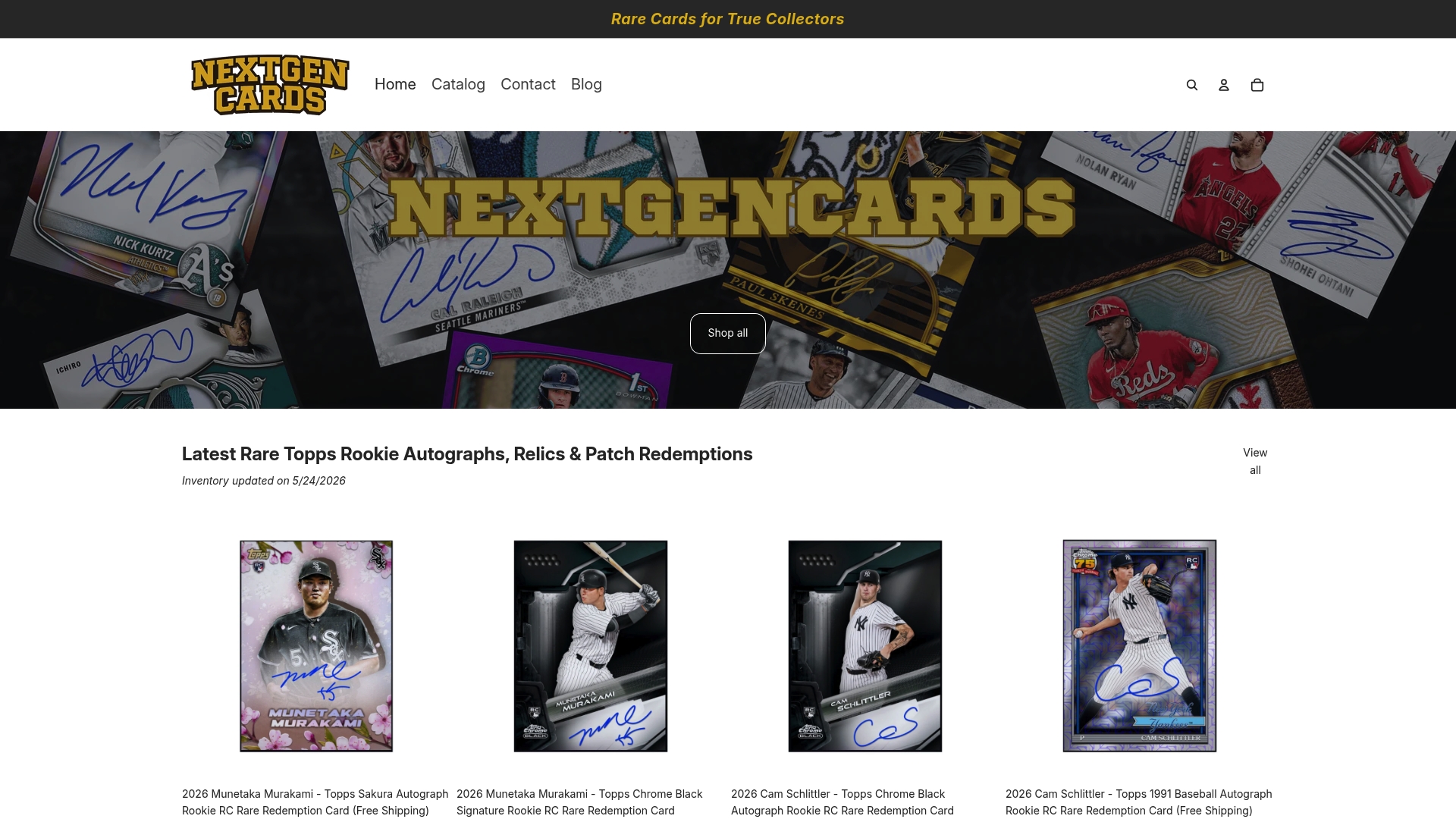
If you’re ready to add a verified milestone-quality card to your collection, browse the rare autographs and relics at Nextgencards or visit the full shop to see current inventory. Every listing reflects the authentication standards and rarity focus that serious collectors expect.
Useful sources
- Sports card value factors — Hall of Cards
- Upper Deck GR8 Moments — Alex Ovechkin milestone release
- Authenticated game-used memorabilia and provenance — AP News
- Derek Jeter and the 30-Year Rule — Sports Illustrated
- 2008 Topps Moments & Milestones variations — BaseballCardPedia
- Pete Alonso milestone card tiers — cllct
- Nextgencards collector guides — Sports Cards Investment Benefits
0 comments