

A framed sports card is a collectible trading card mounted and displayed using archival-quality materials to preserve its condition and showcase its value. The term “framed sports card” is widely used by collectors, but the recognized industry term is custom framed collectible card display, which covers the full range of preservation-grade mounting, glazing, and enclosure techniques. Whether you collect rookie autographs, graded slabs, or limited edition relics, proper framing protects your investment and transforms individual cards into gallery-worthy pieces. This guide covers materials, display options, key benefits, and expert tips for collectors who want to do it right.
What is a framed sports card and why does it matter?
A framed sports card is defined by three core elements: protective enclosure, archival mounting, and UV-resistant glazing. Together, these elements prevent the chemical deterioration, physical damage, and color fading that degrade unprotected cards over time. Professional framing uses acid-free, pH-neutral mounting boards and precision-cut apertures to hold cards securely without contact with adhesives. That distinction separates a true preservation frame from a standard photo frame bought at a retail store.
Framing also serves a display purpose that raw storage cannot match. A graded PSA 10 rookie autograph from a player like Shohei Ohtani or Aaron Judge deserves to be seen, not buried in a binder. Framing converts a collectible into a curated piece that tells a story on your wall. Collectors who frame their cards consistently report higher personal satisfaction with their collections, and the visual impact of a well-framed card is immediately apparent to any visitor.
The intersection of value protection and aesthetic presentation is what makes framing a serious collector’s tool, not just a decorative choice. A card that sits in a drawer faces humidity, dust, and accidental bending. A properly framed card faces none of those threats.
What materials and techniques are used in professional sports card framing?
Professional card framing relies on a specific set of archival materials that differ significantly from standard framing supplies. Each material serves a defined preservation function.
- Acid-free, pH-neutral mounting boards: These prevent the chemical off-gassing that causes card stock to yellow and become brittle over time.
- 99% UV-protective acrylic glazing: UV energy breaks down molecular bonds in card pigments, causing irreversible color fading. Museum-grade acrylic blocks 99% of UV rays, which is the current standard for serious collectors.
- Interior air gap spacers: Specialized spacers within frames prevent the card surface from touching glass or acrylic. This gap stops condensation buildup and warping caused by temperature fluctuations.
- Non-adhesive, reversible mounting: Cards are held in place without glue or tape, so they can be removed later without damage. This is critical for maintaining a card’s resale grade.
- Deep box frames for graded slabs: Standard photo frames are often too shallow for graded slabs, which measure 5–8mm thick. Pressure from a shallow frame can crack a slab and destroy the grade.
DIY framing kits offer an affordable entry point, but they rarely include museum-grade acrylic or precision-cut apertures. Professional custom framing delivers all these elements together, which is why custom-framed sports card displays cost from about $18 to over $200 depending on complexity. That price range reflects the difference between a basic single-card frame and a full multi-card shadow box with archival backing.
Pro Tip: Always request a certificate of archival compliance from a professional framer. This confirms that all materials meet preservation standards and protects your card’s long-term condition.

How do framed sports card display options vary?
Collectors have more display choices today than at any previous point in the hobby. The right option depends on your collection size, security needs, and how you want to present your cards.
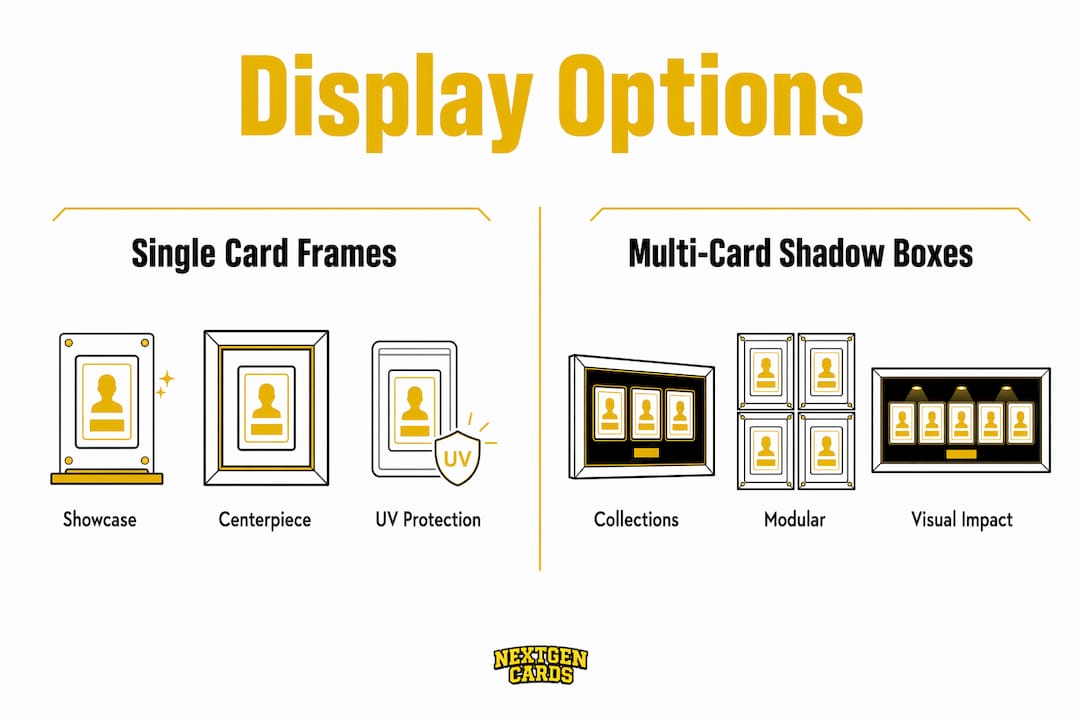
Single card frames vs. multi-card shadow boxes
Single card frames work best for a centerpiece card, such as a triple autograph rare card or a numbered rookie. They draw full attention to one piece and fit naturally on a desk or shelf. Multi-card shadow boxes allow collectors to group thematically related cards, such as a full rookie class or a player’s career highlights, into one cohesive display.
Wall-mounted locked display cabinets
Wall-mounted locked display cases can hold up to 35 graded cards, feature 98–99% UV-protective acrylic fronts, and lock to prevent unauthorized access. This option suits collectors with significant graded inventories who want both visibility and security. The lock mechanism is a practical feature for households with children or for collectors who display cards in shared spaces.
Modular and rotating display systems
Systems like SlabDock offer modular, adhesive-free rotation to protect graded slabs. The most effective framing systems allow card rotation without adhesives to avoid physical damage. This balances display flexibility with preservation, which is a real challenge for collectors who rotate their featured cards seasonally.
| Display type | Best for | Security | UV protection |
|---|---|---|---|
| Single card frame | Centerpiece cards | Low | High (with archival acrylic) |
| Multi-card shadow box | Themed groupings | Low | High |
| Locked wall cabinet | Graded slab collections | High | High (98–99%) |
| Modular display system | Rotating featured cards | Medium | Varies by product |
Pro Tip: For graded slabs, always measure slab thickness before purchasing a frame. A frame that is too shallow will press against the slab and risk cracking it.
What are the key benefits of framing sports cards?
Framing delivers four concrete benefits that matter to collectors who treat their cards as both a passion and an investment.
-
Preservation of condition. Framed sports cards preserve condition by preventing damage from UV light, moisture, and physical contact, which lowers degradation risks significantly. A card that holds its physical grade holds its market value.
-
Protection from environmental threats. Indoor LED lights and indirect sunlight contribute significantly to color fading. UV-protective acrylic is not optional for cards displayed in lit rooms. It is the minimum standard for responsible display.
-
Narrative display creation. Combining cards with related memorabilia, such as a signed photo or a jersey patch, creates a display that tells a story. Creating a narrative display by combining cards with related memorabilia enhances collector engagement and display impact. A Shohei Ohtani rookie autograph displayed alongside a game-used item becomes a complete collector statement.
-
Investment protection and resale value. A card in documented excellent condition commands stronger resale prices. Framing with reversible, non-adhesive mounting preserves the card’s original state, which graders and buyers verify at resale.
Bespoke framing is a preservation-first method that connects a card’s investment value with its role as gallery-style home décor. A properly framed card is not just stored. It is presented, protected, and appreciated every day.
The sports cards investment benefits that serious collectors pursue depend heavily on condition maintenance. Framing is one of the most direct ways to protect that condition over years and decades.
What are best practices and expert tips for framing sports cards?
Collectors who frame their cards correctly from the start avoid costly mistakes later. These practices reflect current professional standards.
- Use spacers without exception. Interior air gap spacers are critical to prevent condensation and card cockling from temperature fluctuations. Even a small gap between the card and the glazing makes a measurable difference in long-term preservation.
- Match frame depth to slab thickness. Framed graded slabs require deep box frames tailored to slab thickness of 5–8mm to avoid damage from glass pressure. Measure before you buy.
- Choose reversible mounting only. Adhesive mounting permanently alters a card’s surface. Reversible systems, such as corner pockets or precision-cut apertures, protect resale value.
- Control your lighting environment. Position framed cards away from direct sunlight and strong LED spotlights. Even with UV acrylic, minimizing light exposure extends the life of card pigments.
- Combine cards with memorabilia thoughtfully. A rookie autograph displayed with a related photo or patch creates a display that collectors and visitors find genuinely compelling. Keep the narrative focused on one player or one moment for maximum impact.
Pro Tip: When framing a card you plan to resell, photograph it before mounting and keep all original packaging. Buyers value documented provenance, and a framed card with a clear history commands stronger offers.
Collectors who present cards as gifts also benefit from professional framing. A well-framed autographed card as a gift carries far more visual impact than a card in a sleeve, and it arrives ready to display.
Key Takeaways
Proper framing is the single most effective way to protect a sports card’s condition and display value simultaneously.
| Point | Details |
|---|---|
| Use archival materials | Acid-free boards and 99% UV acrylic are the minimum standard for preservation framing. |
| Always include spacers | Air gap spacers prevent condensation and warping from card-to-glazing contact. |
| Match frame depth to slab | Graded slabs are 5–8mm thick and require deep box frames to avoid pressure damage. |
| Choose reversible mounting | Non-adhesive mounting protects resale grade and allows future removal without damage. |
| Combine cards with memorabilia | Narrative displays that pair cards with related items increase both visual impact and collector satisfaction. |
Richard’s take on framing as a collector’s discipline
Most collectors think about framing as the last step after acquiring a great card. I think that’s backwards. The framing decision should happen before the card arrives, not after it sits on a desk for three months.
The collectors I respect most treat framing as part of the acquisition plan. They know the slab dimensions, they have the frame ordered, and the card goes straight from the mailer into a proper display. That discipline is what separates a collection that holds value from one that slowly degrades in a binder.
What surprises newer collectors is how much framing changes the experience of owning a card. A PSA 10 rookie autograph in a sleeve is impressive. The same card in a deep box frame with UV acrylic and archival backing, mounted on a wall, is a completely different object. It becomes something you look at every day, not something you check on occasionally.
The investment argument for framing is real, but the personal argument is stronger. You collect because these cards mean something to you. Framing is how you honor that meaning and protect it at the same time. Professional framing is not an expense. It is the cost of taking your collection seriously.
— Richard
Premium cards worth framing from Nextgencards
Nextgencards curates some of the most display-worthy cards available to serious collectors. The inventory focuses on rookie autographs, rare redemption cards, and limited edition relics that deserve proper framing from day one.
The 2024 Skenes, Cole, and Strasburg triple autograph rare physical redemption card is exactly the kind of piece that earns a dedicated frame. Three authenticated signatures on a single card represent a display centerpiece, not a binder card. Nextgencards offers free shipping on select items, and the catalog covers the rare and authenticated cards that collectors build their displays around. If you are serious about collecting framed sports cards, start with a card that is worth the frame.
FAQ
What is a framed sports card?
A framed sports card is a collectible trading card mounted in a protective enclosure using archival materials, including acid-free boards, UV-resistant acrylic glazing, and non-adhesive mounting. The goal is to preserve the card’s condition while displaying it as a gallery piece.
Does framing a sports card affect its value?
Proper framing with reversible, non-adhesive mounting preserves a card’s grade and resale value. Framing with adhesives or improper materials can damage the card and reduce its market value significantly.
What frame depth do I need for a graded slab?
Graded slabs are 5–8mm thick, so standard photo frames are too shallow. Deep box frames designed for slab thickness are required to prevent glass pressure from cracking the slab.
How do I protect a framed card from UV damage?
Use acrylic glazing that blocks 99% of UV rays, which is the current museum-grade standard. Position the frame away from direct sunlight and strong LED spotlights even with UV-protective glazing in place.
Can I frame multiple sports cards together?
Multi-card shadow boxes and wall-mounted locked display cabinets accommodate multiple cards. Locked cabinets can hold up to 35 graded cards and include UV-protective acrylic fronts for full collection security.
0 comments