

A serial number on a rookie autograph card is a print run identifier, stamped directly onto the card, that tells you exactly how many copies exist and which copy you hold. Reading rookie autograph card serial numbers is the single most direct way to measure a card’s scarcity before you spend a dollar. The Beckett rookie card (RC) definition sets the standard for what qualifies as an official rookie, and serial numbering sits at the center of that framework. Collectors and investors who skip this step routinely overpay for cards that look rare but are not. This guide covers every layer of serial number literacy, from basic format decoding to 2026 market strategy.
How to read rookie autograph card serial numbers
Serial numbers appear as fractions, such as 33/499 or 15/100, printed on the front or back of the card. The numerator is your card’s position in the print run. The denominator is the total number of copies produced. A card stamped 15/100 is the 15th card printed out of exactly 100 total. That fraction is the entire rarity story in two numbers.

The location of the stamp varies by manufacturer and product. Topps typically places the foil stamp on the front face, near the bottom corner. Panini often stamps the back. Some premium products print the serial number directly into the card stock rather than using foil. Regardless of placement, the format is always numerator/denominator.
One-of-one cards, labeled 1/1, represent the ultimate print run. Only one copy exists in the world. These are called “true one-of-ones” in the hobby, and they carry a category of their own in terms of desirability and pricing. Collectors treat 1/1 cards as irreplaceable artifacts rather than standard collectibles.
- Numerator: Your specific card number within the print run (e.g., 15 out of 100)
- Denominator: Total copies produced for that parallel or variation
- 1/1: True one-of-one, the rarest possible serial number
- Foil stamp location: Front face (Topps) or card back (Panini) depending on the product
- Unnumbered cards: Some parallels carry no serial number despite being scarce
Pro Tip: If a seller describes a card as “rare” but it carries no serial number, check the parallel designation. Some super short prints like Panini Zebra or Topps Checkered Flag are genuinely scarce without any stamped number. Rarity without a serial number is real but harder to verify.
What do serial number rarity tiers mean for card value?
Collectors prioritize cards numbered /99 or less, with /10, /5, and 1/1 cards commanding the highest market values in 2026. The hobby uses a color-coded parallel system to signal these tiers visually. Gold parallels typically run /10, Black parallels run 1/1, and the color of the card border tells you the tier before you even read the number.
The table below maps the standard rarity tiers to their collector priority and general market position.
| Serial number range | Parallel color (common) | Collector priority | Market position |
|---|---|---|---|
| /499 or /250 | Silver or Blue | Entry level | Widely available |
| /99 | Red or Purple | Moderate | Solid demand |
| /25 | Orange | High | Strong premium |
| /10 | Gold | Very high | Top tier |
| 1/1 | Black or Superfractor | Maximum | Irreplaceable |
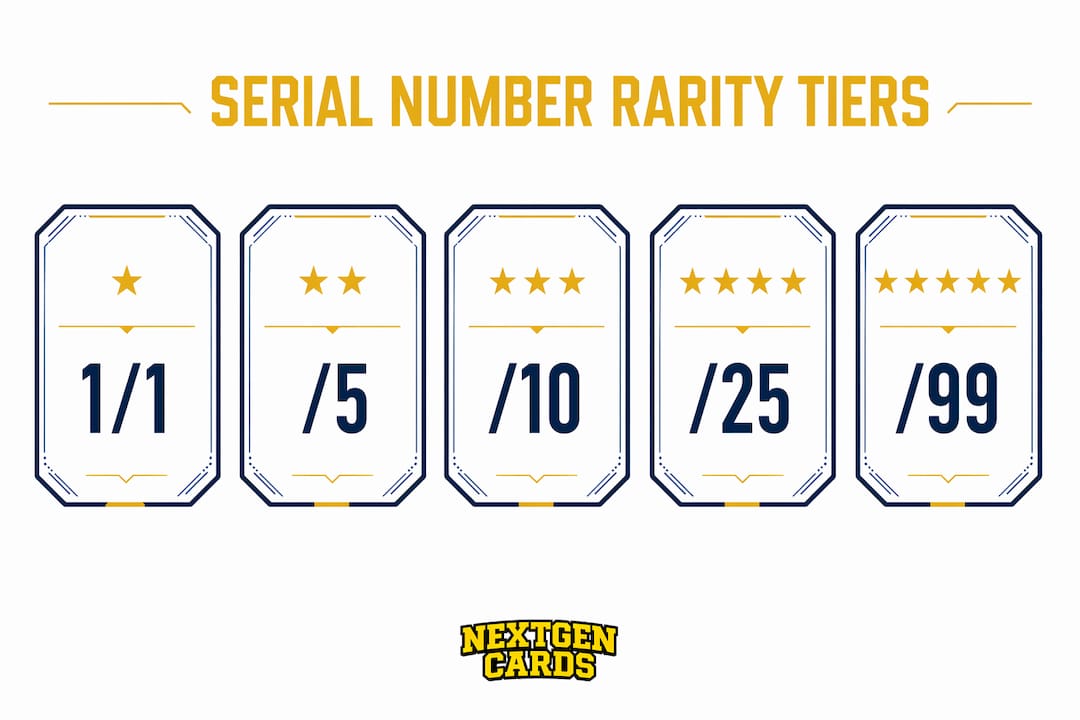
Lower serial numbers command premiums because scarcity drives collector competition. A /25 rookie autograph of a star prospect attracts multiple serious bidders. A /499 of the same card rarely generates that urgency.
There is one important exception. Rarity alone does not guarantee value. Player performance and set desirability often outweigh serial number scarcity. A 1/1 of a prospect who never reaches the majors holds far less value than a /99 of a proven All-Star. Collectors who chase low numbers without evaluating player trajectory routinely get burned.
Collectors increasingly view serial numbers below /99 as an effective hedge against the mass prints that flood the modern card market. That threshold has become a practical dividing line between cards worth holding and cards worth flipping quickly.
How do jersey number matches and autograph type affect value?
Jersey number matching is one of the most underappreciated factors in rookie autograph card valuation. Investors seek jersey-match serial numbers, such as card 23/99 for a player who wears jersey number 23, and these cards can sell at double the value of a random serial from the same print run. That premium exists because the match is a one-time coincidence within an already limited print run, creating a subset of scarcity within scarcity.
The autograph type matters just as much as the number. On-card autographs with low serials are valued more highly than sticker autographs even when the serial numbers are identical. An on-card /25 rookie auto is perceived as a premium artifact. A sticker auto at /25 carries the impression of mass production, even if the print run is the same.
Here is what collectors weigh when combining serial numbers with autograph type:
- On-card auto + low serial (/25 or below): Maximum desirability, commands the strongest premiums
- On-card auto + mid serial (/99): Strong demand, especially for top prospects
- Sticker auto + low serial (/25): Discounted relative to on-card equivalents
- Sticker auto + high serial (/250 or above): Lowest tier for serious collectors
Pro Tip: When comparing two cards with the same serial number, always check whether the autograph is on-card or sticker. Serial number value is magnified when paired with autograph quality and provenance. The combination of both factors is what separates a $200 card from a $2,000 card.
Expert collectors value jersey-match serials as a unique rarity trait that commands significant premiums beyond what the print run alone would suggest. If you spot a jersey match, treat it as a separate category entirely.
How to use serial number data when investing in rookie autograph cards
Practical investing starts with verifying rookie card status. Beckett’s rookie card definition excludes cards with print runs under 99 copies from qualifying as official rookies in some cases. That distinction matters because official RC status affects long-term demand and resale liquidity. Always confirm RC designation before committing capital to a low-numbered card.
The steps below form a repeatable research process for any rookie autograph purchase.
- Confirm RC status. Check Beckett’s RC definition for the specific card. A card numbered /50 may not carry official rookie status, which limits its ceiling.
- Check the serial number tier. Identify where the card falls in the rarity hierarchy. Cards at /99 or below deserve deeper research.
- Look for jersey number matches. Cross-reference the card’s serial number against the player’s jersey number. A match justifies a premium.
- Assess autograph type. On-card autographs outperform sticker autos at every serial number tier.
- Pull sales history. Use market data tools like 130point.com for price trends and actual sales history. Low serial cards can have poor liquidity without consistent sales volume or player demand.
- Check grading population reports. PSA 10 certification is critical for liquidity. Raw or lower-grade cards can trap value even when the serial number is elite.
- Evaluate set importance. Diversifying by set reduces single-player risk. Iconic sets sustain value even if a player underperforms expectations.
The most common pitfall is buying a low-numbered card without checking sales consistency. A card numbered 3/10 sounds extraordinary. If it has sold once in three years, you own an illiquid asset regardless of the serial number. Market data tools like 130point exist precisely to surface this problem before you buy, not after.
Understanding how to identify undervalued sports cards requires combining serial number data with sales velocity, player trajectory, and set context. No single factor tells the full story.
Key Takeaways
Reading rookie autograph card serial numbers requires combining print run data, autograph type, jersey number matches, and market sales history to accurately assess value and liquidity.
| Point | Details |
|---|---|
| Serial number format | The fraction (e.g., 15/100) shows your card’s position and total print run. |
| Rarity threshold | Cards numbered /99 or below are the collector priority tier in 2026. |
| Jersey number match | A serial matching the player’s jersey number can double the card’s market value. |
| Autograph type matters | On-card autographs outperform sticker autos at every serial number level. |
| Liquidity check required | Always verify sales history and PSA 10 grade before investing in low-serial cards. |
Serial numbers are one piece of the puzzle, not the whole picture
Richard here. After years of collecting and studying the rookie autograph market, the single biggest mistake I see collectors make is treating serial numbers as the final word on value. They are not. They are the starting point.
I have watched collectors pay enormous premiums for a 1/1 of a prospect who flamed out in year two. I have also watched a /99 of a generational talent like Shohei Ohtani appreciate far beyond what the print run suggested, because the player’s trajectory and the set’s prestige compounded the value over time. The serial number told you the floor. The player and the set told you the ceiling.
What I have found actually works is building a checklist habit. Every card gets the same evaluation: serial number tier, autograph type, jersey match check, RC status confirmation, and a sales history pull. That process takes ten minutes. It has saved me from several expensive mistakes and helped me spot rookie autograph grading opportunities that other collectors missed because they only looked at the number on the front.
The 2026 market has also made one thing clear: craftsmanship and provenance are gaining weight relative to raw scarcity. An on-card auto from a premium Topps product at /25 now commands a different conversation than a sticker auto at /10 from a mid-tier release. Serial numbers set the stage. Everything else determines the outcome.
— Richard
Rare serial numbered rookie autograph cards at Nextgencards
Nextgencards carries a curated selection of authenticated rookie autograph cards with serial numbers across the rarity tiers covered in this guide.
The inventory includes high-demand prospects and established stars, with serial numbered parallels ranging from /99 down to true one-of-ones. Every card ships with authenticity backing, and free shipping is available on select items. If you are looking for a specific serial number tier or a jersey-match opportunity, the rookie autographs and relics collection is the right place to start. For a standout example of what a premium serial numbered rookie autograph looks like, the 2026 Cooper Flagg Topps VIP autograph rookie card represents exactly the kind of scarce, authenticated piece serious collectors target.
FAQ
What does a serial number on a rookie card mean?
A serial number identifies the card’s exact position within its print run, displayed as a fraction such as 15/100. The denominator tells you how many total copies were produced.
Which serial numbers are most valuable on rookie autograph cards?
Cards numbered /10, /5, and 1/1 command the highest market values. Collectors in 2026 treat /99 as the threshold for serious collector interest.
Does a jersey number match on a serial number increase value?
Yes. A serial number matching a player’s jersey number can double the card’s value compared to a random serial from the same print run, due to the unique collector demand it generates.
Is an on-card autograph worth more than a sticker autograph at the same serial number?
On-card autographs are valued more highly than sticker autographs even when the serial numbers are identical. The on-card format signals craftsmanship and direct player involvement.
Can a card be rare without a serial number?
Yes. Some super short print parallels, such as Panini Zebra or Topps Checkered Flag, carry no serial number despite being extremely scarce. These require parallel designation research rather than a simple number check.
Recommended
- Rarest Rookie Card Variations: Collector’s 2026 Guide – Next Gen Cards LLC
- Rookie Autograph Grading Explained for New Collectors – Next Gen Cards LLC
- Buy Certified Autograph Rookie Cards: 2026 Collector’s Guide – Next Gen Cards LLC
- Examples of Appreciating Rookie Cards: 2026 Collector Guide – Next Gen Cards LLC
0 comments