

Undervalued sports cards are listings priced below their true market value due to mislabeling, seller inexperience, or short-term price dips that do not reflect a card’s actual demand. Collectors and investors who know how to identify undervalued sports cards gain a real edge: they buy low on cards that the broader market has not yet recognized. The methods covered here include broad eBay search tactics, pricing dashboards like Beckett’s Hot/Cold List and Market Movers, grading ROI frameworks built around PSA expected value math, and a step-by-step verification checklist. These tools, used together, are how serious collectors find hidden sports card gems before prices correct.
How to identify undervalued sports cards using eBay broad searches
Most collectors search eBay with precise terms like “2021 Topps Chrome Shohei Ohtani PSA 10 Refractor.” That precision is exactly the problem. Specific searches land you in the most efficient part of the market, where every buyer already knows what they are looking at. Broad, generic searches uncover mislisted and underpriced cards that precise searches miss entirely. Sellers who do not know a card’s full details list it with incomplete titles, and those listings get far less traffic.
Here is a practical sequence for running broad eBay searches that surface undervalued listings:
- Start with player name and year only. Search “Shohei Ohtani 2018” rather than specifying the set, parallel, or grade. This pulls in every listing a seller created without knowing the card’s exact identity.
- Filter to auctions only. Buy-it-now prices reflect what sellers think a card is worth. Auctions reveal what buyers are actually willing to pay, and low-traffic auctions often close well below market.
- Set a one-bid minimum filter. Listings with zero or one bid are frequently overlooked. Combining this with the auctions filter isolates the lowest-competition opportunities.
- Exclude graded cards from results. Graded cards carry clear labels and attract informed buyers. Raw cards from unfamiliar sellers are where mislabeling and underpricing concentrate.
- Sort by ending soonest. Auctions ending in the next few hours with low bids are your best targets. Most buyers snipe at the last minute, so early monitoring gives you time to research the card before bidding.
Auction timing matters more than most collectors realize. Bidding during low-competition periods, specifically midday and midweek, reduces the number of active bidders and improves your odds of winning at a lower price. Weekend evening auctions attract the largest audiences and the highest closing prices.
Pattern recognition is the skill that ties this together. Collectors who have studied set checklists for Topps Chrome, Bowman Draft, and Panini Prizm can spot a mislabeled short print or a rare parallel from a thumbnail image. That knowledge is what turns a broad search into a profitable find. Save your most productive search strings in eBay’s saved search feature so new listings trigger automatic alerts.

Pro Tip: Study the checklist for one specific set each week. After a month, you will recognize parallels, print runs, and short prints on sight, which is the core skill behind spotting mislabeled undervalued cards.
What pricing tools reveal about card market value
Manual searching finds individual opportunities. Pricing dashboards find patterns across thousands of listings simultaneously. The two approaches solve different problems, and the most effective collectors use both.
| Approach | Best for | Limitation |
|---|---|---|
| Broad eBay search | Finding mislabeled or obscure listings | Time-intensive; requires set knowledge |
| Beckett Hot/Cold List | Spotting cards with recent price drops | Weekly data; does not show live listings |
| Market Movers Deals feature | Automated alerts on below-comp listings | Requires manual verification of condition |
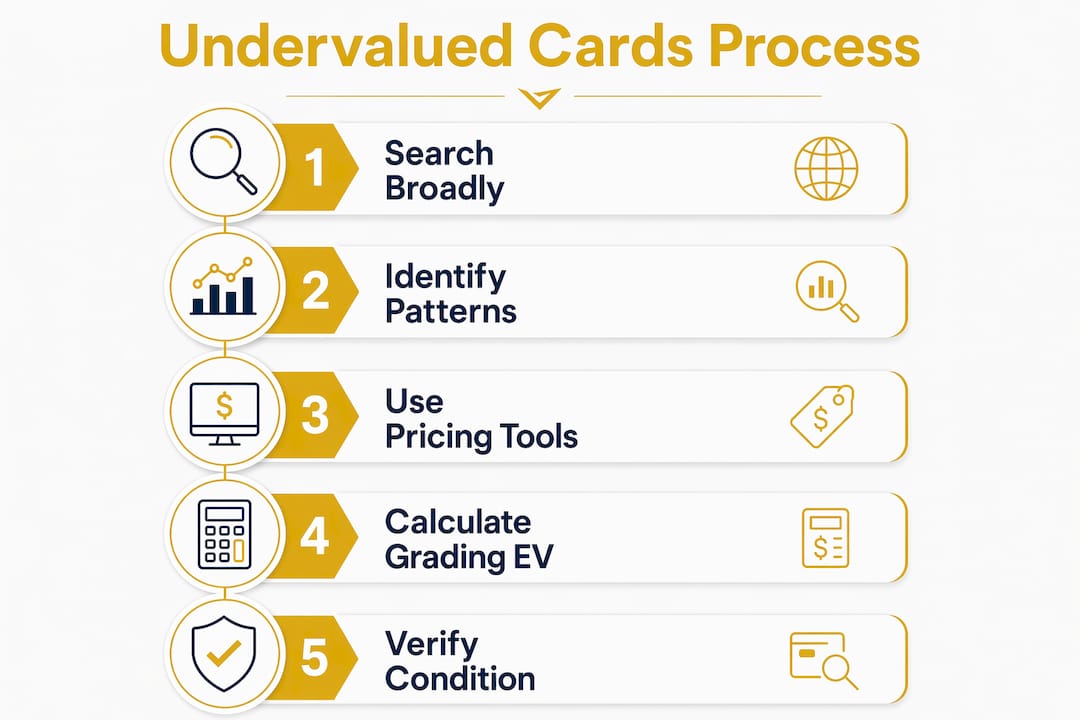
Beckett’s Hot/Cold List tracks auction price movements over a seven-day window and flags cards with rapid price declines as “cold.” A cold card signal often indicates temporary undervaluation rather than a permanent drop in demand. Players coming off a bad week, cards affected by a slow news cycle, or sets that briefly flooded the market all show up as cold. Skilled investors treat cold signals as potential buy windows, not warnings to avoid.
Market Movers takes a different approach. Its Deals feature compares live listings to millions of aggregated sales records updated daily, then flags listings priced below recent comps. This automates the discovery process that would otherwise require hours of manual research. The platform covers cards across eBay and other major marketplaces, making it one of the most practical tools for collectors who want to discover rare sports cards at scale.
The critical limitation of both tools is that automated alerts require manual verification. A listing flagged as undervalued might show a PSA 9 comp while the actual card is raw and off-center. Verification means checking the player, set, parallel, print run, and physical condition before acting on any data signal.
Pro Tip: Use Beckett’s cold list to build a watchlist of players and sets, then run those specific searches in Market Movers to find live listings priced below recent sales. Combining both signals cuts false positives significantly.
When does grading an undervalued card actually pay off?
Grading transforms a raw card into a certified, standardized asset, and the price premium for a PSA 10 over a raw card can be substantial. But grading is not always profitable, and the math matters before you submit anything.
The standard framework is the expected value formula: EV = (PSA 10 Value × Gem Rate) + (PSA 9 Value × (100% minus Gem Rate)) minus Grading Costs minus Selling Fees. This EV grading formula forces you to account for the realistic probability of getting a gem mint grade, not just the best-case scenario. Most collectors overestimate their gem rate and underestimate fees.
| Variable | Example value | Notes |
|---|---|---|
| PSA 10 value | $200 | Recent sold comps on Market Movers |
| Gem rate estimate | 55% | Based on card condition and set reputation |
| PSA 9 value | $80 | Often 30 to 50% of PSA 10 value |
| Grading cost | $25 | Standard tier fee |
| Selling fees | $18 | Approximately 13% of sale price |
| Expected value | ~$131 | Compared to raw card cost to assess profit |
If the raw card costs $90 and the EV is $131, the expected profit is $41. That margin is workable but thin. If the raw card costs $110, the same math produces a near-zero expected profit, and grading becomes a break-even exercise at best.
PSA grading is generally not cost-effective for cards valued below approximately $30 raw. Grading fees alone consume most of the potential upside, and low-value cards rarely command meaningful grade premiums. The threshold is not a fixed rule, but it is a reliable starting point for filtering out submissions that will not generate returns.
One nuanced tactic that experienced submitters use: submit cards at service tiers aligned with the PSA 9 value rather than the PSA 10 value. This avoids expensive upcharge tiers triggered when a card grades higher than expected, which can erode profit on cards that do gem. Timing also matters. Grading turnaround currently ranges from weeks to months depending on the service tier, and market conditions can shift during that window.
Pro Tip: Run the EV formula on every card before submitting. If the expected profit does not exceed $40 after all costs, the risk and wait time are rarely justified.
Step-by-step checklist to verify a card before buying or grading
Spotting a potential undervalued card is only the first step. Verification is what separates profitable purchases from expensive mistakes. Use this sequence before committing to any buy.
- Cross-check recent sold comps. Pull the last 10 to 15 sold listings on Market Movers or eBay’s completed sales for the exact card, parallel, and condition. Averages can be skewed by outliers, so look at the median price.
- Inspect the card image closely. Centering, edge wear, surface scratches, and print defects all affect grade and resale value. A card that looks clean in a thumbnail can have significant flaws at full resolution.
- Confirm the exact card identity. Verify the player, year, set, parallel type, and print run. Short prints, refractors, and numbered parallels from sets like Bowman Chrome or Topps Finest are frequently mislabeled by sellers who do not know the difference.
- Assess whether the undervaluation is temporary or structural. A card priced low because of a player’s recent slump may recover quickly. A card priced low because the player retired or the set is genuinely unpopular represents a different risk profile entirely.
- Check the seller’s return policy and feedback score. Sellers with limited feedback or no return policy add risk to any purchase, especially for raw cards where condition is subjective.
Common pitfalls to avoid:
- Buying based on a single comp that was an outlier sale
- Assuming a “lot” listing contains the card shown in the thumbnail
- Overlooking the difference between a base card and a parallel with the same player image
- Ignoring print defects that will prevent a card from grading above PSA 8
Most undervaluation arises from information gaps, not from genuine card quality problems. That distinction is what makes verification so valuable: you are confirming that the low price reflects a seller’s ignorance rather than a flaw you missed.
Key takeaways
Identifying undervalued sports cards requires combining broad search tactics, real-time pricing data, grading ROI math, and thorough card verification before every purchase.
| Point | Details |
|---|---|
| Broad eBay searches find mislabeled cards | Search by player and year only, filter to auctions, and exclude graded cards to surface overlooked listings. |
| Beckett and Market Movers reveal pricing gaps | Use cold signals and the Deals feature together to find cards priced below recent market comps. |
| Grading ROI requires expected value math | Calculate EV using gem rate, PSA 9 value, grading costs, and selling fees before submitting any card. |
| Skip grading on low-value raw cards | Cards worth under $30 raw rarely generate profit after PSA fees and selling costs are factored in. |
| Verification prevents costly mistakes | Confirm card identity, condition, and comp history before buying, regardless of how strong the data signal looks. |
What I’ve learned from years of hunting undervalued cards
The collectors who consistently find the best undervalued cards are not the ones with the most money or the fastest internet connection. They are the ones who have done the same searches hundreds of times and built genuine pattern recognition. That repetition is not glamorous, but it is the actual skill.
I have seen collectors make the mistake of trusting Market Movers alerts without verifying condition, then receiving cards that will never grade above a PSA 7. The tool is excellent, but it is a starting point, not a final answer. Combining data tools with manual inspection is the only approach that holds up over time.
On grading: the current market in 2026 rewards patience. Turnaround times and fee structures have shifted, and submitting everything you find is a fast way to tie up capital in cards sitting in a grading queue while the market moves. I now apply the EV formula strictly and only submit cards where the expected profit exceeds $50 after all costs. That threshold has eliminated a lot of marginal submissions and improved my overall return rate.
The best resource for staying current is the collector community itself. Forums, Discord servers focused on Topps and Panini products, and weekly reads of Beckett’s market trend data keep your pricing instincts calibrated. No single tool or article replaces the ongoing education of watching the market move week after week.
— Richard
Find authenticated rookie cards worth adding to your collection
If your undervaluation strategy focuses on rookie autographs and relic cards, having a trusted source for authenticated inventory saves significant research time. Nextgencards curates a selection of rare rookie autographs and relics from sets including Topps and Bowman, featuring athletes like Shohei Ohtani and Aaron Judge. Every card in the inventory is authenticated, and the collection is updated regularly to reflect current market availability.
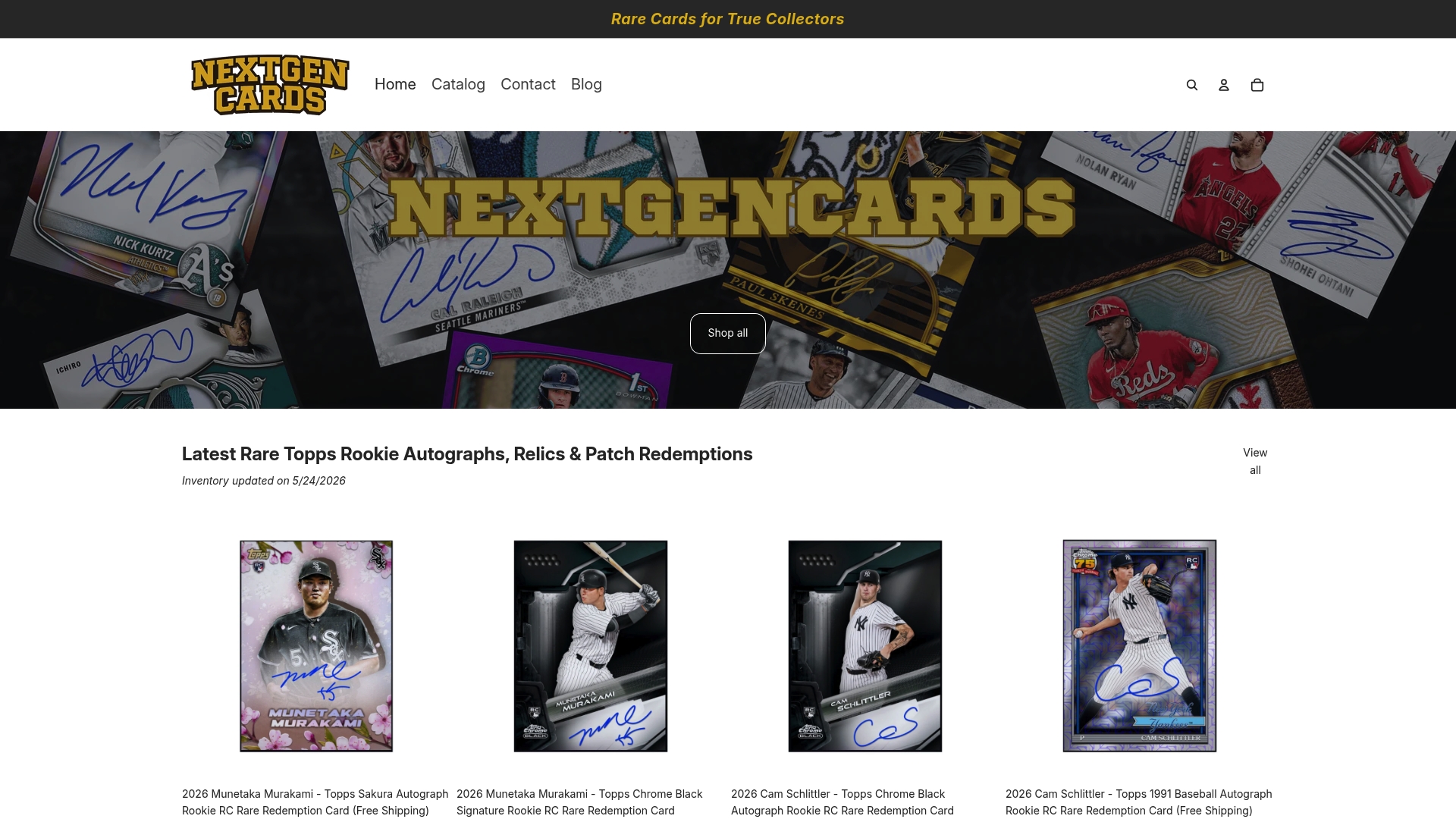
Collectors who use the broad search and EV grading methods covered in this article will recognize the value in starting from a verified, curated source rather than sorting through unverified raw listings. Nextgencards offers free shipping on select items and focuses exclusively on the card types that serious investors prioritize: limited editions, numbered parallels, and certified rookie autographs. Browse the full collection at Nextgencards to find cards that complement your existing undervaluation hunting strategy.
FAQ
What makes a sports card undervalued?
A sports card is undervalued when its listed price falls below its true market value, typically due to seller mislabeling, incomplete listing titles, or short-term price dips unrelated to the card’s actual demand.
How do I spot undervalued cards on eBay?
Search by player name and year only, filter to auctions ending soon, and exclude graded cards. Broad searches surface mislisted cards that precise searches miss because sellers with limited knowledge use incomplete titles.
Is PSA grading worth it for every undervalued card I find?
No. PSA grading is generally not profitable for raw cards valued below $30, since fees consume most of the potential upside. Always run the expected value formula before submitting any card for grading.
What is the Market Movers Deals feature?
The Market Movers Deals feature compares live listings to aggregated historical sales data and flags cards priced below recent comps. It updates daily and covers multiple marketplaces, making it one of the most practical tools for finding best investment sports cards at scale.
How do I avoid buying a card that looks undervalued but is actually flawed?
Inspect high-resolution images for centering, edge wear, and surface defects. Confirm the exact card identity including parallel type and print run, and cross-check at least 10 to 15 recent sold comps before purchasing.
Recommended
- Top Places to Buy Rare Rookie Cards (Collectors Guide) | NextGenCards – Next Gen Cards LLC
- NextGenCards - Rare Topps Rookie Cards – Next Gen Cards LLC
- Rare Topps Rookie Autographs & Relics – Authentic Cards – Next Gen Cards LLC
- 2026 Derik Queen Topps 1980-81 Basketball Rookie Autograph Rare Card – Next Gen Cards LLC
0 comments