

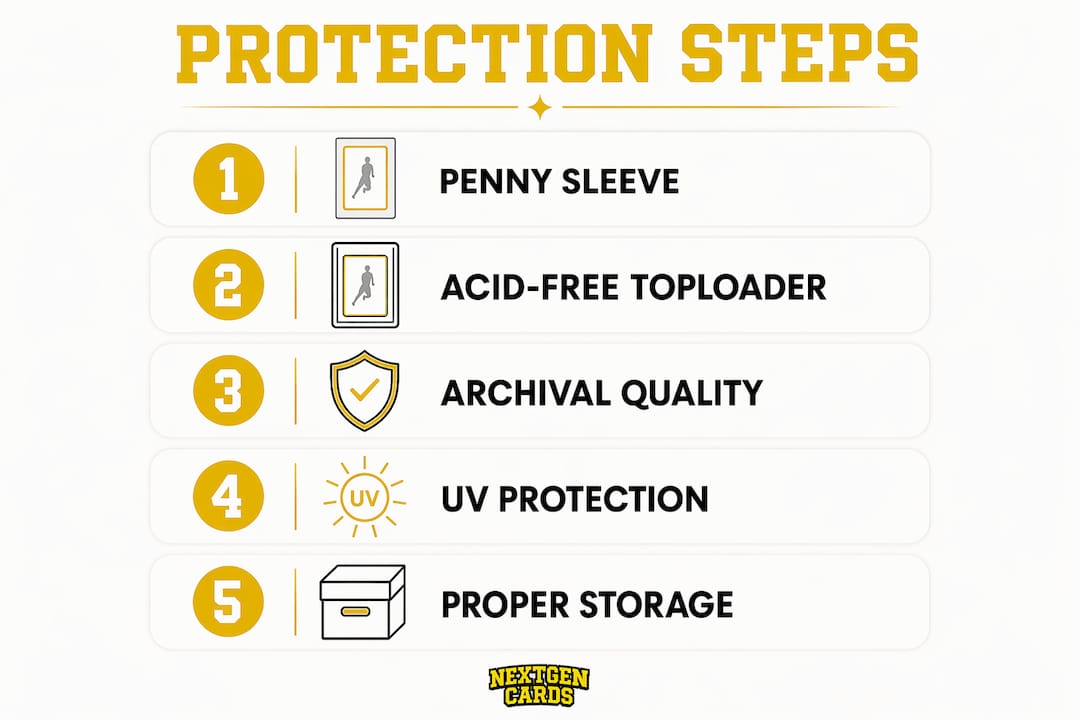
To protect autographed cards from damage, immediately slip the card into a penny sleeve with the autograph side facing inward, insert it into an acid-free rigid toploader, and place it in a cool, dark, climate-stable location with moderate temperature and humidity. These three steps, recommended by Nextgencards, form the foundation of every sound preservation strategy for collectors and investors alike.
If you just acquired a signed card, follow this triage checklist immediately:
- Let a fresh in-person autograph cure for at least 24 hours before sleeving — rushing this step risks permanent ink smear.
- Slide the card into a penny sleeve, autograph side facing inward, to prevent ink contact with any rigid surface.
- Insert the sleeved card into an acid-free toploader or semi-rigid holder, then store it upright in a dark, interior cabinet away from heat sources and exterior walls.
Table of Contents
- Which protective materials actually keep signed cards safe?
- How temperature, humidity, and light affect your autographed cards
- How to store autographed cards for the long term
- When does professional grading and encapsulation make sense?
- Safe handling habits that prevent the most common damage
- How to pack and ship autographed cards without risking damage
- Common mistakes that damage autographed cards and early warning signs
- Your supply checklist: what to buy now and what to upgrade later
- Key Takeaways
- Why preservation is the foundation of every serious collection
- Nextgencards has the autographs and supplies worth protecting
- Useful sources for deeper reading
Which protective materials actually keep signed cards safe?
Penny sleeves and toploaders are the minimum standard for any autographed card, but the full protective stack goes further. The correct layering order matters as much as the materials themselves.
The recommended protective stack:
- Penny sleeve (soft polyethylene): autograph side facing inward, creating a barrier between ink and any rigid surface.
- Perfect-fit sleeve (optional): a tighter-fitting soft sleeve that reduces movement inside the toploader.
- Acid-free toploader or semi-rigid holder: provides structural rigidity against bending and physical impact.
- Magnetic case: the premium option for display or long-term holds; some magnetic cases include UV protection and a secure seal that basic toploaders lack.
Choosing between holder types:
- Toploaders suit everyday storage and trading; they are inexpensive and widely available in standard sizes (3" x 4" for standard cards, larger for thick relics or patches).
- Semi-rigids offer slightly more flexibility and are preferred for thicker cards.
- Screw-downs provide maximum rigidity but require careful tightening to avoid pressure damage.
- Magnetic cases are best for display-worthy pieces or investment-grade autographs you plan to hold long-term.
Always verify that packaging states “acid-free” or “archival-quality.” Non-archival plastics can release chemicals that yellow card stock and degrade ink over time. Check the product label for PVC-free and acid-free designations before purchasing.
Pro Tip: Match the holder size to the card’s exact dimensions. An oversized toploader lets the card shift and rub against the sleeve interior, which can cause micro-abrasions on the autograph surface over time.
How temperature, humidity, and light affect your autographed cards
Environmental conditions are the leading cause of long-term autograph degradation, and the damage is permanent once it sets in. Light exposure is the primary driver of autograph fading; UV radiation breaks down ink at the molecular level, and even indirect fluorescent lighting compounds the damage over years.
| Condition | Ideal Range | Risk Outside Range |
|---|---|---|
| Temperature | stable, moderate range | Heat accelerates ink breakdown; cold causes brittleness |
| Relative humidity | moderate, controlled range | Above moderate levels: ink bleed, warping, mold; below moderate levels: brittleness |
| Light exposure | Dark or UV-filtered | UV fading — irreversible within months of direct sun |
Practical environmental controls:
- Store cards in an interior closet or cabinet, away from exterior walls where temperature changes can be severe.
- Use a small digital hygrometer/thermometer to monitor conditions; inexpensive models are widely available.
- Place silica gel desiccant packets inside storage boxes to absorb excess moisture.
- Run a dehumidifier or humidifier in your storage room if your climate pushes humidity outside the 35–50% range.
- Never store cards in attics, basements, or garages — these spaces fluctuate far beyond safe parameters seasonally.
Toploaders protect against physical damage but cannot prevent ink degradation in a damp or fluctuating environment. Physical protection and climate control must work together.
Pro Tip: UV-rated glazing on display cases is not the same as UV-blocking. Look specifically for materials rated to block 99% of UV radiation. Many standard “archival” plastics offer minimal UV filtering — check the product spec sheet before purchasing a display case.
How to store autographed cards for the long term
The core rule for long-term storage is straightforward: store cards upright in acid-free toploaders, never flat in stacked piles. Flat stacking creates localized pressure that, combined with thermal expansion and contraction over years, can produce permanent impressions or ink transfer.
Long-term storage checklist:
- Use compartmentalized, acid-free storage boxes designed for toploaders — these hold cards upright and separated.
- Insert silica gel packets in each box and replace them every six months.
- Keep boxes in an interior closet, not against exterior walls or near plumbing.
- Inspect stored cards periodically for fading, mold spots, warping, or sticky surfaces; photograph each card at acquisition for a condition baseline.
- Maintain a simple index (a spreadsheet works) noting each card’s player, year, grade, and storage location.
Visualize the setup as a row of upright toploaders standing side by side in a divided box, like books on a shelf. Each card stays isolated, pressure-free, and accessible without disturbing the others.
When does professional grading and encapsulation make sense?
For investment-grade autographs, grading and encapsulation are often worth the cost. Professional encapsulation authenticates the signature and seals the card in a tamper-evident, archival-grade holder that effectively freezes its market condition, reduces buyer uncertainty, and often raises liquidity for resale.
Benefits of grading:
- Independent authentication of the autograph and card condition.
- Tamper-evident slab that protects against post-sale disputes.
- Standardized grade that gives buyers and sellers a shared reference point.
- Archival-grade encapsulation that outperforms most DIY storage for long-term preservation.
Trade-offs to weigh:
- Grading fees typically range from roughly $20 to $150+ per card depending on the service tier and turnaround speed; express tiers cost significantly more.
- Turnaround times can range from a few weeks to several months at standard service levels.
- Once slabbed, the card cannot be handled or re-sleeved without cracking the holder.
Pro Tip: Most grading services prefer Card Savers (semi-rigid holders) over hard toploaders for submission. Check the specific submission guidelines for your chosen service before packing — submitting in the wrong holder can delay or complicate your order.
For collectors considering authentication alongside grading, Nextgencards’s guide on authenticating rare sports memorabilia covers the full evaluation process.
Safe handling habits that prevent the most common damage
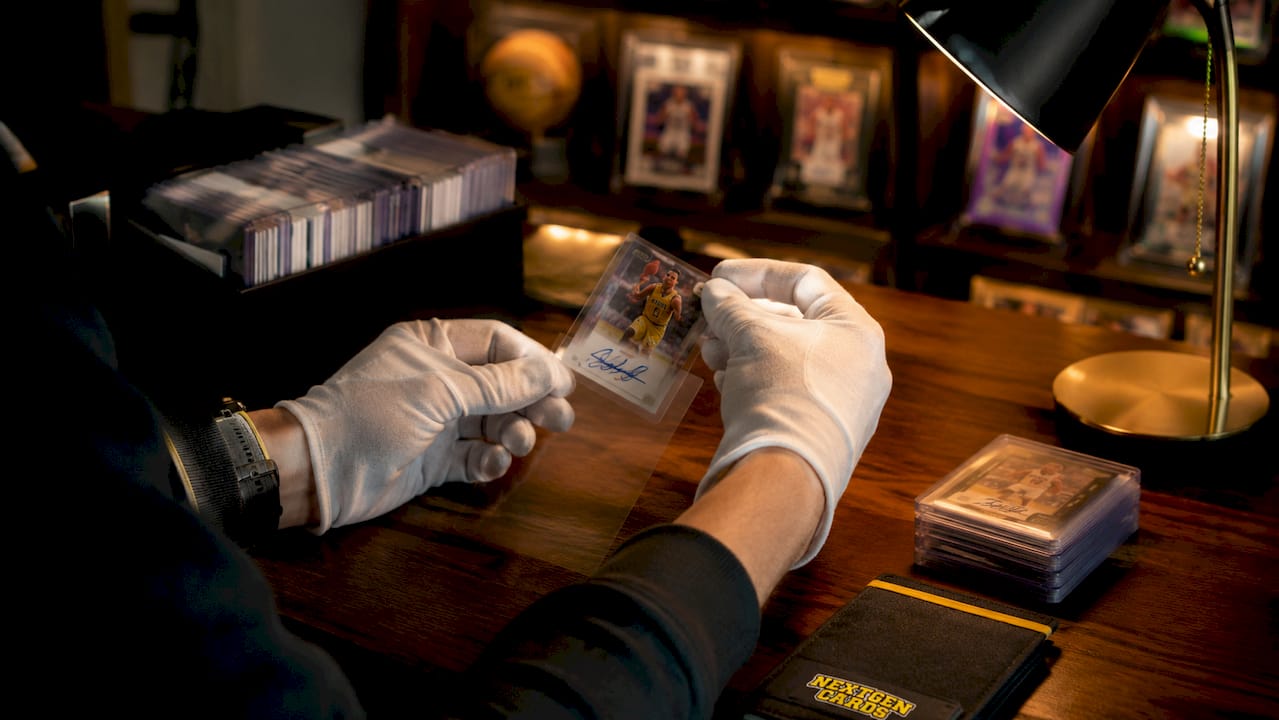
The oils and moisture on bare hands are among the most frequent causes of autograph degradation. Washing and thoroughly drying hands before any handling reduces oil transfer significantly; for high-value pieces, clean white cotton gloves add an extra layer of protection.
Handling dos and don’ts:
- Always hold cards by the edges — never touch the autograph surface directly.
- Wash and fully dry hands before handling; lotions and residual moisture both cause damage.
- Allow fresh in-person signatures at least 24 hours to cure before inserting into any sleeve.
- If a card gets wet, lay it flat on a clean, non-abrasive surface and let it air-dry completely before sleeving.
- Never use solvents, adhesive tape, or chemical cleaners on a card surface.
- Dust only with a soft, dry brush; for serious moisture or mold damage, consult a professional conservator rather than attempting home remediation.
Pro Tip: Never remove a card from its toploader over carpet or a cluttered surface. Work over a clean, flat table so that if the card slips, it lands safely rather than picking up debris or bending on impact.
How to pack and ship autographed cards without risking damage
Shipping is one of the highest-risk moments for any signed card. A proper packing sequence and declared insurance value are non-negotiable for high-value autographs.
Step-by-step packing sequence:
- Penny sleeve the card (autograph side inward).
- Insert into a perfect-fit sleeve, then into an acid-free toploader.
- Tape the toploader opening with painter’s tape to prevent the card from sliding out.
- Sandwich the toploader between two pieces of rigid cardboard cut slightly larger than the holder.
- Wrap the cardboard sandwich in bubble wrap, then place inside a rigid mailer or small box.
- Ship via a tracked, signature-required service and declare the card’s full market value for insurance purposes.
For graded slabs, wrap the slab in bubble wrap first, then box it with padding on all six sides. Graded cards are heavier and more rigid, so the box must prevent any movement during transit. For additional guidance on safe transport, Nextgencards’s gifting and shipping guide covers carrier options and packaging in detail.
Common mistakes that damage autographed cards and early warning signs
Most autograph damage is preventable. The mistakes below account for the majority of condition losses collectors report.
Common beginner mistakes:
- Handling with bare, unwashed hands — oils transfer immediately and accumulate over time.
- Sleeving a fresh autograph before the ink has cured, causing smear or transfer.
- Stacking cards flat under weight, creating pressure impressions.
- Storing in basements, attics, or garages where humidity and temperature fluctuate widely.
- Using non-archival, PVC-containing plastics that off-gas chemicals onto card stock.
- Skipping periodic inspections and missing early-stage damage before it spreads.
Red flags to watch for during inspections:
- Faint fading or color shift in the autograph ink.
- Ink bleed or feathering at the edges of the signature.
- Visible mold spots (small dark or white specks on the card surface).
- Warping or bowing of the card stock.
- Sticky or tacky surfaces, which indicate chemical off-gassing from non-archival materials.
- Pressure impressions where a card was stacked under weight.
Photograph each card at acquisition and again at every inspection. These condition records support insurance claims and establish provenance for future resale.
Your supply checklist: what to buy now and what to upgrade later
Getting the right supplies in the right order prevents the most common damage without overspending upfront.
Buy immediately:
- Penny sleeves (polyethylene, acid-free): roughly $5–$10 per 100-count pack.
- Acid-free toploaders (standard 3" x 4" for most cards): roughly $10–$20 per 25-count pack.
- Silica gel desiccant packets: roughly $8–$15 for a multi-pack.
- Acid-free compartmentalized storage box: roughly $15–$30.
Upgrade when ready:
- Perfect-fit sleeves for tighter card-to-holder fit.
- Magnetic cases with UV protection for display-worthy pieces: roughly $2–$8 per case.
- Digital hygrometer/thermometer for ongoing climate monitoring.
- Card Savers for grading submissions.
Nextgencards carries curated collector supplies alongside its autograph inventory, making it a practical single source for both archival storage supplies and investment-grade signed cards.
Pro Tip: Buy supplies before you need them. Waiting until after a card arrives means it sits unprotected while you wait for shipping — a risk not worth taking on a scarce rookie autograph.
Key Takeaways
Protecting autographed cards from damage requires the right materials, stable environmental conditions, and consistent handling habits applied every time a card changes hands or storage location.
| Point | Details |
|---|---|
| Sleeve and holder sequence | Penny sleeve (autograph side in) first, then acid-free toploader — always in that order. |
| Climate control | Store at 65–72°F and 35–50% relative humidity; avoid attics, basements, and garages. |
| Light and UV protection | Keep cards in the dark or behind UV-rated glazing; light fading is permanent and irreversible. |
| Grading for investment cards | Professional encapsulation authenticates, protects, and stabilizes resale value for high-value autographs. |
| Nextgencards as a resource | Nextgencards offers curated rookie autographs and collector supplies, with storage guidance for serious collectors. |
Why preservation is the foundation of every serious collection
Every autographed card in a collection represents a moment — a player’s signature at a specific point in their career, on a specific card, in a specific condition. That condition is not fixed. It degrades without deliberate care, and the degradation is almost always irreversible. The collector who treats preservation as an afterthought is, in practice, choosing to let value erode.
What most guides understate is the compounding nature of environmental neglect. A card stored at 60% humidity for two years does not look slightly worse — it can look dramatically worse, with ink bleed and warping that no grading service will overlook. The cost of a hygrometer and a box of silica gel packets is trivial against that outcome.
Nextgencards’s collector guides and curated inventory reflect a straightforward belief: a rare autograph is only as valuable as the condition it’s kept in. Sourcing a scarce rookie autograph is the exciting part. Keeping it pristine is what makes it worth something years from now.
Nextgencards has the autographs and supplies worth protecting
Rare rookie autographs from athletes like Shohei Ohtani and Aaron Judge deserve the best protection from day one. Nextgencards curates investment-grade signed cards — rookie autographs, patch cards, relic cards, and limited-edition memorabilia — alongside the collector supplies needed to preserve them properly.
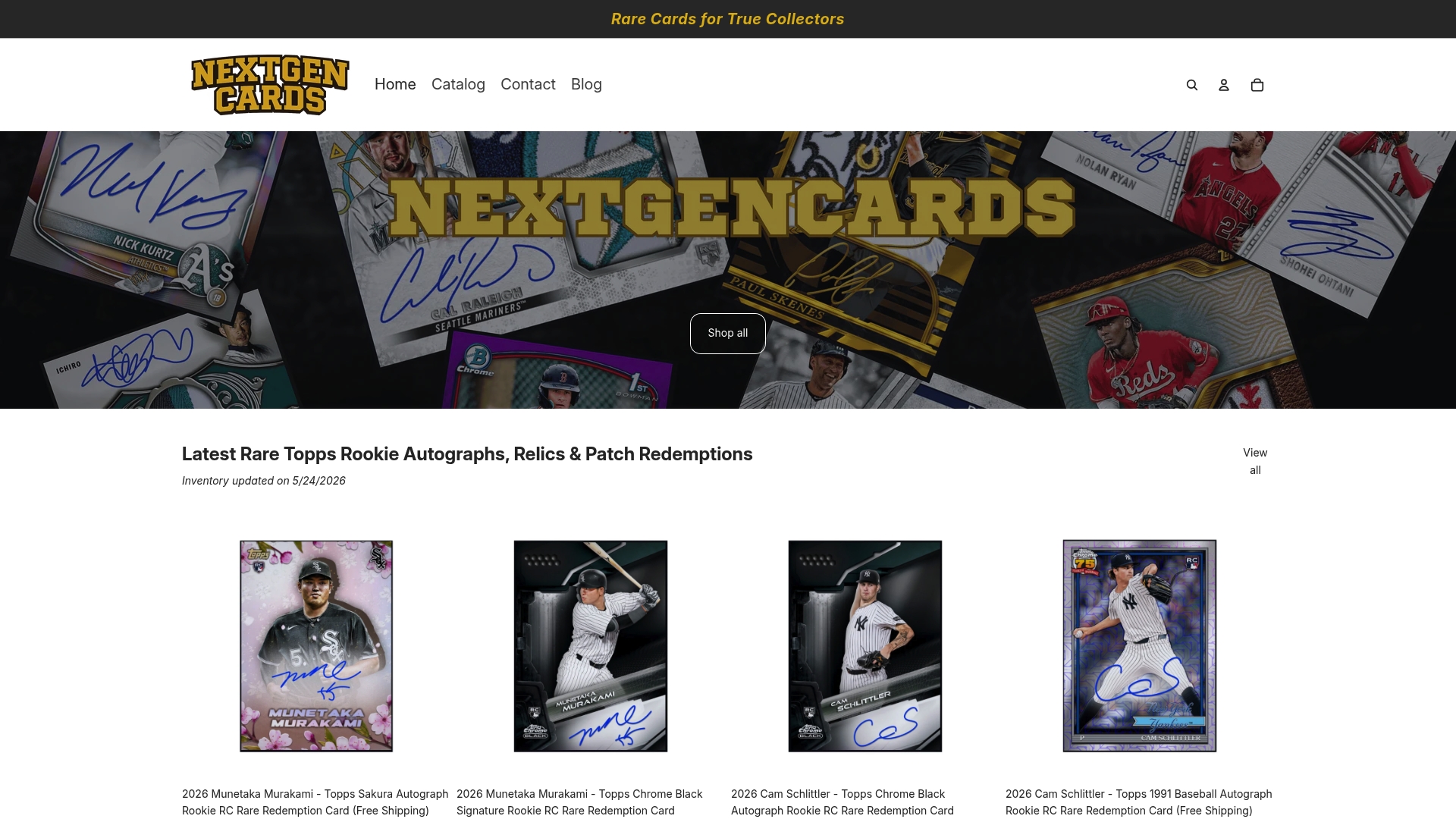
Browse the rookie autographs and relic collection to find scarce, authenticated signed cards worth adding to your portfolio. Free shipping is available on select items, and every card ships ready for immediate protective storage. Whether you’re building a long-term investment collection or adding a standout piece to an existing set, Nextgencards is the place to start.
Useful sources for deeper reading
These sources back the preservation guidance in this article and are worth bookmarking for ongoing reference.
- Preservation tips for autographed memorabilia — Minico: Covers environmental specs (temperature, humidity, light) and handling best practices. Best for collectors setting up a storage environment from scratch.
- How to protect autographed sports cards — DeckSentry: Detailed guide on sleeve and holder selection, insertion order, and physical protection. Best for material choices and beginner supply decisions.
- How to prepare items for autograph signings — Swau: Covers the 24-hour curing rule and in-person signing preparation. Best for collectors who attend signings or player appearances.
- PSA/BGS/Beckett grading guide — Public.com: Explains grading services, submission processes, and how encapsulation affects market value. Best for investors considering professional grading.
- Protecting autographed memorabilia — Signet Collectibles: Focuses on inspection cadence, condition records, and provenance documentation. Best for collectors managing larger inventories.
- How to store trading cards — Cardshellz: Practical guidance on upright storage, sleeve orientation, and holder organization. Best for long-term storage setup.
0 comments