

One point equals 0.001 inches, and that number is the only measurement that matters when you’re sizing a holder for a patch card. Measure the card’s edge with a digital caliper or a printed point gauge, convert the reading to points, and pick the toploader or magnetic holder that matches, or the next size up. If your card sits between two standard sizes, always size up. Forcing a thick relic card into an undersized holder is one of the fastest ways to crease a patch or scuff a hard-earned edge.
TL;DR:
- Measuring a patch card’s thickness accurately requires a digital caliper, taking three edge readings, and averaging the results for reliable sizing.
- Most patch autographs fall between 75 and 130 points, with jumbo patches and multi-swatch cards exceeding 180 points, requiring larger holders.
- For between-size measurements, always round up to the next standard holder size to prevent pressure damage, edge whitening, and surface scratches.
- Thickness can vary due to embedded memorabilia, finishes, and lamination, so never rely solely on set ratings; always measure the finished card.
- Store thick cards in wider storage options and verify grading service surcharges before submission to avoid damage or extra fees.
Table of Contents
- What Patch Card Thickness Actually Means
- How Thick Are Patch Cards, Really?
- How Do You Measure Patch Card Thickness Correctly?
- Which Toploader Size Fits Your Measured Points?
- Storing and Grading Thick Patch Cards
- How Do Thickness Standards Compare Across the Hobby?
- Why Does Card Material Affect Thickness So Much?
- Can Humidity or Temperature Change a Card’s Measured Thickness?
- What Thickness Variance Should You Expect as Normal?
- Why Some Specialty Shops Are Built for Serious Relic Collectors
- Protect What You Collect, Starting With the Right Cards
- Sources
- FAQ
What Patch Card Thickness Actually Means
A “point” is a unit of thickness, not weight, and that distinction matters more than most new collectors realize. One point equals 0.001 inches, so a card measuring 0.075 inches at the edge is a 75pt card. Multiply the caliper reading in inches by 1,000 and you have your point count.
This is different from GSM (grams per square meter), which measures paper density and shows up on printing spec sheets more than hobby boxes. Two cards can share a similar GSM and still slide into different-sized holders, because GSM describes weight per area while points describe the physical caliper thickness a toploader has to accommodate. When you’re deciding on a holder, points are the number that predicts fit. GSM is not.
A few things push a card’s effective thickness past its base stock rating:
- Gloss or matte lamination layers, which add a thin but measurable coating on both faces.
- Foil stamping or chrome finishes, common on rookie and prospect parallels.
- Embedded memorabilia swatches, including jersey, bat, or ball fragments sewn or laminated into the card.
- Autograph ink and sticker layers, which are minor individually but add up on multi-signature cards.
None of these show up if you just eyeball the card stock. That’s why measuring the finished card, not assuming based on the base cardboard, is the only reliable approach.
How Thick Are Patch Cards, Really?
Most patch cards cluster into a handful of recognizable bands, and knowing them helps you estimate before you ever pull out a caliper. Standard base cards run around 20 to 35 points. Thin single-swatch relics tend to land near 55 points. The bulk of rookie patch autographs, the RPAs collectors chase hardest, fall in the 75 to 130 point range, with 75pt being common for a single clean patch window and 100 to 130pt showing up on jumbo or multi-piece designs. Booklet cards, the fold-out designs used for oversized or multi-swatch relics, are notably thicker than standard cards.
Here’s the range breakdown collectors reference most often:
- ~35pt — standard base rookies and veterans, no memorabilia.
- ~55pt — thin single relics, early-2000s style swatches.
- ~75pt — the most common patch autograph thickness across modern sets.
- 100 to 130pt — jumbo patches, dual swatches, or thick foil stock.
- 180pt+ — booklet cards and multi-panel relic designs.
Why does thickness vary within the same product line? Multi-piece patches (two or three fabric swatches stacked or laid side by side) add bulk unevenly across the card face. Embedded hardware, like a small button, bat knob slice, or metal lace tag, can push one corner or edge thicker than the rest. A PreGradeCards breakdown of thickness categories notes cards ranging as high as 360pt for extreme multi-material designs.
Treat these ranges as a starting point for your shopping list, not a substitute for measuring. A card that “should” be 75pt based on the set can easily run 90 or 100 once you put calipers to it.
How Do You Measure Patch Card Thickness Correctly?
You need the right tool before you need the right technique. A standard ruler cannot resolve thousandths of an inch, so it’s useless here. Your options are:
- Digital calipers — the most accurate and repeatable tool, usually accurate to 0.0005 inches or better.
- A printable point gauge, printed at exactly 100% scale with no “fit to page” scaling, which lets you slot a card into pre-marked slots for a quick estimate.
- A micrometer, which works but is often overkill for a hobby application calipers already handle well.
Follow this sequence for a reading you can trust:
- Remove the card from any sleeve or one-touch holder. Measuring through plastic adds thickness you’ll misread as the card’s own.
- Measure the card edge, not across the patch. Set the caliper jaws on the plain cardboard border, away from any raised memorabilia window, since that area often sits proud of the surrounding stock.
- Take readings at three separate points along different edges of the card.
- Average the three readings, then convert to points by multiplying the inch measurement by 1,000.
- If the card has embedded rigid material (a bat knob, a metal tag), take a reading near that spot too, and favor the thicker figure when choosing a holder.
If you absolutely must estimate while a card is still sleeved, a printable gauge can get you in the right neighborhood, but treat that number as provisional. SetScribe’s measurement guide recommends verifying against a caliper whenever precision matters, which it always does for a five or six figure relic.
Pro Tip: Handle high-value patch autographs with clean nitrile gloves during measurement, and keep a known 75pt card on hand as a calibration check before you trust an unfamiliar caliper or a freshly printed gauge.
Which Toploader Size Fits Your Measured Points?
Once you have a point number, matching it to a holder is mostly arithmetic, with one important exception: always round up when you’re between sizes.
- 20 to 35pt → standard 35pt toploader, the default for base rookies and veterans.
- 55pt → 55pt “thick” toploader, sized for early relic and jersey-swatch cards.
- 75pt → a 75pt holder, or a 100pt if the reading runs close to the upper edge of that range.
- 100 to 130pt → 100pt or 130pt holders, depending on exact measurement.
- 180pt and above → magnetic one-touch holders or custom-fit cases, since standard toploaders don’t reliably accommodate booklet-style cards.
The rule collectors rely on most is simple: when a card sits between two sizes, choose the larger holder. A 75pt card slides cleanly into a 100pt sleeve with room to spare. The reverse, forcing a 90pt card into a 75pt slot, puts constant pressure on the card’s edges every time it’s handled.
That pressure is not a minor cosmetic issue. Forcing a thicker card into an undersized holder is a recurring cause of edge whitening, corner dings, and surface scratches on exactly the memorabilia cards collectors most want to protect. For insertion, slide the card into a penny sleeve first, then angle it into the toploader corner-first rather than pushing it straight in. If it doesn’t glide, stop. Go up a size instead of forcing it.
Storing and Grading Thick Patch Cards
Thickness changes more than which holder you buy. It changes how you store and submit cards too.
- Storage boxes: standard card boxes are built around 35pt toploaders. A run of 100pt and 130pt holders eats up significantly more linear space, so widen your box or shift to team bags and shorter row counts.
- Magnetic holders and booklets: these need dedicated slots or padded storage boxes rather than tight rows, since forcing them alongside standard-thickness cards risks pressure damage.
- Grading fees: thicker cards frequently carry surcharges at grading services, and some services will return a submission if it arrives improperly sleeved for its thickness tier. Measure and document the point count before you submit, not after a rejection notice.
- Insurance: high-value patch autographs, especially anything triple-signed or featuring rare rookie swatches, deserve a rider on a collectibles policy rather than assuming standard homeowner coverage applies.
Check the current fee schedule with your grading service of choice before submitting a card near a thickness threshold. Policies and surcharge tiers change, and the cost of a wrong guess is far higher than the cost of a five-minute caliper check.
How Do Thickness Standards Compare Across the Hobby?
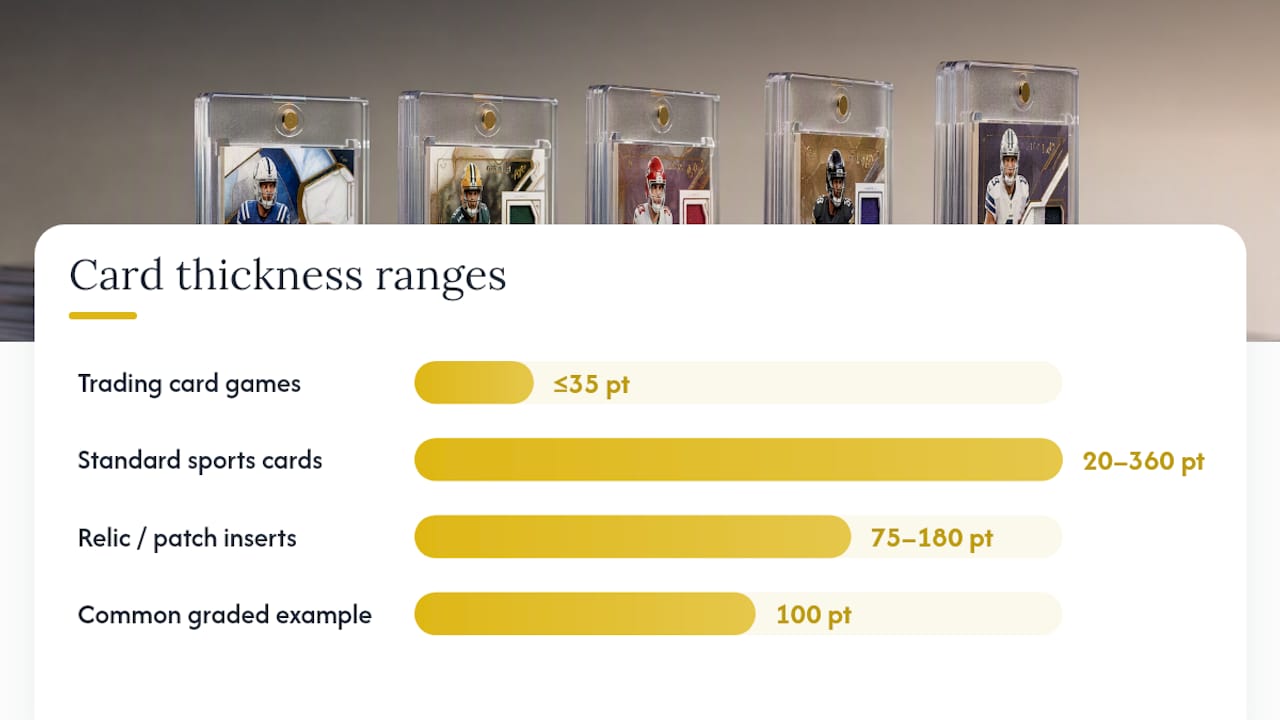
Sports card thickness conventions are more consistent than you might expect across different collecting communities, mostly because manufacturers and supply companies settled on the same point-based sizing decades ago. Baseball, basketball, and football card products from major manufacturers all use the same 20 to 360pt scale, and toploader sizing follows suit regardless of sport.
Where things diverge is card-game collecting outside sports, like trading card games built around thinner, more uniform stock. Those products rarely produce anything above 35pt, since they don’t typically embed memorabilia swatches or foil booklets into a card. Sports card collecting is unusual precisely because relic and patch inserts routinely push cards into the 75 to 180pt range that other collecting hobbies almost never touch.
Grading services also apply thickness tiers fairly uniformly across sports, since PSA and BGS process baseball, basketball, and football submissions through the same intake pipeline and the same surcharge structure for oversized cards. That consistency is useful. It means a 100pt basketball jersey patch and a 100pt baseball relic card face the same grading logistics and the same holder math, which simplifies life for anyone who collects across multiple sports.
Vintage-focused communities sometimes use looser, less standardized language, describing cards as “thick” or “extra thick” without a hard point figure. If you’re active in those circles, converting anecdotal descriptions to an actual caliper reading before buying a holder saves you a guessing game.
Why Does Card Material Affect Thickness So Much?
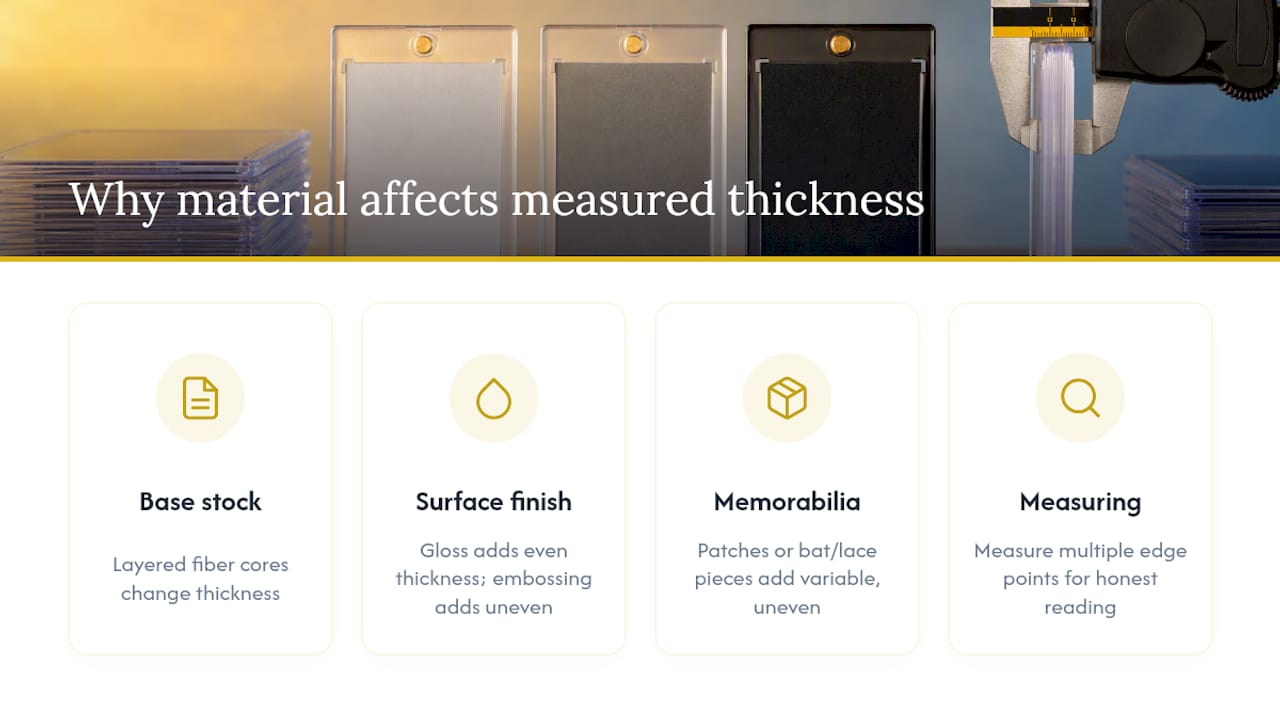
Two cards with the same point rating on the box can still measure differently once you put a caliper on them, and the reason comes down to what’s actually inside the stock. Card manufacturers layer different fiber densities, black-core versus standard paper stock, into the base cardboard, and that core material affects both rigidity and thickness even before any finish is applied.
Lamination adds another variable. A glossy UV coating on both faces adds thickness that’s consistent and predictable. A textured or embossed finish, increasingly common on premium autograph parallels, adds thickness unevenly across the card face, which is part of why measuring at multiple edge points produces a more honest reading than a single spot check.
Memorabilia swatches complicate things further. A single thin jersey fragment laminated flush with the card surface might add only a handful of points. A game-used bat barrel slice, a lace tag, or a multi-layer patch stacked from two or three fabric pieces can add dramatically more, and unevenly, so one edge of the card measures differently than another. This is the practical reason two cards from the same insert set, same year, same manufacturer, can require different holder sizes. The printed checklist tells you what’s supposed to be inside the card. Only a caliper tells you what’s actually there.
Can Humidity or Temperature Change a Card’s Measured Thickness?
Card stock is a fiber-based material, and fiber absorbs moisture from the surrounding air. In practical terms, that means a card measured in a humid basement can read very slightly thicker than the same card measured in a dry, climate-controlled room, because the paper fibers swell marginally as they take on moisture.
For most point-range decisions, this fluctuation is too small to change which holder size you need. A 75pt card isn’t going to swing into 100pt territory because of humidity. Where it matters more is at the edges of a size range, when your reading sits right on the boundary between two holder sizes. If a card measures 74 or 76 points depending on the day, environmental swing might be part of the explanation, and it’s one more reason the “round up when in doubt” rule exists.
Temperature has a smaller, more indirect effect, mostly through its influence on humidity levels rather than any direct expansion of the cardboard itself. Extreme heat can also soften lamination adhesives over time, which is a preservation concern separate from the thickness reading itself.
The practical takeaway: measure in a stable, room-temperature environment when precision matters, and don’t treat a single caliper reading taken in unusual conditions as gospel if the card is borderline between two holder sizes. Take your three-point average, note the conditions, and re-check on a different day if the number sits right on a size boundary.
What Thickness Variance Should You Expect as Normal?
Manufacturing tolerances mean no two cards from the same print run are identical down to the thousandth of an inch, and that’s expected rather than a defect. A batch of cards printed as “75pt” on packaging or checklists will typically show a spread of several points across individual cards, depending on where the cardboard core came from and how consistently the lamination was applied.
This is exactly why the industry convention of rounding up to the next holder size at a boundary exists. A tolerance band of a few points around a nominal rating is normal. A holder sized with zero margin for that variance is a holder that will fight you on roughly half your cards even when the packaging says they’re all the same thickness.
Manufacturer specifications sometimes state a hard ceiling rather than a nominal thickness. Ultra PRO’s PATCHCRAFT card pocket, for example, is rated to hold single-sleeved cards up to 35pt, which tells you the maximum the product is designed for rather than a guess at what a “typical” card in that category measures. When a product lists a stated maximum like that, treat it as a hard ceiling, not a target, and size up if your card runs anywhere close to it.
The practical rule holds across all of this: measure your actual card, not the printed rating on the pack, and give yourself a few points of headroom when a reading lands near a size boundary.
Why Some Specialty Shops Are Built for Serious Relic Collectors
Some shops focus specifically on rare rookie autographs, patch cards, and redemption cards, the exact category where thickness variance runs highest and the stakes for a wrong holder are steepest. Before buying your next holder, check the card sleeve size chart and printable gauge, and review the discreet packaging guide for shipping high-value patches safely.
Protect What You Collect, Starting With the Right Cards
This shop gives you a direct path to rare rookie patch autographs and redemption cards sourced for collectors who care about condition as much as the pull itself.

Browse rare patch and autograph inventory like the 2026 Jalen Brunson All Star Game Jersey Patch Autograph, the 2024 Elly De La Cruz Sterling Rookie Patch Autograph RPA, and the 2024 Skenes, Cole, Strasburg Triple Autograph redemption card, each the kind of relic card where guessing at holder size is not an option.
Pro Tip: Order a small stock of 75pt, 100pt, and 130pt toploaders along with thick penny sleeves before your next redemption card arrives, so you’re never stuck improvising storage for a card that needs to be protected the moment it hits your mailbox.
Ready to add a rare patch autograph to your collection? Browse the full rookie autograph and relic catalog and check current free-shipping offers before you check out.
Sources
- Grading thick cards: Jersey patch & relic card guide — PreGradeCards
- Business card thickness chart: your guide to paper weights — 4OVER4
- Sports Card Thickness Guide: Mystery Solved & Free Point Gauge — SetScribe
- Toploader size guide — The Penny Sleeever
FAQ
What Is the Recommended Thickness for Patch Cards?
Most patch autograph cards measure between 75 and 130 points, with 75pt being the most common single-swatch thickness and 100 to 130pt typical for jumbo or multi-piece patches. Always measure your specific card rather than assuming based on the set.
What Point Thickness Are Patch Cards Usually?
Patch cards commonly run 55 to 130 points, with thin early-2000s style relics near 55pt and modern jumbo or booklet-style patches exceeding 180pt. A digital caliper reading is the only way to know your exact card’s number.
What Is the Difference Between a 35pt and a 130pt Card?
A 35pt card is a standard base card with no embedded memorabilia. A 130pt card is typically a jumbo or multi-swatch patch card, and requires a specialized thick toploader or magnetic holder rather than a standard sleeve.
What Is the Standard Thickness of a Trading Card?
Standard base trading cards, the kind with no memorabilia or foil treatment, typically measure around 20 to 35 points, which is why 35pt toploaders are the default size stocked by most supply retailers.
How Do I Know Which Holder Size to Buy for a New Patch Card?
Measure the card’s edge with a digital caliper, average three readings, and convert to points by multiplying inches by 1,000. If the result falls between two standard holder sizes, choose the larger holder to avoid edge stress and surface damage.
0 comments