

Premium rigid toploaders protect display and long-term-hold cards of higher value. Semi-rigid holders belong in front of any card headed to PSA or CGC. Economy bulk toploaders handle commons and rip-and-ship volume without wasting money. Get the PT size right and the insertion technique gentle, and any of these three categories will do its job.
TL;DR:
- Most standard cards fit comfortably in 35pt top loaders, but thicker relics and patches may require up to 180pt, making size testing essential.
- Semi-rigid holders are preferred for grading submissions because they flex slightly, reducing the risk of corner damage during extraction.
- A quality top loader should have smooth edges, clear plastic, and accept a sleeved card with a gentle drop-in fit, not force.
- Bulk packs offer lower prices per unit but may vary in quality; testing a small pack first helps prevent large losses from batch defects.
- Counterfeit or low-quality toploaders often have warped plastic, inconsistent printing, cloudy appearance, or rough seams, indicating inferior manufacturing.
Table of Contents
- Best Top Loaders by Use Case: Display, Grading, Shipping, and Bulk
- What PT Size Do You Need for Your Cards?
- How Do You Spot a Good Toploader Before You Buy It?
- Will PSA Accept Toploaders for Grading Submissions?
- How Do You Insert Cards Without Damaging Them?
- What Do Toploaders Cost, and When Should You Buy in Bulk?
- How Can You Tell a Toploader Is Counterfeit or Low Quality?
- Which Toploader Brands Do Collectors Trust Most?
- Do Toploader Materials Affect Long-Term Card Protection?
- Publisher Perspective: How Nextgencards Approaches Card Protection
- Protect What You Collect: Curated Cards, Packaged Right
- Sources
- FAQ
Best Top Loaders by Use Case: Display, Grading, Shipping, and Bulk
Choosing among the best top loaders comes down to matching the holder’s rigidity and finish to what you’re actually doing with the card. A $5 base rookie and a $2,000 patch autograph have almost nothing in common in terms of protection needs, and treating them the same way wastes either money or protection.
Premium rigid toploaders are the thickest, clearest option on the market, built for cards you’re going to frame, display in a case, or hold for years. They typically carry archival or acid-free claims and resist yellowing better than bargain-bin alternatives. The tradeoff is cost per unit and stiffness, which makes them a poor fit for anything you plan to grade, since they don’t flex during extraction.
Semi-rigid holders, often called Card Saver style, are the default for anything heading into a PSA or CGC submission. They bend slightly, which lets graders slide the card out without prying at the corners. They offer less rigidity for shipping alone, so collectors typically pair them with a rigid toploader or top mailer for transit.
Economy bulk toploaders are the workhorse for commons, base rookies, and high-volume rip-and-ship sellers. Clarity and edge finish vary more between batches, but for a card worth a few dollars, that tradeoff rarely matters.
Specialty jumbo toploaders exist for ultra-thick relics, patch cards, and multi-piece memorabilia cards that won’t fit a standard PT. These run wider PT ranges, and community-tested roundups note that not every retailer stocks the higher end of that range consistently.
Here’s how the categories stack up when you’re deciding where to spend:
- Premium rigid: best clarity and archival claims, higher price per unit, wrong choice for grading submissions
- Semi-rigid: required or strongly preferred for grading intake, moderate cost, less protective alone for shipping
- Economy bulk: lowest cost per card, wider quality variance, ideal for commons and high-volume sellers
- Specialty jumbo: only real option for thick relics and patches, higher price, limited availability at the top PT sizes
Pro Tip: Keep a small stock of both semi-rigid and premium rigid on hand. A card that grades well often gets re-sleeved into a premium holder for display or resale, so you’ll need both anyway.
As a rule of thumb, reserve premium rigid for anything you’d be upset to lose, use semi-rigid for grading regardless of value, and let economy toploaders handle the rest of the box.
What PT Size Do You Need for Your Cards?
PT stands for “point thickness,” and one point equals 0.001 inches, according to Ultra Pro’s own sizing guidance. A 35pt toploader, the standard for most base cardboard, measures a small fraction of an inch of internal clearance. That single unit is the entire vocabulary you need to shop for the right fit.
Most standard trading cards, including base rookies and vintage singles, fit comfortably in a 35pt holder, which is why The PennySleeve’s size guide lists it as the default starting point. Chrome, Prizm, and other thicker card stocks often need slightly more room, sometimes 55pt, since the coating adds bulk. Relics, jersey patches, and thick autograph cards typically require 75pt to 130pt, and multi-relic or booklet-style cards can push past 180pt into specialty territory.
To measure what you actually need, slide the card into a penny sleeve first, then test the drop-in fit in a toploader. Ultra Pro recommends this exact sequence because a bare card can pick up surface scuffs from friction against the plastic during a test fit. If the card slides in with a gentle tap and doesn’t rattle, you’ve got the right size. If you have to push or the corners buckle, size up.
| Card type | Typical PT range |
|---|---|
| Standard base card | 35pt |
| Chrome/Prizm/refractor | 35pt to 55pt |
| Relic or jersey card | 75pt to 130pt |
| Thick patch/multi-relic | 130pt to 180pt |
| Ultra-thick booklet/memorabilia | 180pt+ |
A few sizing habits worth building:
- Always sleeve before you test-fit, never bare card against plastic
- When a card sits between two PT sizes, size up rather than forcing a tight fit
- Recheck PT after adding a penny sleeve, since the sleeve itself adds a small amount of thickness
How Do You Spot a Good Toploader Before You Buy It?
A quality toploader passes a short physical inspection before it ever touches your card. Run a finger along the inner edges and feel for burrs. Community reports gathered by PullRate point to rough inner edges as one of the most common complaints tied to inconsistent production runs, and a burr you can feel is a burr that can scratch a surface on insertion.
Hold the toploader up to light and check for cloudiness or a hazy finish. Clear, distortion-free plastic matters more than it seems for anything you plan to photograph, display, or eventually resell, since cloudy plastic makes even a gem-mint card look duller than it is.
- Check the edges. Feel every inner edge for burrs or rough seams before you load a card.
- Check the clarity. Hold it to a light source and look for haze, cloudiness, or visible mold lines.
- Check the fit tolerance. A quality holder should accept a sleeved card with a light drop, not a shove.
- Check the labeling. Look for acid-free or archival claims, but treat marketing language as a starting point, not proof.
- Check the seam finish. A rough or uneven top seam can snag a sleeve or scratch a card edge during removal.
On labeling specifically, “archival” and “acid-free” are real material properties worth seeking out, but they’re also unregulated marketing terms with no third-party certification body verifying them on most toploader packaging. Treat them as a mild positive signal, not a guarantee.
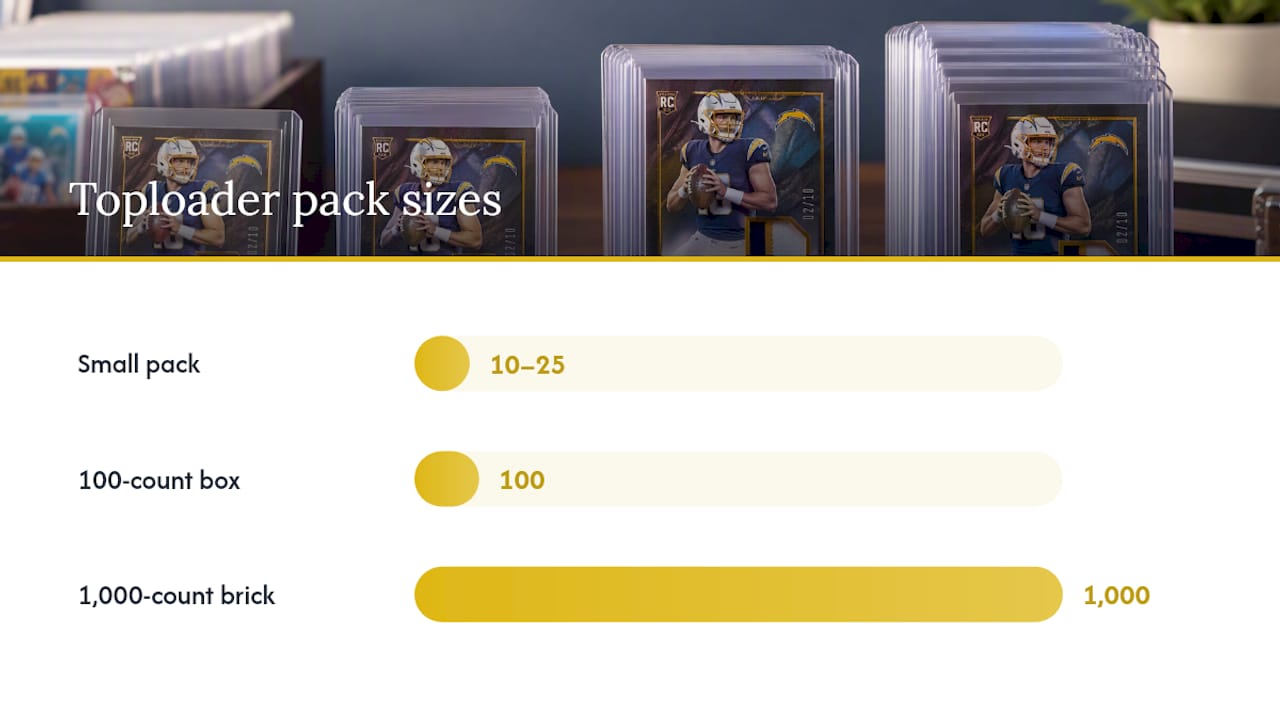
Pack size changes your economics more than most collectors expect. Small packs (10 to 25 count) cost more per unit but let you test a new brand before committing. A 100-count box is the sweet spot for most active collectors. A 1,000-count brick drops the per-unit price further but locks you into one supplier’s quality for a long stretch, so it pays to test a small pack of the same product line first.
Pro Tip: Buy one small pack of any new toploader brand or PT size before ordering a brick. A batch quality issue on 25 units is an annoyance. The same issue on 1,000 units is a real loss.
Will PSA Accept Toploaders for Grading Submissions?
Yes, PSA generally accepts hard toploaders at intake, but semi-rigid holders are the preferred format, and using one can smooth your submission. The preference isn’t about grading policy rejecting rigid plastic outright. It’s about handling time and extraction risk on the grading floor.
Semi-rigid holders flex slightly, which lets a grader slide a card out without prying at the corners the way they sometimes have to with a stiff, tightly fitted rigid toploader. Fewer touches and less prying means less risk of a fresh corner ding on a card that was otherwise gem-mint going in.
If you’re transporting a card in a rigid toploader on its way to submission, a few habits reduce extra handling:
- Use a semi-rigid holder as the final layer before boxing, even if a rigid toploader protected the card up to that point
- Avoid taping directly across a toploader seam, since removal can stress the card inside
- Pack submissions snugly enough that holders can’t shift and rub against each other in transit
For collectors sending in valuable submissions regularly, grading-prep guidance from Pressing Issues covers additional steps worth reviewing before you box anything up.
How Do You Insert Cards Without Damaging Them?
The insertion sequence matters more than the toploader brand you choose. Sleeve first, always. A bare card sliding against toploader plastic is how surface scuffs happen, even with a high-quality holder.
- Sleeve the card in a penny sleeve or similar soft sleeve before anything else.
- Line up the corners with the toploader’s opening, holding the card level rather than at an angle.
- Drop it in gently, letting gravity and a light tap do the work instead of pushing or forcing the card down.
Never force a card that feels tight. A card that won’t drop in cleanly needs a larger PT, not more pressure. Fit research from The PennySleeve notes that a tight fit risks scratching on insertion while a loose fit risks corner damage in transit, so the right size threads that needle in both directions.
Before shipping, check the inner edges one more time for burrs, then secure the loader inside a bubble mailer or rigid mailer with painter’s tape across the outside seam, never across the toploader itself. Pack filler around the card to stop it from sliding, and orient it so corners face away from mailer edges.
Pro Tip: Tape the outside of a bubble mailer in an X pattern across the toploader’s flat face, not its edges. It keeps the card centered without putting pressure directly on the seam.
What Do Toploaders Cost, and When Should You Buy in Bulk?
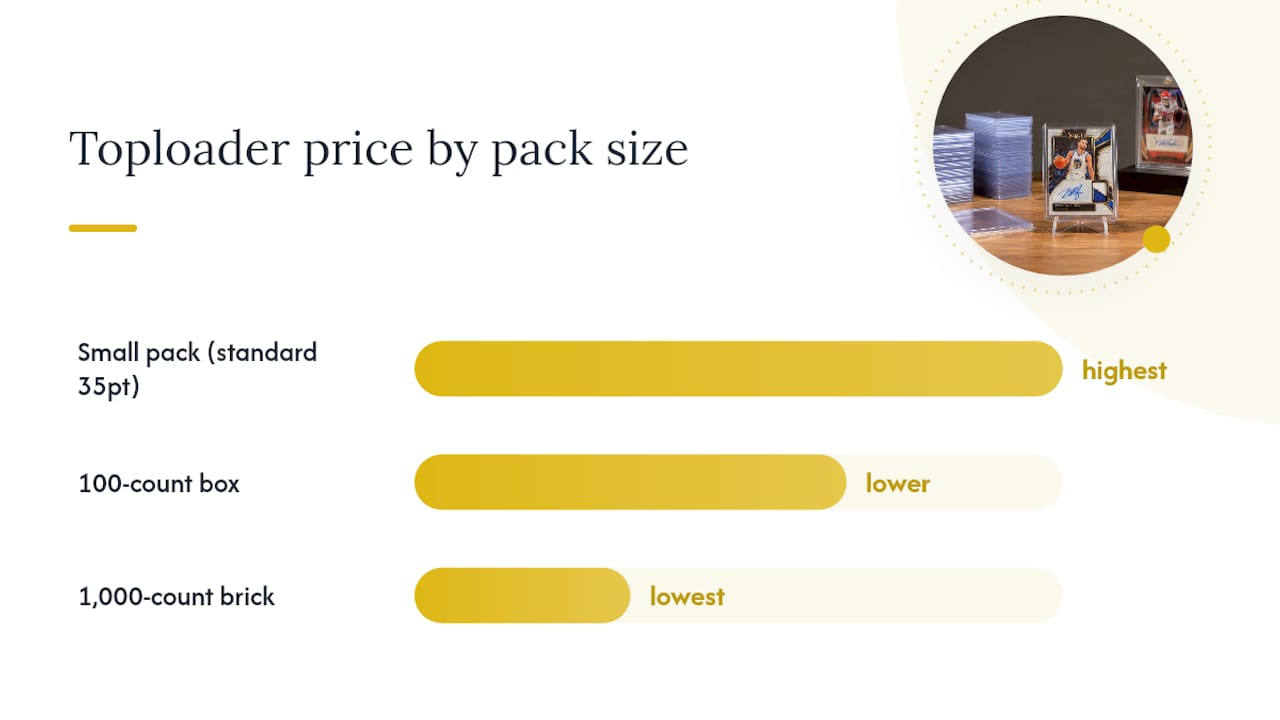
Price per unit drops fast as pack size grows, and PT size pushes the price back up at every tier. A small pack of standard 35pt holders costs the most per card. A 100-count box brings the per-unit price down meaningfully, and a 1,000-count brick offers the lowest cost per toploader of any format, provided the batch quality holds up across the whole case.
PullRate’s pricing analysis frames toploader spend as a cost-containment decision tied directly to card value: a few extra cents per unit on a card worth hundreds of dollars is cheap insurance against a grading knock or a shipping scratch that could cost far more in resale value.
Before committing to a brick, a few habits pay off:
- Inspect a random sample from the middle of the case, not just the top layer
- Rotate older stock to the front so nothing sits pressed against the same card for years
- Check recent forum and community feedback for batch-specific complaints before ordering the same product line again
Balance your spend against three factors: the card’s actual value, how far it’s shipping, and how long you plan to store it. A common rookie shipping across town doesn’t need the same toploader as a graded autograph headed cross-country for auction.
How Can You Tell a Toploader Is Counterfeit or Low Quality?
Counterfeit and low-quality toploaders share a handful of physical tells that separate them from a reputable product even before you check the packaging. Warped or slightly bowed plastic straight out of the pack is one of the clearest signs, since a properly molded toploader sits flat.
Look closely at the printed branding, if there is any. Blurry logos, inconsistent font weights, or a product name that’s slightly misspelled all point to an off-brand knockoff riding on a recognizable name. Genuine products from established manufacturers keep tight, consistent printing across every unit in a case.
Cloudy or yellow-tinted plastic straight from a sealed pack is another red flag, since fresh archival-grade plastic should be clear. A slight tint that develops over years of UV exposure is normal aging. A tint present on day one usually means lower-grade plastic or resin that wasn’t meant for long-term card storage in the first place.
Seam quality tells you a lot too. A cheap or counterfeit toploader often has a rough, uneven top seam that catches on a sleeve or leaves plastic burrs. Run your thumb along it before you trust it with a card.
Price is the final tell. A listing priced dramatically below the market rate for a known brand’s name and packaging is worth treating with suspicion, especially on third-party marketplaces where counterfeit supply lines are more common than on manufacturer or established retailer storefronts.
Which Toploader Brands Do Collectors Trust Most?
Brand reputation in the toploader market comes down to consistency across batches more than any single standout feature, since the core product, a rigid plastic sleeve, doesn’t vary that much between quality manufacturers.
Forum monitoring cited by PullRate shows collector sentiment on platforms like Reddit and Blowout Forums shifting toward BCW for bulk purchasing and Cardboard Gold for high-value cards, largely on the strength of edge finish and PT size availability. Ultra Pro remains a widely stocked standard, with documented product specs for its 3-inch by 4-inch 35pt line that make it an easy baseline for standard-size cards.
None of these brands is immune to batch variation. Even reputable manufacturers occasionally ship a run with edge burrs or seam issues, which is exactly why the inspection habits covered earlier matter regardless of whose name is on the packaging. Community feedback moves faster than manufacturer updates, so checking recent threads before a bulk order is worth the five minutes it takes.
For collectors buying premium rigid holders specifically for display purposes, brand consistency in clarity matters more than for bulk economy purchases, since a cloudy holder undermines the entire point of a display-grade card.
Do Toploader Materials Affect Long-Term Card Protection?
Material claims on toploader packaging, acid-free, archival, UV-resistant, describe real properties that matter over years of storage, not just marketing language. Acid-free plastic resists the yellowing and brittleness that acidic materials can transfer to paper and cardstock over time, which matters most for cards you intend to hold for a decade or longer rather than flip within a season.
UV protection is a separate claim from acid-free, and the two don’t always come bundled together. Standard clear plastic offers minimal UV filtering on its own, so a card displayed under direct sunlight or strong showcase lighting for years can still fade even inside an “archival” holder if that holder makes no UV-specific claim. Collectors planning long-term display setups should treat UV resistance as its own checklist item, not an assumption that comes free with acid-free labeling.
None of these claims carry a standardized third-party certification the way archival paper products sometimes do in other collecting hobbies. That doesn’t make the claims false, but it does mean two “archival” toploaders from two different manufacturers can vary in actual longevity. For cards that matter most, pairing a quality toploader with basic environmental care, keeping storage boxes out of direct sunlight and away from humidity swings, does more for long-term condition than the toploader alone ever could.
Publisher Perspective: How Nextgencards Approaches Card Protection
Working with rare rookie autographs and patch relics every day changes how you think about a two-dollar piece of plastic. At Nextgencards, high-value inventory doesn’t move through casual packaging, because a scratched corner on a five-figure redemption card isn’t a minor cosmetic issue. It’s a direct hit to grade and resale value.
The category-first framing in this guide, matching toploader rigidity to card value rather than defaulting to whatever’s cheapest, reflects how serious sellers actually operate. Premium rigid holders and careful packaging aren’t upsells on a high-end card. They’re the baseline expectation once a card’s value crosses a threshold worth protecting.
Collectors who internalize that logic tend to make fewer regretful purchases, on toploaders and on the cards themselves.
— Richard
Protect What You Collect: Curated Cards, Packaged Right
Every rare card Nextgencards ships gets packaged the way this guide recommends: sleeved, sized correctly, and boxed to survive transit without shifting. That’s not a claim you have to take on faith when you’re the one opening the box.
The curated inventory at Nextgencards focuses on exactly the kind of cards that justify premium protection in the first place, rookie autographs, patch relics, and rare redemption cards from players like the current Skenes Cole Strasburg triple autograph redemption card or the Jalen Brunson jersey patch autograph card. Free shipping on select items means the packaging investment goes into protecting the card, not padding a shipping fee. Browse the rookie autographs and relics collection to see how a curated, protection-first inventory looks in practice, then check the listing for any card you’re eyeing to confirm shipping and packaging details before you buy.
Sources
- How do I know what thickness of toploader to buy? – Ultra Pro support
- Toploader size guide – The PennySleeve
- Best Toploaders for Sports Cards in 2026 (Tested Picks) | PullRate
FAQ
Who makes the best top loaders?
No single brand wins every category. BCW is a common pick for bulk economy purchases, Cardboard Gold gets frequent mentions for high-value cards, and Ultra Pro remains a widely stocked baseline standard, according to community sentiment tracked by PullRate.
Why doesn’t PSA like toploaders?
PSA doesn’t reject toploaders outright. Graders simply prefer semi-rigid holders at intake because they flex during extraction, reducing handling time and the risk of corner damage compared with prying a card out of a stiff, tightly fitted rigid holder.
Will PSA accept top loaders?
Yes, PSA generally accepts hard toploaders for submissions, but using a semi-rigid holder as the final layer before boxing can speed up intake and reduce extraction risk during grading.
Can top loaders damage cards?
A poor fit can. A tight fit risks scratching the card on insertion, while a loose fit lets the card shift and take corner damage in transit, which is why correct PT sizing and a gentle drop-in technique both matter.
What PT size do I need for a standard trading card?
Most standard base cards fit a 35pt toploader, while chrome, refractor, and relic cards often need 55pt to 130pt depending on thickness, per The PennySleeve’s size guide.
0 comments