

Most base sports cards generally require holders sized for thinner cards. Patches, jersey relics, and thicker inserts typically need thicker holders, while multi-patch autographs and booklet cards need significantly thicker cases. Never guess by eye. Measure with a printable point gauge or the stacking method described below, then buy the holder that actually fits your card, not the one that looks about right on the shelf.
TL;DR:
- Measuring card thickness with a printable gauge or stacking method ensures a snug fit, preventing potential damage from overly tight or loose holders.
- Most base and chrome cards fit into 35pt holders, but thicker parallels or relic cards often require 55pt to 100pt, with patch autographs needing up to 180pt.
- Choosing the wrong size, especially forcing thick patches into 35pt cases, can cause creases, warping, and loss of resale value, so re-measuring when in doubt is essential.
- Always verify the printed gauge against a ruler before use to avoid false readings caused by printer scaling issues.
- Listing card size details alongside sales helps buyers select the correct holder, reducing damage risk and ensuring long-term value preservation.
Table of Contents
- What Is the One Touch Size Guide for Card Thickness?
- How Do You Measure Card Thickness Accurately?
- Which Holder Size Fits Which Card Type?
- What Goes Wrong When You Pick the Wrong Size?
- How Do You Print a Gauge Correctly Without a Printer Mishap?
- Why Trust This Sizing Guide?
- One-Touch Size Guide for Collectors: Measure, Match, Protect
- Buying Rare Cards? Here’s How We Handle Sizing
- Downloadable Gauges and Reference Pages
- Sources
- FAQ
What Is the One Touch Size Guide for Card Thickness?
A one-touch is a rigid, magnetic case built to hold and display a single card without a screwdown or a sleeve underneath it. The “size” on the label refers to thickness, not length or width, and it’s measured in points, a unit unique to the trading card hobby. One point (pt) is a small unit for measuring card thickness, often reported in thousandths of an inch or fractions of a millimeter, which is why holders are labeled with point sizes like 35pt, 75pt, or 180pt, rather than any dimension you’d recognize from a ruler at the hardware store.
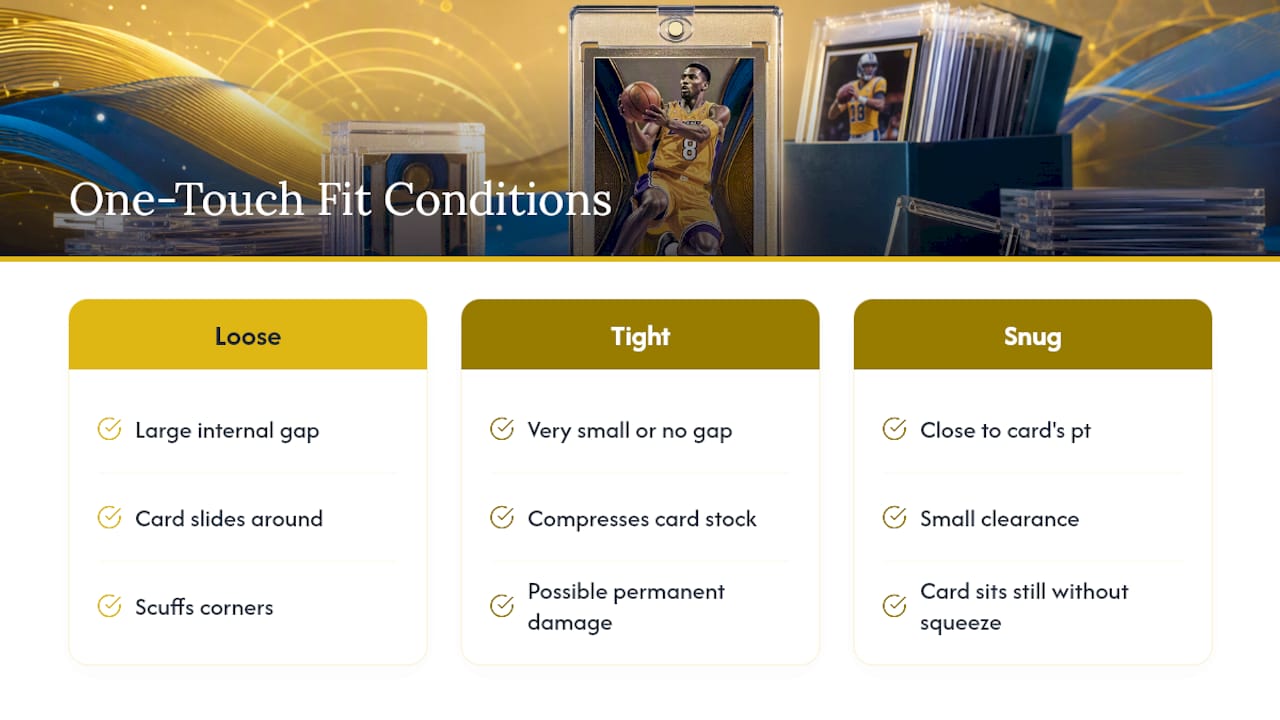
Every card, from a plain base rookie to a triple-relic patch autograph, has a specific pt thickness, and the correct one-touch holder should sit close to that number. Too much gap inside the case and the card slides around, scuffing corners. Too tight and you compress the card stock, sometimes permanently. The goal is a snug fit with just enough clearance that the card sits still without being squeezed.
One-touch sizes at a glance
Ultra PRO’s One-Touch lineup covers this full range, including specialty booklet and UV-protective versions for cards that’ll spend time under display lighting. As a general rule, favor the size that leaves the card snug rather than loose. A little resistance when you close the holder is normal; a card that rattles inside is a sign you sized down too far.
How Do You Measure Card Thickness Accurately?
Guessing thickness by eye is the most common mistake collectors make, and it’s an easy one to fix with three reliable methods.
- Printable point gauge. Download a gauge PDF, print it at 100% scale (never “fit to page”), and check the printed one-inch marker against a physical ruler before trusting it. Slide your card into the matching notch to read its pt directly.
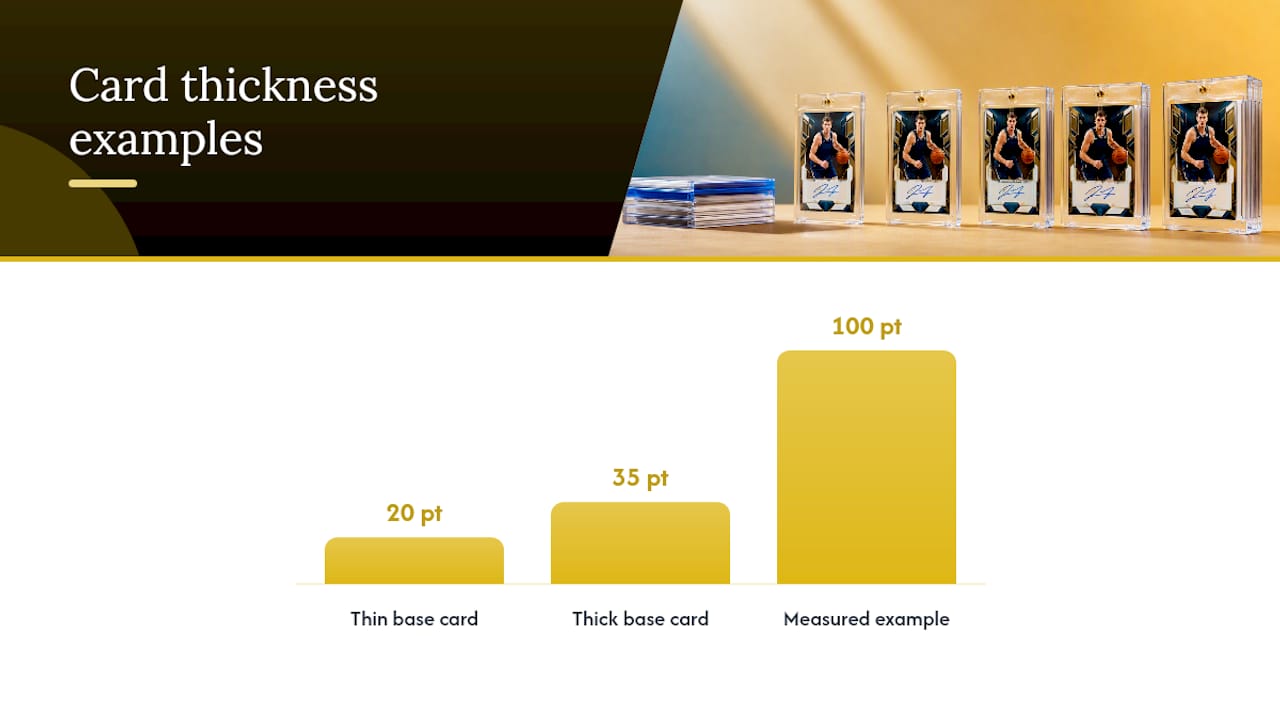
- Stacking method. Stack a known quantity of standard base cards, since most run 20 to 35pt each, and measure the stack’s total height with a ruler. Stacking a known number of standard base cards provides an approximate measurement of thickness to help estimate the appropriate holder size, with typical stacks falling within certain point ranges based on the number of cards stacked.
- Direct ruler measurement. Measure the card’s edge in millimeters, then convert: 1 pt equals 0.001 inches or 0.0254 mm, so a card measuring 2.5 mm is roughly 100pt.
The biggest failure point isn’t the math, it’s the printer. Scaling settings default to “fit to page” on plenty of home printers, which shrinks your gauge without warning. Always verify the printed scale against a ruler before you trust a single reading from it.
Pro Tip: Never build your stacking test out of thick chrome or foil parallels. Those run heavier than standard base stock and will throw your estimate off by a full size tier.
Which Holder Size Fits Which Card Type?
Once you know the pt, matching it to a holder is straightforward, but a few categories deserve specific attention.
- Standard base and chrome cards almost always land at 35pt. This covers the overwhelming majority of rookies, veterans, and inserts in any given box.
- Chrome and foil parallels sometimes run slightly thicker due to the coating, so measure before assuming 35pt is correct; some land closer to 55pt.
- Single jersey patch or relic cards typically need 55pt to 100pt, depending on the swatch thickness sewn or glued into the card.
- Multi-patch and rookie patch autographs (RPAs) commonly require 100pt to 180pt, since these stack multiple memorabilia pieces and thicker card stock.
- Booklet-style and shadowbox cards need 180pt and often go all the way to 360pt.
Rookie patch autographs and other relic constructions vary more in thickness than standard cards because manufacturers embed physical swatches directly into the card. That variance is exactly why measuring beats assuming.
Double-sleeved cards and those with raised features generally have extra thickness beyond the base card. When uncertain between two holder sizes, selecting the larger holder helps prevent compression damage. A little extra room costs you nothing; a compressed corner on a five-figure card costs you real money.
What Goes Wrong When You Pick the Wrong Size?
Forcing a double-sleeved or thick patch card into a 35pt case is the single most common sizing mistake, and it leaves marks that hurt resale value immediately, making collectibles like the Big League Chew Player Ring - Shohei Ohtani more desirable for properly preserved items.
- Compression creases along the card’s long edges from a case that’s too tight
- Corner dings and soft bends from a card that shifts and knocks against the case walls
- Visible warping on jersey patches or thick memorabilia pieces squeezed flat
- A card that slides audibly when you tilt the holder, a sign the fit is too loose
If you spot any of these signs, re-measure the card immediately and move up one size tier. When you’re genuinely unsure between two sizes, a toploader or screwdown case gives you more forgiving clearance than committing to a one-touch that might be wrong.
Pro Tip: Before listing or shipping any card, close the holder and give it a gentle shake near your ear. Silence means a good fit. Any rattle means the card needs a smaller size or a supplemental sleeve.
How Do You Print a Gauge Correctly Without a Printer Mishap?
A miscalibrated printout is worse than no gauge at all, because it gives you false confidence in a wrong number.
- Open the gauge PDF and select “Actual Size” or “100%” in your print dialog, never “Fit to Page” or “Shrink to Fit.”
- Print a single test page and measure its labeled one-inch or 10mm marker with a physical ruler before trusting any reading on it.
- If the printed marker doesn’t match, adjust your print settings and reprint rather than mentally “correcting” a bad scale in your head.
No printer nearby? Use your phone camera’s zoom against a known reference object, like a coin or a ruler laid flat next to the card, and estimate against that scale. At a card show or dealer table, the stacking method works just as well without any equipment at all, and most experienced sellers can eyeball a rough pt range from a quick stack test.
Why Trust This Sizing Guide?
Dealers in rookie autographs, patch cards, and rare redemption cards know these categories are where sizing mistakes cost the most money. Our rookie autographs and relics collection spans standard base thickness all the way up to jumbo multi-patch construction, giving us a practical, hands-on view of where cards actually fall across the pt spectrum.
These recommendations line up with widely used Ultra PRO sizing standards and the measurement practices experienced collectors have relied on for years. For deeper reference on conversions and construction types, our card sleeve millimeter chart breaks down the numbers further, and our relic types guide explains why certain patch and RPA constructions run thicker than collectors expect.
One-Touch Size Guide for Collectors: Measure, Match, Protect
The conventional advice in this hobby treats sizing as an afterthought, something you handle after the card arrives rather than before you commit to buying protection. That’s backward. If you’re spending real money on a rookie patch autograph or a redemption card, the holder decision deserves the same care as the authentication check.
Here’s where most collectors go wrong: they trust the size printed on a listing or assume every “patch card” behaves like the last one they owned. Memorabilia thickness varies card to card, even within the same product line, because swatches get cut and sewn by hand. A measurement you took on last year’s patch card tells you nothing reliable about this year’s.
Prioritize the measurement step over the purchase step, every time. A $3 gauge print or thirty seconds of stacking base cards costs you nothing compared to a compressed corner on a card worth hundreds. The collectors who protect value long term aren’t the ones with the fanciest display cases. They’re the ones who measure first and buy second.
— Richard
Buying Rare Cards? Here’s How We Handle Sizing
When you’re shopping for a high-value card, the last thing you want is uncertainty about what holder it needs the moment it arrives. Some sellers list relevant sizing details and recommended holder guidance directly on product pages for pieces where thickness matters, like thick relic and multi-patch cards, to help avoid guessing after checkout.

If you’re selling or trading cards yourself, include the pt size in your own listings. It cuts down on buyer questions and builds trust before a sale ever closes. Browse rare rookie autographs, patch cards, and redemption pieces like the Junior Caminero Bowman Chrome Green Signature rookie card or the Jalen Brunson Full Court Jersey Patch autograph, and check the listing notes for holder guidance before you buy your protection separately. Visit the Nextgencards shop to see current inventory and get sizing help before your next order ships.
Downloadable Gauges and Reference Pages
Print your own gauge before your next sizing session using a free point gauge PDF, and cross-check available sizes against Ultra PRO’s full One-Touch collection. For conversion math and printer verification steps, BCW’s sizing breakdown is worth bookmarking alongside your gauge printout.
Sources
- Sports Card Thickness Guide: Mystery Solved & Free Point Gauge
- UV Magnetic ONE-TOUCH Card Holders – Ultra PRO International
- What thickness of card holder do I need?
FAQ
What Size One-Touch Do I Need?
Most standard base and chrome cards need a 35pt one-touch. Measure with a printable gauge or the stacking method to confirm before buying anything thicker.
What Size One-Touch Do I Need for Patch Cards?
Single patch and relic cards typically need 55pt to 100pt, while multi-patch RPAs often require 100pt to 180pt depending on how many memorabilia pieces are embedded.
What Is the Difference Between 35pt and 55pt Holders?
A 35pt holder is 0.035 inches thick and fits standard base cards, while a 55pt holder is 0.055 inches thick and accommodates slightly heavier stock or a card with light additional bulk, like a single sleeve.
Would a Double-Sleeved Card Fit in a 35pt One-Touch?
Usually not. A double-sleeved card typically adds 10 to 20 points of extra thickness beyond the bare card, so a 55pt or 75pt holder is the safer choice to avoid compression.
How Do I Know if My One-Touch Is Too Tight?
Look for compression creases along the card’s edges or slight warping on patch cards. If you see either, move up to the next pt size immediately.
0 comments