

Appreciating rookie cards are first-year player cards that gain significant market value over time, driven by three core forces: scarcity at top grading tiers, certified condition, and the athlete’s lasting legacy. The best investment rookie cards share a consistent profile: extremely low PSA 10 population counts, record-breaking auction sales, and athletes whose careers validate long-term collector demand. Cards from Robin Yount, Wayne Gretzky, Victor Wembanyama, Michael Jordan, and Brett Favre represent the clearest examples of appreciating rookie cards in the modern market, each demonstrating how condition and scarcity combine to produce extraordinary returns.
1. High-grade vintage examples of appreciating rookie cards
Vintage rookie cards in PSA 10 condition represent the most reliable appreciation pattern in the hobby. Age, handling, and storage conditions mean that very few vintage cards survive decades in Gem Mint condition, creating a supply ceiling that no amount of collector demand can overcome.
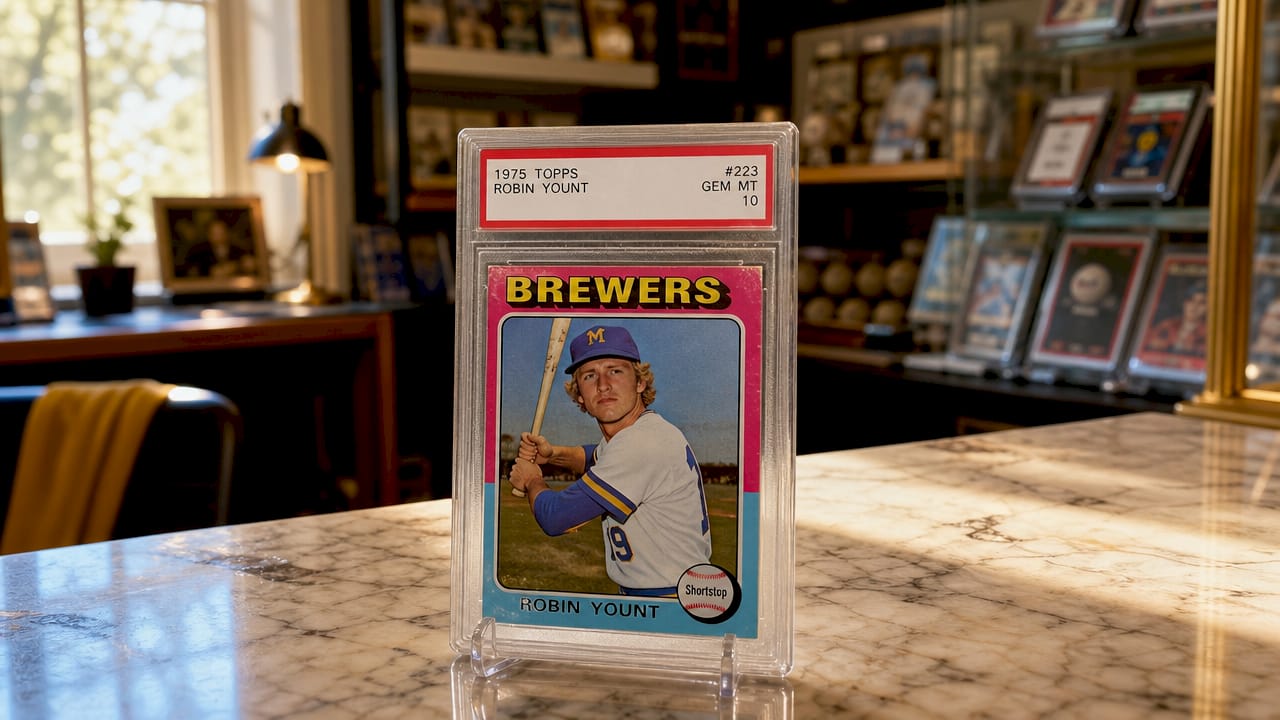
The 1975 Topps Robin Yount rookie card is one of the most compelling examples in baseball. The PSA 10 record sale reached $152,500 on January 30, 2026, a 49.51% increase from the $102,000 sale in 2021. Only six PSA 10 copies exist in the entire grading population. That six-copy ceiling is what separates this card from thousands of other Yount cards sitting in collections worldwide.
The 1979 O-Pee-Chee Wayne Gretzky rookie card operates at an even more extreme level of scarcity. With only two PSA 10 copies sold publicly, the card peaked at $3.75 million in March 2021. The PSA 9 population sits at 95 copies, with the top PSA 9 sale around $265,200. That gap between PSA 9 and PSA 10 pricing tells you everything about how top-grade scarcity functions in this market.
Pro Tip: When evaluating vintage rookie cards, check the PSA population report before the price history. A card with six or fewer PSA 10 copies has a structural scarcity advantage that no modern reprint or parallel can replicate.
Key vintage cards worth tracking:
- 1975 Topps Robin Yount PSA 10 — 6 copies, record $152,500 sale in 2026
- 1979 O-Pee-Chee Wayne Gretzky PSA 10 — 2 copies sold publicly, peak $3.75M
- 1952 Topps Mickey Mantle PSA 9 — benchmark vintage baseball card with multi-million dollar auction history
- 1954 Topps Hank Aaron PSA 8/9 — consistent appreciation driven by Hall of Fame legacy
| Card | PSA 10 Pop | Record Sale |
|---|---|---|
| 1975 Topps Robin Yount | 6 | $152,500 (2026) |
| 1979 O-Pee-Chee Wayne Gretzky | 2 (publicly sold) | $3,750,000 (2021) |
2. Modern rookie cards with exceptional recent appreciation
Modern cards present a different challenge. Print runs are larger, card stock is more consistent, and grading services have processed millions of submissions. Yet certain modern rookie cards still produce extraordinary appreciation, specifically when parallel rarity and PSA 10 scarcity align with a player’s breakout performance.
Victor Wembanyama’s 2023-24 Panini Prizm one-of-one Black parallel PSA 10 sold for $5.1 million in May 2026, more than five times the previous record for any Wembanyama card. The prior benchmark was a PSA 9 sale at $860,100 in February 2025. That jump from $860K to $5.1M in roughly 15 months illustrates how a one-of-one parallel at PSA 10 creates a category of its own, completely separate from the standard base card market.
Michael Jordan’s 1986-87 Fleer #57 PSA 10 produced one of the most cited ROI figures in the hobby. The card delivered a 46,000% return in 11 months between 2019 and 2021, selling at auction for $738,000. That figure reflects both Jordan’s unmatched cultural status and the extreme scarcity of PSA 10 copies from a 1986 set printed on cardboard that aged poorly.
Brett Favre’s 1991 Wild Card “1000 Stripe” PSA 10 set a new record at $18,600 in 2026, with only eight PSA 10 copies in existence. Long-term growth since 2009 exceeds 800%. The Wild Card stripe design was intentionally produced in limited quantities, making it one of the earliest examples of a manufactured scarcity parallel in football cards.
Pro Tip: For modern cards, the base Prizm PSA 10 and the numbered parallel PSA 10 are entirely different markets. Always confirm which version you are evaluating before comparing prices.
Notable modern appreciating rookie cards:
- Victor Wembanyama 2023-24 Panini Prizm Black 1/1 PSA 10 — $5.1M private sale, May 2026
- Michael Jordan 1986-87 Fleer #57 PSA 10 — $738,000 auction sale, 46,000% ROI in 11 months
- Brett Favre 1991 Wild Card “1000 Stripe” PSA 10 — $18,600 record, 800%+ growth since 2009
3. How grading population reports create steep value curves
Population reports, commonly called “pop reports,” are the published counts of every card graded at each tier by services like PSA, BGS, and SGC. Understanding them is non-negotiable for anyone tracking rookie cards that increase in value at the top end of the market.
The Robin Yount example makes the mechanics concrete. Six PSA 10 copies exist against 278 PSA 9 copies. The PSA 9 peak sale sits at $5,200. The PSA 10 record is $152,500. That is roughly a 29x price premium for one grade point of difference. Visually, a PSA 9 and PSA 10 Yount card look nearly identical to the naked eye. The premium is not about appearance. It is about scarcity at the top tier creating a competition among collectors who want the best-certified copy available.
The same dynamic appears across every sport. The Gretzky O-Pee-Chee PSA 9 sells around $265,200 while the PSA 10 reached $3.75 million. That is a 14x premium. For the Wembanyama Black parallel, the PSA 9 sold for $860,100 while the PSA 10 sold for $5.1 million, a 6x premium on a card that is literally one-of-one at PSA 10.
| Card | PSA 9 Pop / Price | PSA 10 Pop / Price | Premium Multiple |
|---|---|---|---|
| 1975 Topps Robin Yount | 278 / $5,200 | 6 / $152,500 | ~29x |
| 1979 O-Pee-Chee Wayne Gretzky | 95 / $265,200 | 2 / $3,750,000 | ~14x |
| 2023-24 Panini Prizm Wembanyama Black 1/1 | 1 / $860,100 | 1 / $5,100,000 | ~6x |
Collectors compete fiercely for PSA 10 copies even when the grade difference is subtle because the pop report bottleneck creates a structural floor under pricing. As long as the population stays at single-digit counts, each new auction sets a fresh reference point for the next buyer.
4. Other factors influencing rookie card appreciation beyond rarity and grading
Scarcity and condition are the primary drivers, but they do not operate in isolation. Player career trajectory, parallel design, and the psychological impact of record sales all contribute to how a card appreciates over time.
Player legacy is the foundation. Wembanyama’s $5.1M sale did not happen in a vacuum. It followed his breakout NBA impact in San Antonio, including a playoff run that raised his national profile significantly. A card’s value is always a bet on the athlete’s continued relevance. Jordan’s Fleer rookie holds its value partly because his cultural status is fixed and permanent.
Parallel types and limited editions create distinct market tiers within a single player’s card catalog. A one-of-one Black Prizm parallel occupies a completely different category than a base Prizm, even if both feature the same player photo and design. Numbered parallels like /10, /25, or /49 sit between these extremes, with value scaling inversely with print run.
“Not all rookie cards are equal; distinctions in parallel types, numbering, and slab grade drastically affect investment value, with one-of-one parallels at PSA 10 exemplifying the highest premiums.”
Record sales also function as market resets. When a card sells at a new all-time high, it shifts the perceived value band for every comparable copy. The Wembanyama $5.1M sale reset expectations for what a top-tier modern basketball rookie can command. The Brett Favre Wild Card record at $18,600 reset the ceiling for early 1990s football parallels. Each record creates a new floor for the next transaction.
Collectible design and historical context add a secondary layer of value. The Wild Card stripe design was a deliberate scarcity mechanism from 1991, making it historically significant as an early parallel concept. The O-Pee-Chee Gretzky carries additional premium over the Topps version because it was the Canadian market issue, adding a cross-border collector base.
5. Comparing top appreciating rookie cards by sport and era
Appreciation patterns differ meaningfully across sports and decades. Baseball vintage cards benefit from the deepest collector base and the longest auction history. Basketball cards, particularly Jordan and Wembanyama, demonstrate the most dramatic short-term ROI figures. Football cards like the Favre Wild Card show steady long-term growth driven by manufactured scarcity. Hockey cards, led by Gretzky, operate at the extreme end of top-grade scarcity with the fewest PSA 10 copies in circulation.
You can find rare rookie card variations across all four sports, but the mechanics of appreciation differ. Baseball vintage relies on age-driven condition scarcity. Basketball modern relies on parallel rarity and player stardom. Football appreciation is often tied to specific parallel designs with intentionally low print runs. Hockey top-end value concentrates in a handful of PSA 10 copies that rarely change hands.
| Player | Card | PSA 10 Pop | Record Sale | Growth |
|---|---|---|---|---|
| Robin Yount | 1975 Topps | 6 | $152,500 | 49.5% (2021-2026) |
| Wayne Gretzky | 1979 O-Pee-Chee | 2 (sold) | $3,750,000 | Multi-decade |
| Michael Jordan | 1986-87 Fleer #57 | Limited | $738,000 | 46,000% (11 months) |
| Victor Wembanyama | 2023-24 Prizm Black 1/1 | 1 | $5,100,000 | 5x+ (15 months) |
| Brett Favre | 1991 Wild Card “1000 Stripe” | 8 | $18,600 | 800%+ (since 2009) |
The consistent thread across all five examples is that top-grade scarcity creates the premium, not the card itself. A PSA 7 Gretzky O-Pee-Chee is a collectible. A PSA 10 is a trophy asset.
Key takeaways
The most appreciating rookie cards share one defining characteristic: a PSA 10 population so small that each new auction sale resets the market ceiling rather than confirming it.
| Point | Details |
|---|---|
| PSA 10 scarcity drives premiums | Cards with fewer than 10 PSA 10 copies command exponential price premiums over PSA 9 equivalents. |
| Record sales reset value bands | Single auction records like Wembanyama’s $5.1M sale permanently shift the perceived value floor for comparable cards. |
| Parallel type determines market tier | One-of-one and low-numbered parallels occupy entirely separate markets from base cards of the same player. |
| Player legacy sustains long-term value | Cards tied to athletes with permanent cultural status, such as Jordan and Gretzky, maintain appreciation across market cycles. |
| Pop reports are the essential research tool | Monitoring PSA population counts at the PSA 10 tier identifies structural scarcity before prices fully reflect it. |
My take on navigating rookie card investments in 2026
I have watched collectors make the same mistake repeatedly: they buy a rookie card because the player is exciting, without checking the pop report first. Excitement about a prospect is not a valuation thesis. The pop report is.
The cards that have produced the most dramatic appreciation, Yount, Gretzky, Jordan, Wembanyama, Favre, all share single-digit or low double-digit PSA 10 populations. That is not a coincidence. It is the mechanism. When fewer than ten certified copies of a card exist at the top grade, every new buyer competes against a fixed ceiling. Prices do not drift upward gradually. They jump at each transaction.
What I find underappreciated is how public auction transparency now accelerates this dynamic. Platforms that publish real-time sale data mean that a $5.1M Wembanyama sale is known globally within hours. That visibility resets buyer expectations faster than any previous era of the hobby. For collectors tracking undervalued sports cards, the window between a card being underpriced and the market correcting has shortened considerably.
My honest caution: do not assume that every rookie card from a star player will appreciate. The base card market for modern players is crowded, print runs are high, and PSA 10 copies are abundant. The appreciation story lives at the intersection of extreme scarcity and certified top grade. Everything else is speculation with a longer time horizon and less predictable outcomes. Diversify across sports and eras, and always verify the pop count before committing capital.
— Richard
Explore rare rookie autographs and relics at Nextgencards
Serious collectors looking to add proven appreciating assets to their portfolios will find a curated selection of premium graded rookie cards, certified autographs, and authenticated relics at Nextgencards. The inventory focuses specifically on scarcity and condition quality, featuring rookie autographs from athletes like Shohei Ohtani and Aaron Judge alongside rare parallel and relic cards that meet the criteria serious investors prioritize.
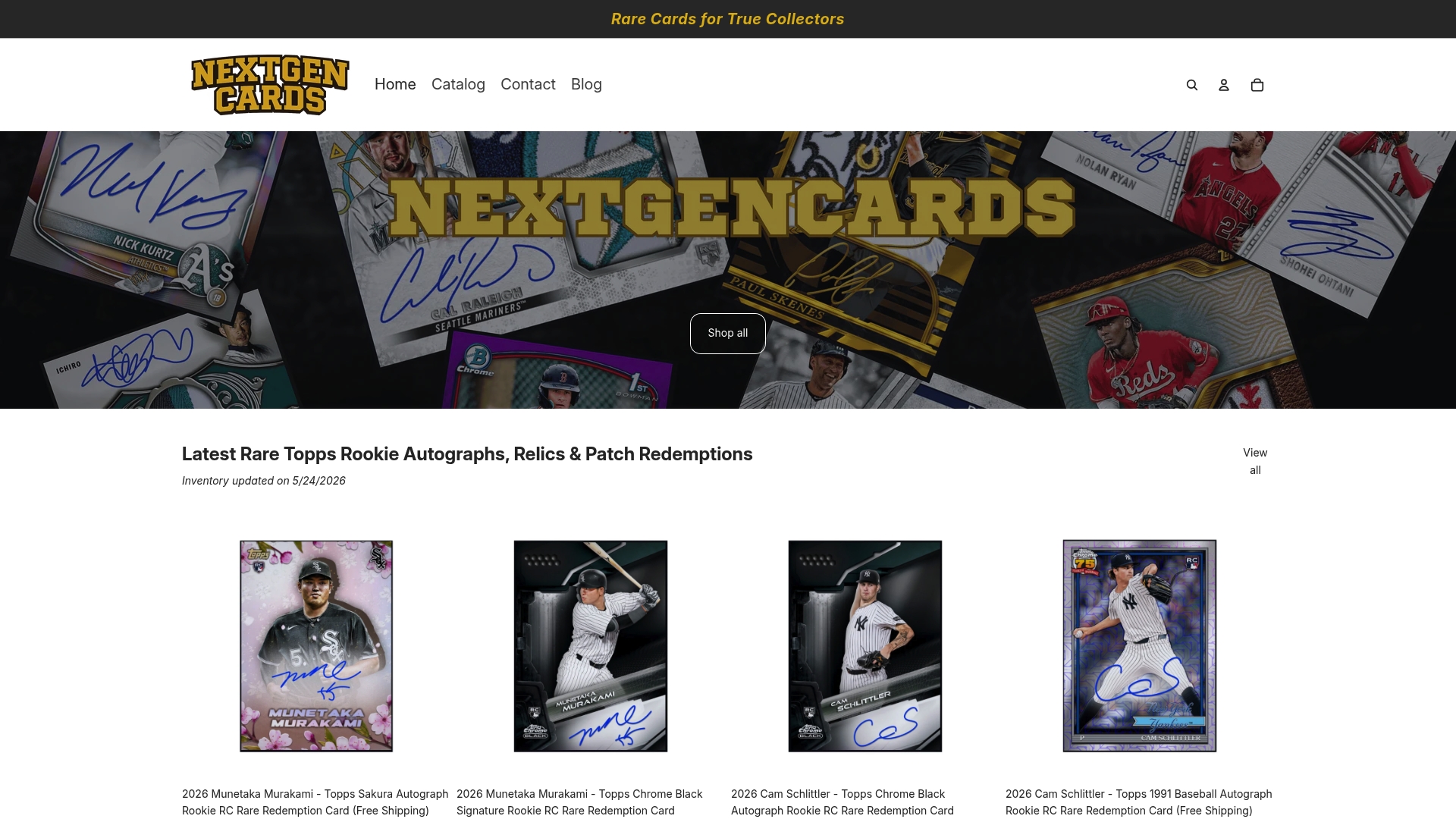
Nextgencards sources cards with documented rarity and authentic certification, so you are not guessing at provenance or condition. Free shipping is available on select items, and the catalog is organized for collectors who know exactly what they are looking for. Browse the full selection of rookie autographs and relics to find cards that combine player legacy with the top-grade scarcity that drives long-term appreciation.
FAQ
What makes a rookie card appreciate in value?
A rookie card appreciates when three factors align: a low PSA 10 population count, a player with sustained or growing cultural relevance, and active collector demand at auction. Cards with fewer than ten PSA 10 copies consistently command the largest premiums.
How do pop reports affect rookie card prices?
Population reports published by PSA show exactly how many copies of a card exist at each grade level. When PSA 10 copies number in the single digits, competition among collectors creates exponential price premiums over PSA 9 equivalents, sometimes 10x to 30x higher.
Are modern rookie cards worth investing in?
Modern rookie cards can produce strong returns, but only at the highest grade tiers and in limited parallel versions. The Wembanyama Black 1/1 PSA 10 at $5.1M and the Jordan Fleer PSA 10 at $738,000 both confirm that condition and scarcity matter far more than the era of production.
What is the difference between a base rookie card and a parallel?
A base rookie card is the standard version printed in the largest quantity. A parallel is a variation with a different color, finish, or foil treatment, produced in a numbered limited run. One-of-one parallels at PSA 10 represent the rarest and most valuable tier within any player’s rookie card catalog.
Which sport produces the most appreciating rookie cards?
Basketball and baseball have produced the highest individual sale prices, with Jordan and Wembanyama leading basketball and Yount and Mantle anchoring baseball. Hockey’s Gretzky O-Pee-Chee holds the most extreme scarcity profile at PSA 10, while football’s Favre Wild Card demonstrates the strongest long-term percentage growth from a low base.
Recommended
- Buy Certified Autograph Rookie Cards: 2026 Collector’s Guide – Next Gen Cards LLC
- Rarest Rookie Card Variations: Collector’s 2026 Guide – Next Gen Cards LLC
- Top Places to Buy Rare Rookie Cards (Collectors Guide) | NextGenCards – Next Gen Cards LLC
- Why Rookie Year Cards Matter for Serious Collectors – Next Gen Cards LLC
0 comments