

Not all rookie cards are created equal, and that misconception costs collectors real money. Understanding why rookie year cards matter goes far beyond nostalgia. It comes down to scarcity, market timing, grading standards, and the fundamental economics of supply and demand in the sports card hobby. Whether you’re new to collecting or you’ve been building a portfolio for years, the distinctions between a true rookie card and a look-alike prospect issue can mean the difference between a $25 card and a $5,000 card.
Table of Contents
- Key takeaways
- Why rookie year cards matter: the genesis of a career
- Market factors that drive rookie card value
- True rookie cards vs. prospect cards and inserts
- How to track and invest in rookie cards effectively
- Notable case studies in rookie card value
- My take on rookie cards as both collectibles and investments
- Find rare rookie cards at Nextgencards
- FAQ
Key takeaways
| Point | Details |
|---|---|
| One rookie season only | Each athlete has exactly one rookie season, making those cards permanently scarce by definition. |
| Grading drives premiums | PSA 10 rookie cards can sell for 50 to 100 times more than ungraded copies of the same card. |
| True rookies have criteria | Base set, fully licensed, and nationally distributed products define an official rookie card. |
| Track before you buy | Monitoring grading population reports and sales volume prevents costly hype-driven purchases. |
| Autographs amplify value | Rookie autograph cards from top prospects command the highest premiums and hold long-term collector demand. |
Why rookie year cards matter: the genesis of a career
Every professional athlete gets exactly one rookie season. That singular fact is the foundation of the entire rookie card market. Collectors see rookie cards as the genesis of a professional career, with intense demand driven by this one-time status. No second chances, no do-overs. Once that season ends, the window for producing official rookie cards closes permanently.
This scarcity is structural, not artificial. A manufacturer cannot print more 1989 Ken Griffey Jr. rookie cards. The supply is fixed forever, while demand can only grow as a player’s legend builds over decades. That dynamic does not apply to any other card type in the hobby.
The emotional dimension matters just as much as the economics. Rookie cards function as collectible records of a player’s professional beginning. They capture the excitement and uncertainty of a career that hasn’t yet been written. A collector who picked up a Shohei Ohtani rookie in 2018 wasn’t just buying cardboard. They were preserving a moment before the world knew what he would become.
Here is what makes rookie cards stand apart from other collectibles:
- Permanent scarcity: The rookie season happens once, locking in a finite production window.
- Career narrative anchor: The rookie card is the starting point of every player’s collectible story.
- Cross-market demand: Both sports fans and card investors compete for the same limited supply.
- Legacy appreciation: As players achieve milestones, their rookie cards gain historical weight that later cards cannot replicate.
Pro Tip: If you’re evaluating a rookie card for long-term holding, focus on the player’s draft position, team context, and early statistical output rather than hype alone. Those fundamentals predict sustained collector interest far better than social media buzz.
Market factors that drive rookie card value
Grading is where rookie card value separates dramatically from raw card pricing. PSA 10 versions of the 1989 Upper Deck Ken Griffey Jr. recently sold for $4,900 to $5,100, while raw copies of the same card trade for $15 to $125. That is not a small gap. It represents a price premium of 40 to 300 times the base value, driven entirely by condition.

The reason for this gap is straightforward. Gem mint examples like PSA 10 represent fewer than 5% of all graded copies for many vintage rookie cards. Decades of handling, storage in binders, and general wear eliminate most cards from contention. The cards that survive in pristine condition become genuinely rare artifacts.
| Grade | Griffey Jr. 1989 Upper Deck | Market Availability |
|---|---|---|
| Raw (ungraded) | $15 to $125 | Common |
| PSA 7 (Near Mint) | $200 to $400 | Moderate |
| PSA 9 (Mint) | $800 to $1,500 | Limited |
| PSA 10 (Gem Mint) | $4,900 to $5,100 | Scarce (~4% of graded) |
Player performance and draft capital also move markets fast. Autograph cards of top draft picks see 30 to 50% price surges immediately after draft events, with top prospects achieving $15,000 or more on 1/1 cards in the days following selection. That surge reflects pure speculation on future performance, which means it can reverse just as quickly.
Rookie card prices often rise 30 to 50% post-debut but experience high volatility tied to player performance. A slow start, an injury, or a disappointing sophomore season can erase months of price gains in weeks.
Pro Tip: Never buy a rookie card at the peak of a hype cycle. The best entry points are before the draft for top prospects or during a player’s first slump when sellers panic and prices temporarily drop.
True rookie cards vs. prospect cards and inserts
This is where many collectors lose money. The hobby has a specific definition of what qualifies as a true rookie card, and not every card produced during a player’s rookie year meets the standard. True rookie cards must be base set cards from fully licensed and nationally distributed products. Inserts and pre-rookie prospect cards do not qualify, regardless of when they were printed.
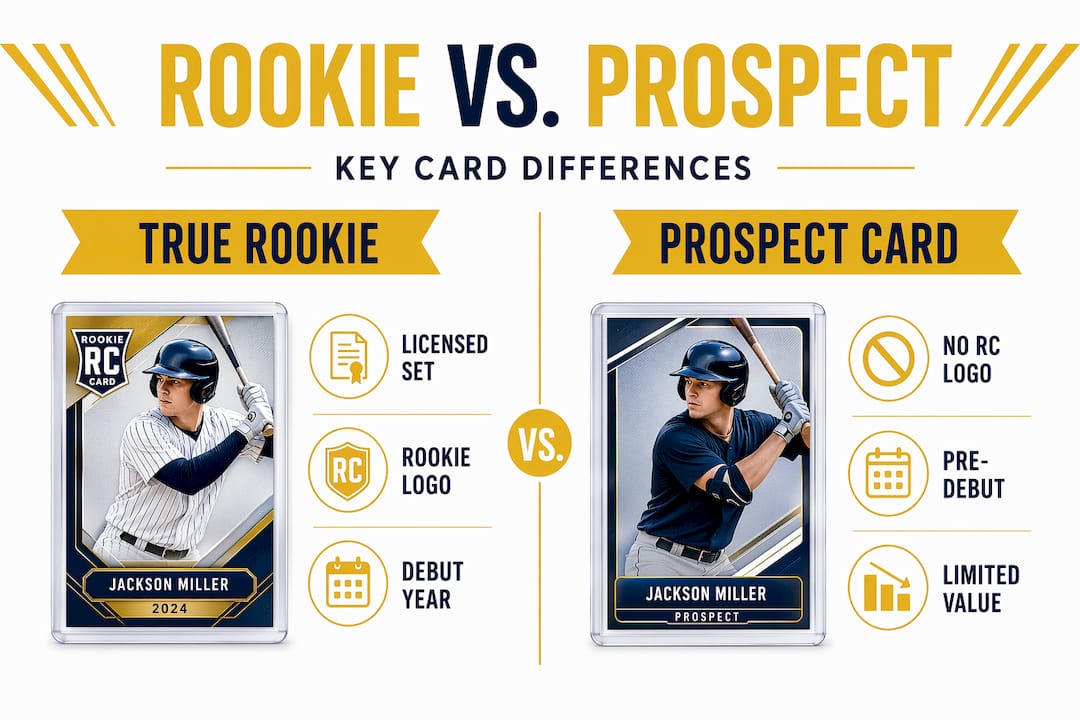
Major licensing bodies like MLB, NBA, NFL, and NHL have formalized this with official rookie card designations. MLB uses an RC logo on qualifying cards. The presence or absence of that logo on a baseball card tells you immediately whether it meets the standard.
Here is a quick reference for what qualifies and what does not:
| Card Type | Qualifies as True Rookie Card? | Notes |
|---|---|---|
| Base set RC from licensed product | Yes | Must carry official RC designation |
| Insert or parallel from licensed product | No | Not base set; does not qualify |
| Prospect card (pre-debut) | No | Issued before professional debut |
| Autograph RC from licensed base set | Yes | Qualifies if base set criteria met |
| Minor league or independent league card | No | Not from officially licensed product |
The practical impact of this distinction is significant. A prospect card of a top baseball player printed before their MLB debut may look nearly identical to a true rookie card. But it will never carry the same market weight, collector demand, or long-term value. Collectors who know the difference build stronger collections. Those who don’t often overpay for cards that plateau early.
When building a collection, prioritize officially licensed base set rookie cards first. Autograph rookies from licensed sets rank second. Parallels, inserts, and prospect cards can round out a collection but should not be treated as equivalent to true rookie cards when evaluating investment potential.
How to track and invest in rookie cards effectively
Successful rookie card investing is not about guessing which player will be great. It is about reading market signals accurately and acting with discipline. Hype-driven price spikes can push values up 300%, but those same spikes can collapse just as fast if a player underperforms or the broader market cools.
Here is a practical framework for tracking and acting on rookie card opportunities:
- Monitor grading population reports. PSA, BGS, and SGC publish population data showing how many cards have been graded at each tier. A card with only 50 PSA 10 examples is far more valuable than one with 2,000. Check these before buying.
- Track sales volume, not just price. A card selling for $500 with three recent sales is very different from one with 200 recent sales at the same price. Volume confirms real market interest.
- Follow draft events and signing news. Team fit, contract length, and role clarity all affect how much collector demand a rookie generates. A top pick on a rebuilding team generates less immediate buzz than one joining a contender.
- Use a ladder buying approach. Instead of committing your full budget at once, buy in stages. Purchase a small position early, add more if the player performs, and reduce exposure if performance disappoints.
- Set price targets before you buy. Decide in advance at what price you will sell. Emotional decisions during hype spikes lead to holding too long and watching gains evaporate.
Pro Tip: Grading population reports are the most underused tool in rookie card investing. A card that looks expensive at $800 may actually be a bargain if only 30 gem mint copies exist. Always check the population before judging a price.
Notable case studies in rookie card value
Real examples illustrate these principles better than theory alone.
- Ken Griffey Jr. 1989 Upper Deck: Over 172,000 copies have been graded, but only approximately 4,300 have received a PSA 10 grade. That 4% gem rate created a massive price gap between grades. The card is culturally significant, widely recognized, and consistently in demand. It is the benchmark case study for understanding how grading scarcity amplifies rookie card value.
- Recent NFL rookie autographs: Top 2026 NFL draft picks saw immediate autograph card sales surge within 48 hours of selection. 1/1 printing plate cards and superfractors from top picks generated five-figure sales before the players had taken a single professional snap. That speed reflects how much the market now prices in projected performance rather than proven results.
- Hype cycle corrections: Several highly hyped NFL rookies from recent draft classes saw their autograph card prices drop 60 to 70% within their first season after slow starts. Collectors who bought at peak hype absorbed significant losses. Those who waited for the correction and bought during the dip were positioned for recovery as the players developed.
The lesson across all three examples is consistent. Scarcity, grading, and patience determine long-term outcomes. Short-term hype creates opportunity for disciplined buyers and losses for reactive ones.
My take on rookie cards as both collectibles and investments
I’ve spent years watching collectors make the same mistake. They see a rookie card spike in price after a big game and assume the value is locked in. It rarely is. The rookie card market rewards patience and punishes panic buying more consistently than almost any other collectible category.
What I find genuinely compelling about rookie cards is the time-capsule quality. When I look at a well-preserved rookie autograph from a player who went on to have a Hall of Fame career, there is something real about owning that specific moment. The card existed before the career was written. That is not something you can replicate with a card from year five or year ten.
My honest advice: collect for the story first, the investment second. If you buy rookie cards you genuinely care about, you will hold through the volatility that shakes out short-term speculators. And holding through volatility is often exactly what creates long-term gains. I’ve seen collectors who bought Paul Skenes rookie autographs early and held through the initial price swings come out significantly ahead of those who flipped at the first opportunity.
The collectors who do best treat grading population data and sales volume as seriously as any financial metric. They also know what they own and why they own it. That combination of informed patience and genuine passion is what separates serious collectors from speculators who happen to collect cards.
— Richard
Find rare rookie cards at Nextgencards
If the principles covered here have you thinking about which rookie cards belong in your collection, Nextgencards is built for exactly that search. The curated inventory focuses on rare and high-value rookie cards, autographs, and redemption cards from officially licensed products across baseball, basketball, and football.
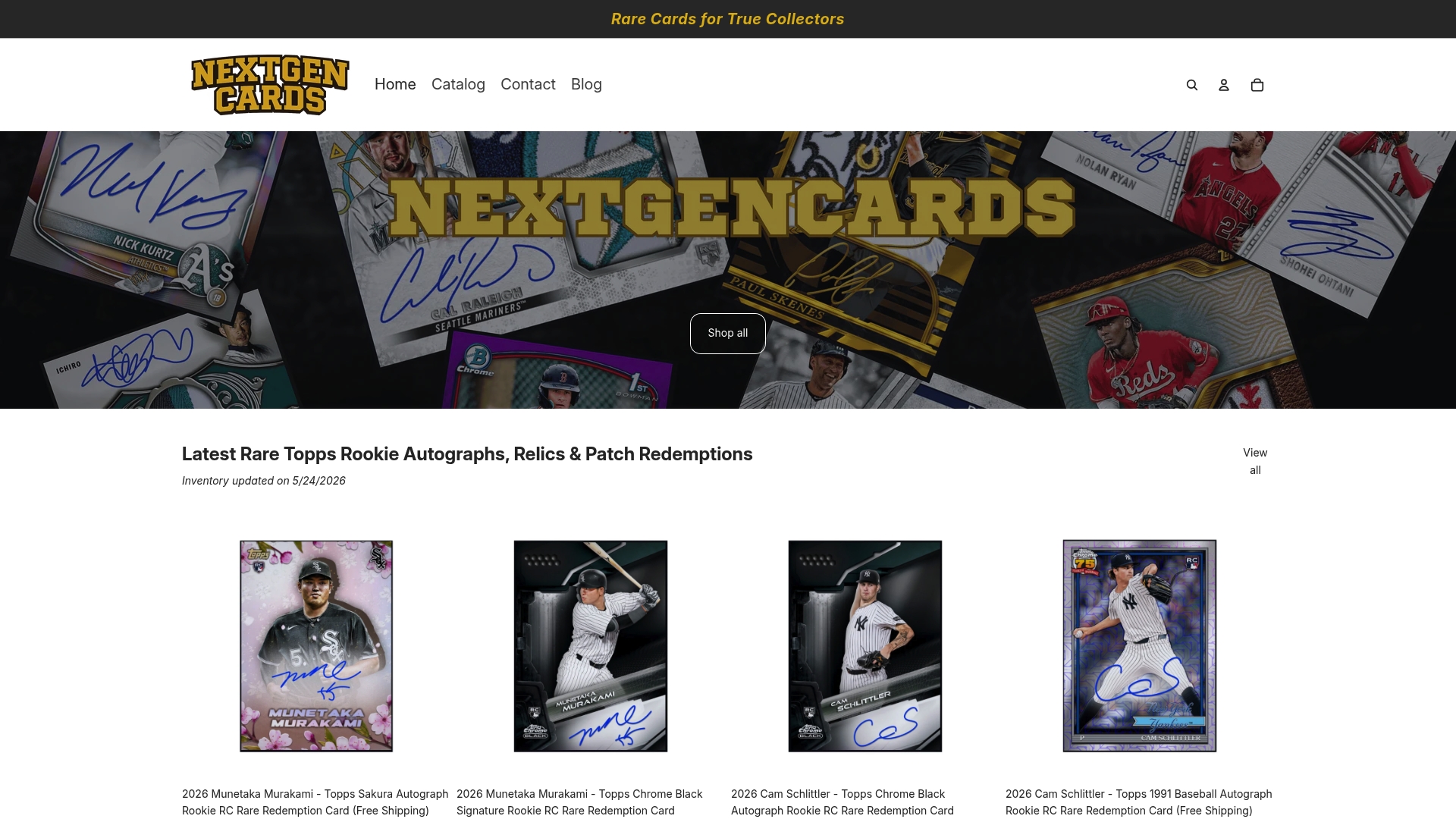
Whether you’re looking for a standout piece like the 2026 Derik Queen rookie autograph or exploring the full range of rare Topps rookie cards available right now, Nextgencards provides detailed card descriptions, authentication details, and free shipping on select items. Every listing is selected with serious collectors in mind. You won’t find filler inventory here. Browse the collection and find the cards that complete your portfolio.
FAQ
What makes a rookie card different from a prospect card?
A true rookie card comes from a base set in a fully licensed, nationally distributed product and carries an official RC designation. Prospect cards are issued before a player’s professional debut and do not qualify as official rookie cards regardless of timing.
Why do graded rookie cards sell for so much more than raw copies?
Grading authenticates condition and scarcity. PSA 10 gem mint copies often represent fewer than 5% of all graded examples, creating genuine rarity that collectors and investors pay significant premiums to own.
How do rookie cards appreciate over time?
Rookie card value grows through a combination of player performance, grading scarcity, and sustained collector demand. Cards from players who achieve Hall of Fame status or sustained excellence see the strongest long-term appreciation.
When is the best time to buy a rookie card?
The best entry points are typically before a player’s draft or during their first performance slump, when hype has not yet peaked or has temporarily cooled. Buying at peak hype after a breakout game carries the highest risk of overpaying.
Do rookie autograph cards hold more value than base rookie cards?
Yes. Rookie autograph cards from officially licensed sets command higher premiums due to their limited print runs and the direct connection to the player. They also tend to hold value better during market corrections than non-autographed base rookie cards.
Recommended
- Top Places to Buy Rare Rookie Cards (Collectors Guide) | NextGenCards – Next Gen Cards LLC
- NextGenCards - Rare Topps Rookie Cards – Next Gen Cards LLC
- 2026 Derik Queen Topps 1980-81 Basketball Rookie Autograph Rare Card – Next Gen Cards LLC
- 2026 Derik Queen - Topps Flagship Rookie Autograph Rare RC Card – Next Gen Cards LLC
0 comments