

A rookie autograph card, known in the hobby as a “rookie auto” or RPA (Rookie Patch Auto), is investable when it combines official rookie designation, controlled scarcity, verified authenticity, and a player narrative that sustains collector demand. These four factors determine whether a card holds value for years or depreciates after the initial hype fades. The global sports card market is projected to approach $20 billion by 2030. That growth makes understanding what separates a sound investment from a speculative gamble more urgent than ever. Flagship rookie cards often appreciate 30–50% post-debut, but only when the right conditions align.
What makes rookie autos investable: the core factors
Rookie autos earn their investment value from a specific combination of attributes, not from player fame alone. A card from a celebrated prospect printed in mass quantities with no serial number will depreciate rapidly once the hype cycle ends. The cards that hold and grow in value share four consistent traits: true rookie designation, low print runs, strong grading potential, and a player career that keeps generating milestones.
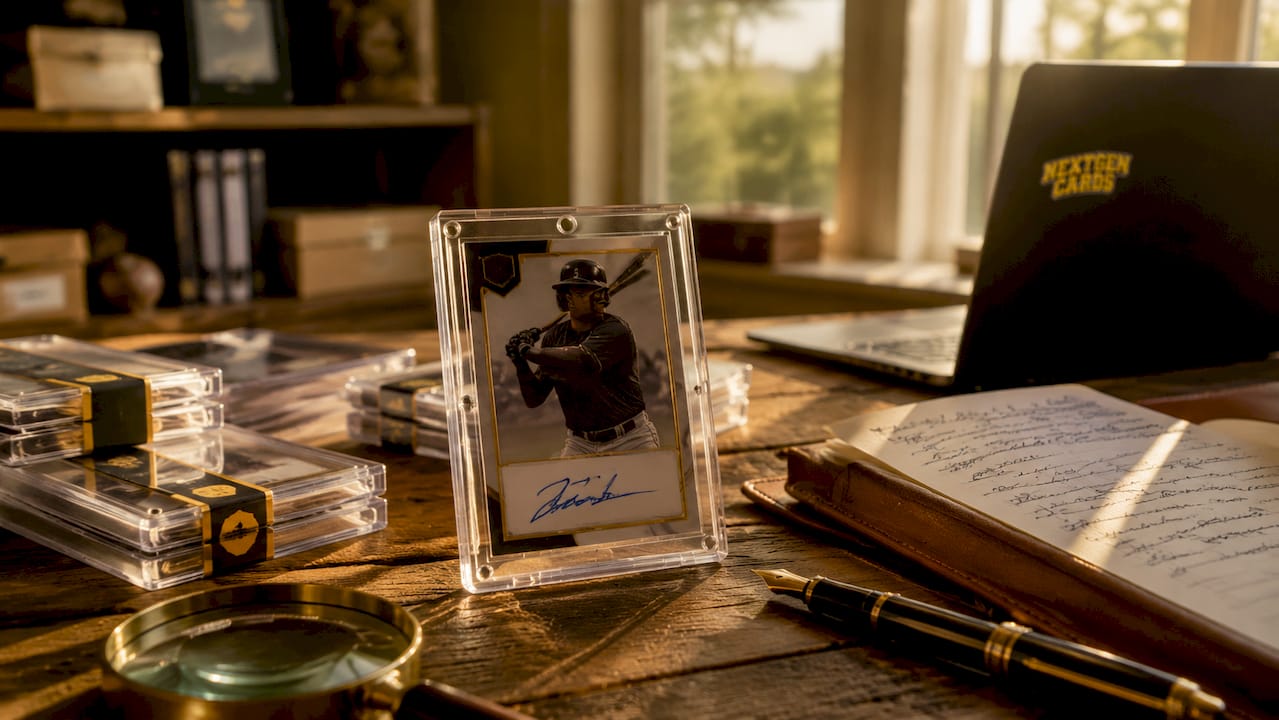
Rookie year cards carry a structural advantage because they can only exist once. No manufacturer can reprint a player’s first-year autograph card with an official rookie logo after that window closes. That irreversibility is the foundation of long-term collector demand.
How does scarcity affect the value of rookie autos?
Scarcity is the single most reliable price floor for a rookie auto. Cards numbered /49 or lower maintain reliable floor values regardless of a player’s peak performance. That is a critical distinction: scarcity protects value even when a player underperforms expectations.
The difference between serial numbers matters more than most new investors realize:
- Cards numbered /10 or lower carry the strongest scarcity premium and attract the most serious buyers at auction.
- Cards numbered /25 to /49 represent the sweet spot for most investors. They are rare enough to hold value but liquid enough to sell within a reasonable timeframe.
- Cards numbered /99 to /100 offer entry-level scarcity. They appreciate with player performance but lack the floor that tighter print runs provide.
- Base rookie cards with no serial number depreciate rapidly unless they come from a flagship set with sustained player performance and grading arbitrage potential.
Rarest rookie card variations consistently outperform high-print alternatives over multi-year holding periods. Scarcity creates a structural ceiling on supply that no amount of new product can undo.
Pro Tip: Before buying any rookie auto, check the serial number against recent auction results for that specific print run tier. A card numbered /25 from the same set as a /100 can trade at three to five times the price, even for the same player.
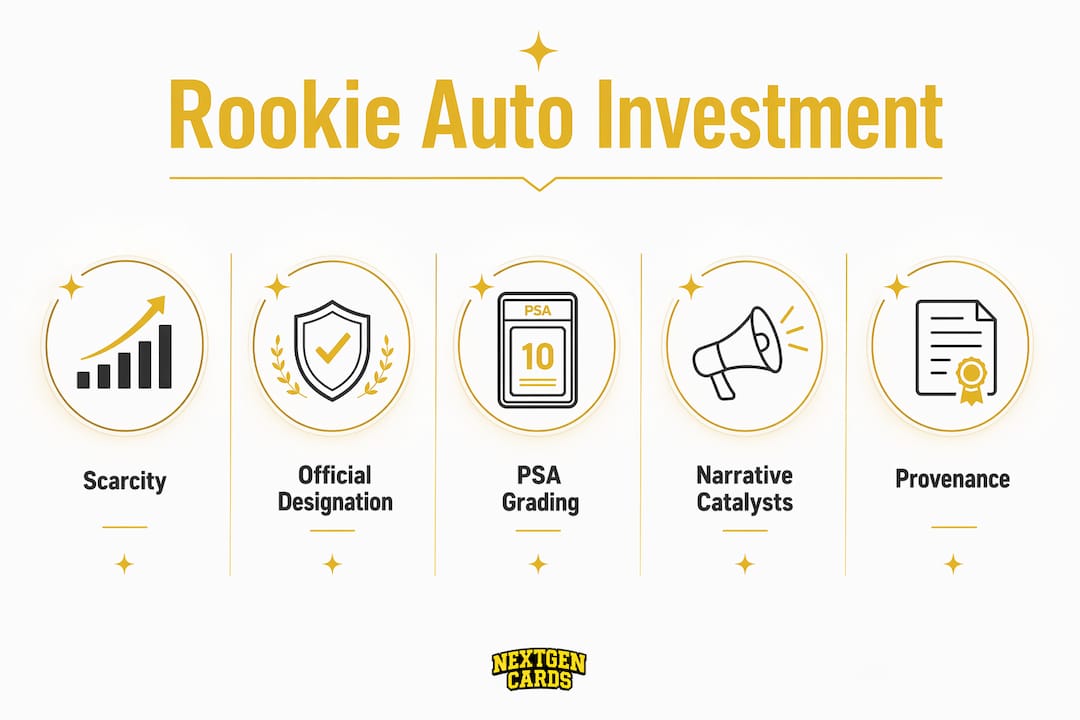
Scarcity alone cannot substitute for player popularity or performance for sustained value. A card numbered /10 for a prospect who never reaches the majors will still lose value. Scarcity is a force multiplier, not a guarantee.
Why does official rookie designation matter for card value?
The “true rookie” designation is the most misunderstood concept in card investing. A true rookie card carries the official rookie logo from the relevant league and appears in a licensed product during the player’s first eligible season. Minor league or pre-rookie cards are riskier and speculative because they lack this anchor, regardless of how early they were produced.
The brand behind the set matters almost as much as the designation itself. Here is why brand prestige directly affects investability:
- Flagship set recognition drives collector adoption. Sets like Panini Prizm, National Treasures, and selected Topps products carry decades of collector trust. That trust translates directly into liquidity when you need to sell.
- Manufacturer licensing determines whether a card qualifies for official rookie status. Unlicensed products cannot carry the rookie logo, which limits their long-term market acceptance.
- Set hierarchy within a brand affects value. A National Treasures rookie auto commands a different market than a base-tier product from the same manufacturer, even for the same player.
- Collector adoption rates for flagship sets are predictable. True rookie autos with low serials and established brand backing have persistent market demand that prospect cards simply cannot match.
Investing in a pre-rookie card because it was produced earlier is a common mistake. The market prices official rookie designation as a premium, not a technicality.
How does PSA grading affect rookie auto investment returns?
Grading transforms a raw card into a standardized, tradeable asset. A PSA 10 (Gem Mint) grade commands significant price multipliers over ungraded equivalents. The multiplier exists because grading removes condition uncertainty, which is one of the biggest barriers to buyer confidence in the secondary market.
Population reports are the tool serious investors use to gauge how rare a PSA 10 actually is for a specific card. A card with only three PSA 10 copies in the entire population report trades very differently from one with 300. Established PSA 10 populations ensure liquidity and higher premiums, but only when the population is low enough to signal genuine scarcity within the graded tier.
Key considerations for grading decisions:
- Buy graded when possible. Purchasing an already-graded PSA 10 eliminates the risk of a lower grade eroding your investment.
- Understand grading costs before buying raw. Grading fees, turnaround times, and the probability of achieving a PSA 10 must factor into your cost basis.
- Check the population report before submitting. A disciplined grading approach with pre-set grading thresholds prevents costly missteps that erode profit margins.
- High-quality patches affect grading difficulty. Patch colors and materials influence centering and surface grades more than most investors expect.
Pro Tip: Use PSA’s population report tool before buying any raw card for grading. If the PSA 10 population already exceeds 200 copies, the scarcity premium within the graded tier is largely gone, and the investment case weakens significantly.
How do narrative catalysts and provenance shape rookie auto prices?
Player milestones create the most dramatic short-term price spikes in the rookie auto market. The earliest market spikes happen around first MLB call-ups, making timing alerts critical for investors who want to buy before the spike rather than chase it afterward.
Provenance and patch quality add a separate layer of value that persists beyond the initial hype cycle. Game-used materials command higher premiums than player-worn items, and multi-color patches trade at a premium over single-color patches.
| Catalyst Type | Value Impact | Duration |
|---|---|---|
| First MLB call-up | Strong short-term spike | Weeks to months |
| Rookie of the Year award | Sustained appreciation | Months to years |
| Playoff or World Series performance | Significant spike with lasting floor | Months to years |
| Multi-color game-used patch | Persistent premium over single-color | Long-term |
| 1/1 printing plate or logoman | Extreme valuation, limited liquidity | Indefinite hold risk |
Patch quality and provenance significantly affect rookie patch auto value, with game-used materials commanding the highest premiums. One important nuance: ultra-rare 1/1 cards may be difficult to exit quickly despite their high valuation. Liquidity varies greatly for the highest-scarcity cards, and holding period risk increases when the buyer pool is extremely narrow.
What are the best investment strategies for rookie autos in 2026?
A disciplined strategy beats speculation in the rookie auto market. Ladder buying divides investments into tranches tied to player milestones, which reduces exposure to hype-induced volatility. Instead of buying a single expensive card at peak hype, you buy smaller positions at different price points as the player’s career develops.
Practical strategies for 2026:
- Set buy thresholds before a catalyst event. Decide your maximum price before a player’s debut, not during the spike. Post-debut prices often correct within weeks.
- Diversify across multiple rookies. Concentrating in one player amplifies both upside and downside. Spreading across three to five prospects in different positions reduces single-player risk.
- Prioritize graded cards over raw when the market is hot. Raw cards carry condition risk that is hard to price accurately during hype cycles.
- Avoid unnecessary grading fees on high-population cards. Base rookie cards depreciate rapidly without flagship set backing, grading potential, and sustained player performance. Grading a card with a weak investment case does not improve the case.
- Monitor population reports quarterly. A rising PSA 10 population on a card you hold signals that the scarcity premium is eroding. That is your signal to reassess your exit timeline.
Pro Tip: Set a pre-defined exit price before you buy, not after. Investors who set sell targets at purchase are far less likely to hold through a correction waiting for a price that may never return.
Examples of appreciating rookie cards consistently share these traits: low serial numbers, flagship set origin, PSA 10 grades, and players who delivered on their early promise.
Key Takeaways
Rookie autos are investable when scarcity, official designation, grading quality, and player narrative align together, not when any single factor stands alone.
| Point | Details |
|---|---|
| Scarcity drives floor value | Cards numbered /49 or lower hold value even when player performance disappoints. |
| Official rookie designation is non-negotiable | True rookie status from a licensed flagship set is the foundation of long-term market demand. |
| PSA 10 grades command multipliers | Graded cards eliminate condition uncertainty and trade at significant premiums over raw equivalents. |
| Narrative catalysts create timing opportunities | First call-ups and awards generate spikes; buy before the catalyst, not during it. |
| Ladder buying reduces hype risk | Splitting purchases across player milestones protects against single-event volatility. |
The uncomfortable truth about rookie auto investing
I have watched collectors overpay for rookie autos at peak hype more times than I can count, and the pattern is always the same. A prospect gets called up, the card market spikes within 48 hours, and buyers who missed the early window pay three times the pre-debut price hoping the momentum continues. Sometimes it does. More often, it corrects sharply within a month.
The investors who consistently profit from rookie autos are not the ones with the best player instincts. They are the ones with the most disciplined process. They set buy prices before events happen, they understand the difference between a /10 National Treasures RPA and a base Prizm rookie, and they check population reports before submitting anything to PSA.
The biggest mistake I see is treating grading as a guaranteed value add. Grading a card that already has a high PSA 10 population does not create scarcity. It just adds cost. The card’s investment case has to be strong before grading, not because of it.
The future of this market points toward continued growth, but also toward more sophisticated buyers. Collectors entering the hobby in 2025 and 2026 are more data-literate than previous generations. They check population reports, they track auction histories, and they understand print run tiers. That means the easy arbitrage opportunities are shrinking. The investors who will outperform are the ones who combine genuine player knowledge with rigorous market discipline, and who treat passion for the hobby as a bonus, not a strategy.
— Richard
Authenticated rookie autos, curated for serious investors
Nextgencards specializes in exactly the cards this guide describes: low-serial rookie autographs from flagship sets, authenticated relics, and rare redemption cards from athletes like Shohei Ohtani, Aaron Judge, and Paul Skenes.
Every card in the Nextgencards inventory is selected for rarity, provenance, and collector demand. The rookie autographs and relics collection includes authenticated RPAs and serial-numbered autos that meet the investment criteria covered in this guide. Free shipping is available on select items. If you are ready to add a card with genuine long-term value to your portfolio, Nextgencards is the place to start.
FAQ
What is a rookie auto in sports card investing?
A rookie auto is an autographed card produced during a player’s first eligible season in a licensed product. The most investable versions carry an official rookie designation and come from flagship sets with low serial numbers.
Why do cards numbered /49 or lower hold value better?
Cards numbered /49 or lower maintain reliable floor values because their supply is permanently capped, which protects against depreciation even when player performance disappoints.
Does grading always increase a rookie auto’s value?
Grading increases value when the PSA 10 population is low and the card comes from a strong investment-grade set. Grading a card with a high existing PSA 10 population adds cost without adding meaningful scarcity.
What is the best time to buy a rookie auto?
The best time to buy is before a player’s first major league call-up or award announcement. Post-debut price spikes often correct within weeks, so buying during the spike typically reduces your return.
Are 1/1 rookie autos the best investment?
Not necessarily. Ultra-rare 1/1 cards carry extreme valuations but limited liquidity. The buyer pool is very narrow, which makes exiting at your target price difficult and increases holding period risk.
0 comments