

A parallel card is defined as an alternate version of a base trading card that shares the same photo and checklist number but features distinct visual elements such as color borders, foil treatments, or serial numbering to create separate collectible tiers. Parallels in trading cards explained properly means understanding that these variants are not random errors or reprints. They are intentional production decisions by manufacturers like Topps to build rarity into every set. Collectors use parallels to chase specific tiers, complete rainbow sets, and assess card value based on print run size. Serial numbering, foil finishes, and box exclusivity are the three core features that define where any parallel sits in the rarity hierarchy.
What are the common types of trading card parallels?
Parallels share the same checklist number and photo as base cards; inserts carry separate numbering and entirely different designs. That distinction matters because collectors often confuse the two. A parallel of a Shohei Ohtani base card still shows Ohtani’s same image. An insert featuring Ohtani would have a unique design concept separate from the base set.
The main types of parallels collectors encounter fall into four categories:
- Color parallels: These use a distinct border or background color to signal rarity. Common examples include blue, gold, red, and black borders. Each color typically corresponds to a specific print run, with darker or less common colors indicating greater scarcity.
- Foil and refractor parallels: These feature holographic or light-catching finishes. Topps Chrome refractors are the most recognized example. Variations within this category include Wave, Lava, and Neon Pulse patterns, each with a distinct visual texture visible under direct light.
- Serial-numbered parallels: These carry a stamped number on the card face, such as 34/99, indicating the card is the 34th copy out of 99 printed. The serial number is the most reliable indicator of a parallel’s rarity tier.
- Box-exclusive parallels: Certain parallels are gated to Hobby, Mega, Hanger, or Fanatics-exclusive boxes, making product-specific checklists necessary for completion strategies. A parallel available only in Hobby boxes will be harder to find than one seeded across all retail formats.
Understanding these four types gives collectors a clear framework for evaluating any card they pull or purchase.
How does rarity and serial numbering influence parallel value?

Serial numbering is the clearest signal of scarcity in modern trading card sets. A /25 card is rarer than a /99 card, and the denominator drives both collector demand and secondary market pricing. The smaller the print run, the fewer copies exist, and the harder the card is to find.
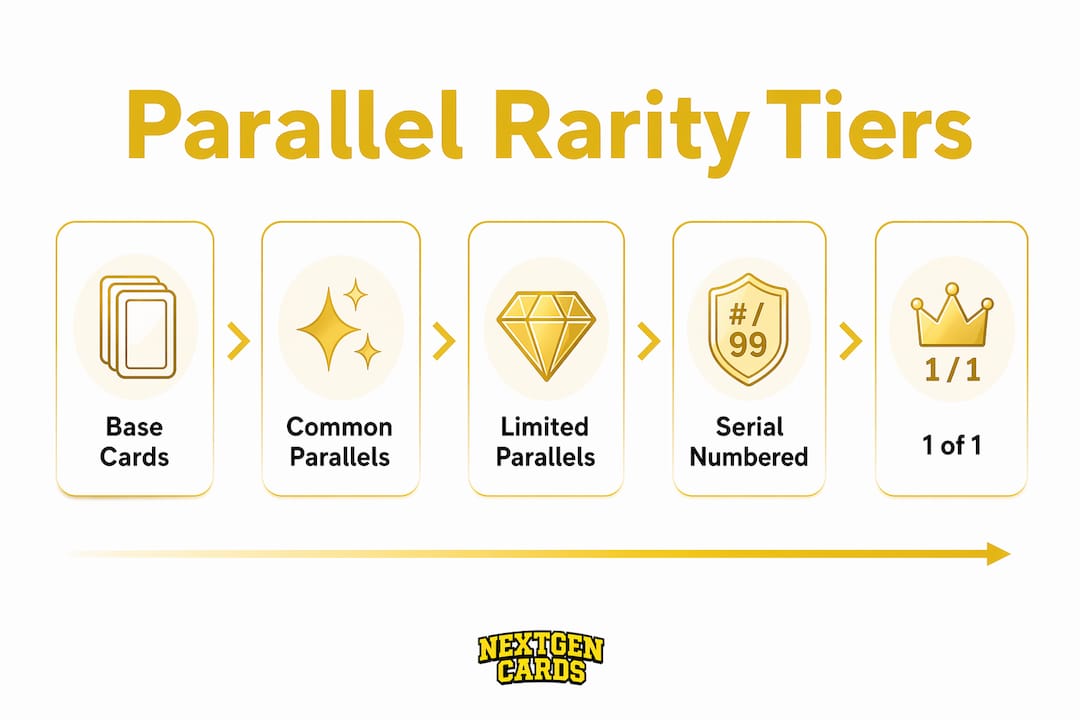
Modern Chrome-style sets follow a color-coded rarity hierarchy that descends from base cards down to the 1/1 Superfractor. The 2026 Topps Chrome Black Baseball set illustrates this structure clearly.
| Rarity Tier | Print Run | Typical Color |
|---|---|---|
| Base Refractor | Unlimited | Silver |
| Blue | /150 | Blue |
| Green | /99 | Green |
| Gold | /50 | Gold |
| Orange | /25 | Orange |
| Red | /5 | Red |
| Superfractor | 1/1 | Gold Prismatic |
Each step down the table represents a meaningful jump in scarcity. A Gold parallel at /50 is three times rarer than a Green at /99. That ratio directly affects what collectors pay on the secondary market.
Rarity is one variable; market behavior is the other. A /25 parallel of a fringe prospect may sell for less than a /99 parallel of a top rookie. Print run rarity alone doesn’t guarantee value; collectors should cross-reference serial numbers with real sales data to gauge true demand.
Pro Tip: Check recent sold listings on major resale platforms before buying any serial-numbered parallel. A card’s rarity tier tells you how many exist. Actual sales tell you what collectors are willing to pay.
Collectors who focus only on the denominator without checking market demand often overpay. The intersection of rarity and player popularity determines real value.
How do you identify and verify parallels when collecting?
Accurate identification is a skill that separates experienced collectors from beginners. Visual identification relies on border color, holographic effects, and light-reflecting patterns such as Wave or Lava finishes. Some parallels are immediately obvious. Others require close examination under direct light to spot the difference.
Follow these steps to verify a parallel accurately:
- Check the card front for border color. Color parallels use a distinct border that differs from the standard base card. Compare the card directly against a known base copy if possible.
- Tilt the card under light. Foil and refractor parallels reveal their finish when angled. Wave patterns show a ripple effect. Lava patterns show irregular color flow. Neon Pulse parallels glow with bright color under direct light.
- Read the serial number on the card face. Most numbered parallels stamp the print run directly on the front. Confirm the number matches the expected tier for that product.
- Examine the card back. Some parallels differ only in back print or subtle textures, requiring examination under good lighting and with reference materials for accurate identification.
- Consult the manufacturer’s official checklist. Topps publishes product-specific parallel guides for major releases. These list every parallel type, its print run, and which box format it appears in.
Pro Tip: Download the official product checklist before opening any box. Knowing the full parallel structure in advance prevents misidentification and helps you recognize every card you pull.
A common beginner mistake involves confusing pack-hit odds with fixed print runs. Some parallels are pack hit odds, such as 1 in 500 packs, rather than fixed rarity. A card listed as a 1:500 pack hit is not the same as a card stamped /25. Always verify via the official checklist rather than assuming rarity from odds alone.
How do parallels fit into collecting strategies?
Parallels are part of Added Value Content (AVC), the primary tool manufacturers use to create scarcity and justify premium product pricing. Every parallel tier adds a reason to open another pack. That structure drives both retail demand and the secondary market for individual cards.
Collectors use parallels in several distinct ways:
- Rainbow collecting: A rainbow set means acquiring every parallel of a single card, from the base version through the 1/1 Superfractor. Completing a rainbow for a star player like Aaron Judge requires patience, budget, and access to box-exclusive tiers.
- Checklist completion: Some collectors target a specific player across an entire set, tracking every parallel tier in the official checklist. This approach requires knowing which box formats contain which parallels.
- Investment targeting: Collectors benefit from integrating serial numbering data with market sales info to make informed purchasing and selling decisions. Low-print-run parallels of top rookies carry the strongest long-term demand.
- Box selection strategy: Experienced collectors prioritize understanding print runs and exclusive parallel types to develop focused collecting strategies. Buying Hobby boxes when chasing /25 or lower parallels makes more sense than buying retail packs where those tiers do not appear.
The most practical advice for any collector is to define the goal first. Chasing a rainbow set requires a different budget and sourcing strategy than targeting one specific low-print-run parallel for investment. Knowing the difference saves both time and money. You can also review valuable insert comparisons to see how parallels stack up against other high-demand card types.
Key Takeaways
Parallels are defined by their print run, visual finish, and box exclusivity, and understanding all three factors is the foundation of any serious collecting strategy.
| Point | Details |
|---|---|
| Parallels vs. inserts | Parallels share the base card’s checklist number; inserts have separate numbering and unique designs. |
| Serial number hierarchy | Print runs descend from unlimited base cards to the 1/1 Superfractor, with each tier representing greater scarcity. |
| Rarity vs. value | A lower print run does not guarantee higher market value; player demand drives actual sale prices. |
| Box exclusivity matters | Some parallels appear only in Hobby or Fanatics-exclusive boxes, making product knowledge necessary for completion. |
| Verification method | Confirm parallels using border color, foil finish, serial number, and the official manufacturer checklist. |
Why parallels changed how I collect
Parallels reshaped my entire approach to building a collection. Early on, I treated every shiny card as equally desirable. That changed the first time I overpaid for a card I thought was rare, only to discover it was a pack-hit parallel with no fixed print run. That experience taught me to read the checklist before I read the price tag.
What I find most interesting about parallels is how they expose the difference between perceived rarity and actual scarcity. A Gold /50 of a top prospect feels rare in hand. But if that player underperforms, the secondary market reflects it quickly. The card’s rarity tier stays fixed. Its value does not. Collectors who understand that distinction make better decisions at every price point.
My honest advice: pick one player or one set and learn its parallel structure completely before expanding. Knowing every tier of a 2026 Topps Chrome release, including which parallels are Hobby-only and which appear in retail, gives you a real edge when buying and selling. Chasing every shiny card across multiple products leads to an unfocused collection and a stretched budget. Depth beats breadth in this hobby every time. You can get a head start by reading the serial number guide to sharpen your rarity assessment skills.
— Richard
Rare parallels and rookie autographs at Nextgencards
Nextgencards carries a curated selection of rare rookie autographs, relic cards, and limited-edition redemption cards built for serious collectors.
The inventory includes high-demand cards like the 2026 Cooper Flagg Topps VIP Autograph Rookie RC, a serial-numbered redemption card with strong collector demand. Nextgencards also stocks rare rookie autographs and relics across baseball, basketball, and football, with free shipping on select items. Every card in the catalog is authentic, making Nextgencards a reliable source for collectors who prioritize verified rarity and condition.
FAQ
What is a parallel card in trading cards?
A parallel card is an alternate version of a base card that shares the same photo and checklist number but features a distinct visual treatment such as a color border, foil finish, or serial number. Parallels create collectible tiers within a single set.
How do I tell a parallel from an insert?
Parallels use the same checklist number as the base card; inserts carry a separate number and a unique design concept. If the card matches the base card’s image and number but looks visually different, it is a parallel.
What does the serial number on a parallel mean?
The serial number, such as 34/99, indicates the card is the 34th copy out of 99 printed. A smaller denominator means fewer copies exist, which signals higher scarcity and typically stronger collector demand.
Are all rare-looking parallels actually low-print-run cards?
Not always. Some parallels are distributed at pack-hit odds, such as 1 in 500 packs, rather than stamped with a fixed print run. Always verify rarity using the official manufacturer checklist rather than relying on visual appearance alone.
What is a rainbow set in card collecting?
A rainbow set is a complete collection of every parallel version of a single card, from the base copy through the 1/1 Superfractor. Completing a rainbow requires sourcing parallels across multiple box formats, including Hobby and retail-exclusive tiers.
0 comments