

Layered protection is the single best answer to UV protection for cards: keep cards out of direct sunlight, house them in UV-rated sleeves or cases, and control the lighting and rotation schedule wherever they’re displayed. No single product does this job alone. A toploader stops scratches, not ultraviolet rays, and a slab protects against handling, not light exposure.
Start with the highest-impact moves:
- Move any displayed card at least a few feet from windows, or block the window with UV-filtering film.
- Replace fluorescent or halogen display lighting with quality low-UV LEDs.
- Add a UV-blocking adhesive overlay or UV-grade acrylic case over raw cards and graded slabs alike.
- Rotate displayed cards out every few months so no single piece takes on cumulative exposure.
When you’re comparing products, one number matters more than any marketing tagline: UV-A transmission in the 315–400 nm range. That’s the band responsible for almost all visible card fading, and a product that doesn’t state a percentage in that specific range isn’t telling you anything useful.
Key Takeaways
Layered protection, combining UV-A-rated materials with environment control and display rotation, is the only reliable way to prevent permanent fading on trading cards.
| Point | Details |
|---|---|
| UV-A is the culprit | Fading comes from the 315–400 nm band, not UV-B or UV-C, so check products for that specific range. |
| Slabs aren’t UV shields | PSA, BGS, and CGC slabs protect physically but don’t block meaningful UV-A on their own. |
| Materials matter | UV-grade acrylics and adhesive films can cut UV-A transmission to the single digits versus standard clear plastic. |
| Rotation prevents cumulative damage | Displayed cards should rotate into dark storage every few months rather than sitting under lights indefinitely. |
| Buy condition-first, protect immediately | Nextgencards sources rare rookie autographs and relics, and pairing them with UV-rated sleeves from day one preserves both condition and value. |
Table of Contents
- What UV Light Actually Does to a Trading Card
- Where Does UV Exposure Actually Come From in Your Home?
- Do Standard Toploaders and Graded Slabs Block UV?
- Which Materials Actually Filter UV-A?
- Building a Layered Protection System for Raw and Graded Cards
- How to Spot a Real UV Protection Claim Before You Buy
- How Fast Does Fading Actually Happen?
- Myths That Are Quietly Ruining Collections
- What I Learned Building Out a Layered Protection Setup
- Protecting Your Collection Starts Before the Card Arrives
- Frequently Asked Questions
- Sources
What UV Light Actually Does to a Trading Card
Ultraviolet light isn’t one thing. It splits into UV-A (315 to 400 nanometers), UV-B (280 to 315 nm), and UV-C (100 to 280 nm), and for a card sitting in your living room or display case, UV-A is the one doing almost all the damage. It passes through ordinary window glass and most clear plastics with surprising ease, while UV-B and UV-C get filtered out far more effectively by comparison.
Here’s the mechanism in plain terms: UV-A photons carry enough energy to break down the chromophores, the light-absorbing molecules that give printed inks their color. Once that molecular structure breaks, the pigment can’t reflect light the way it originally did, so colors wash out, blacks turn gray, and card stock takes on a yellowish tint. Holographic foils and chrome finishes are especially exposed because their reflective layers sit right at the surface, catching every photon that hits the card.
This damage does not reverse. There’s no treatment, cleaning process, or storage fix that restores faded ink to its factory color once the chromophores have degraded. That’s why prevention, not correction, is the entire game.
Vintage cards from the 1970s and 1980s carry an added risk: many older printing inks were less UV-stable to begin with, so they show visible fading faster than modern cardstock exposed to the same light. According to DeckSentry’s breakdown of UV and card protection, standard toploaders and common clear plastics were never engineered as a primary UV defense, which means the fading clock starts the moment a vulnerable card sits in a lit room, slab or no slab.
Where Does UV Exposure Actually Come From in Your Home?
Most collectors picture sunlight streaming through a window as the main threat, and that’s accurate, but it’s not the only one. Ranked by how much damage they typically cause:
- Direct sunlight is the worst offender by a wide margin, delivering the highest-intensity UV-A a card will ever see.
- Window-filtered sunlight is still a real risk. Standard glass blocks a good share of UV-B but lets a meaningful amount of UV-A through, so a “shaded” display case near a window isn’t as safe as it looks.
- Fluorescent tubes and halogen spotlights, common in display cabinets and retail-style setups, emit UV-A as a byproduct of how they generate light.
- Some LEDs and reflective surfaces contribute too, though generally at far lower intensity than the sources above.
Pro Tip: Apply a strip of inexpensive UV-detecting card stock (or even a scrap of colored construction paper) to a display spot for two weeks. If it visibly fades faster than the same paper stored in a drawer, that spot is too hot for a valuable card.
Do Standard Toploaders and Graded Slabs Block UV?
Short answer: not reliably, and collectors who assume otherwise are the ones most likely to open a slab in five years to a faded card. Here’s how the common options stack up.
- Soft penny sleeves offer essentially no UV filtration. They’re a dust and scratch barrier, nothing more.
- Rigid PVC toploaders are similarly transparent to UV-A unless a manufacturer specifically formulates them with UV inhibitors, which most budget toploaders don’t.
- Acrylic display cases, unless labeled UV-grade, transmit UV-A at rates that will fade a card over months to years of display.
- Graded slabs from PSA, BGS, and CGC are built for authentication and physical protection, holding cards securely under tamper-evident plastic. They are not marketed or engineered as UV shields, and their clear casing lets UV-A through just like any other unmodified acrylic or polystyrene.
The physics explains why: visual transparency and UV blocking are two different properties. A slab can look perfectly clear while still transmitting most of the UV-A hitting its surface, because the polymer wasn’t formulated with UV-absorbing additives.
That’s the case for supplementing, not replacing, a slab. If a graded card is going on long-term display rather than sitting in a dark box, add an adhesive UV film over the slab or house it inside a UV-filtering outer case. The slab handles physical protection; the added layer handles light.
Which Materials Actually Filter UV-A?
This is where label-reading pays off, because “UV protected” printed on packaging means almost nothing without a wavelength attached to it.
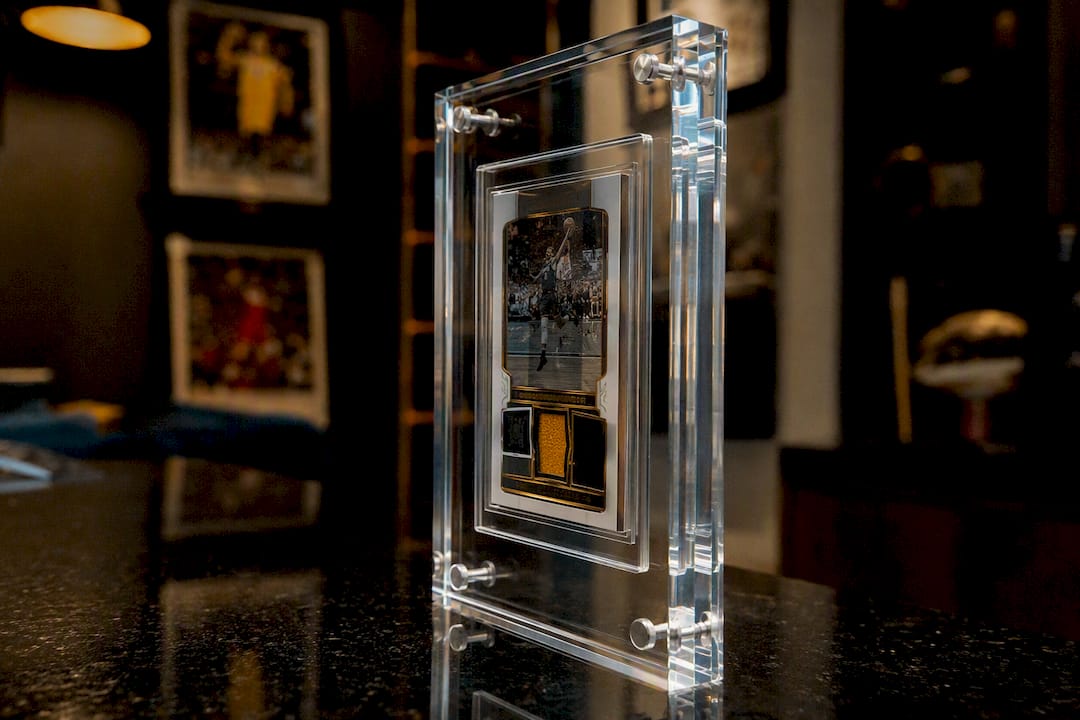
Standard cast acrylic, the kind used in most inexpensive display cases, only blocks a fraction of the UV-A that actually causes fading. UV-grade acrylics and absorbing formulations (Shinkolite is one commonly cited example) are manufactured with additives, often benzotriazole-based, that specifically target the 315 to 400 nm band. According to Wetop Acrylic’s spec guide on UV protection, these absorbing grades can cut combined UV-A transmission to a low single-digit percentage, a dramatic difference from standard clear cast acrylic exposed to the same light source.
Polycarbonate and PMMA (acrylic) behave differently under UV too. Polycarbonate tends to yellow over time under UV exposure itself, while UV-stabilized PMMA holds its clarity longer, which matters if you’re choosing a case meant to last years rather than months.
For products designed specifically for cards, look at these categories:
- UV-filtering acrylic display cases, built with absorbing acrylic rather than standard cast sheet.
- UV-blocking outer sleeves, layered outside a standard toploader for double protection.
- Adhesive full-card UV overlays, thin films applied directly over a slab or toploader surface. DisplayGeek’s FlexFilm product is one example, offering roughly 90 to 95% UV filtration while keeping the slab’s surface visible and undamaged.
- Museum-grade glass, typically reserved for high-value framed pieces.
- UV window film, applied to the glass itself rather than the card housing.
Adhesive overlays aren’t unique to cards, either. AplusID’s UV-blocking overlay products show the same self-adhesive UV film technology used across outdoor signage and badges, applied here to protect printed artwork from cumulative light exposure.
A statistic worth memorizing: standard clear acrylic can transmit the majority of incident UV-A, while an absorbing-grade acrylic or a quality adhesive film can push that number down to the single digits.
Pro Tip: If a product page says “UV protected” without naming a percentage and a wavelength range, treat it as marketing copy, not a spec. Ask the seller directly for a spectral transmission curve covering 315–400 nm before you buy.
Building a Layered Protection System for Raw and Graded Cards
Preservation professionals don’t rely on one product to do this job, and neither should you. The CARLI collections management guidance on environmental monitoring recommends combining UV-blocking display materials, controlled lighting, interior placement, and rotation as a system rather than a single fix. Here’s how to build that system step by step.
Step 1: Control the environment first. Choose interior walls over window-adjacent walls for any permanent display. Swap fluorescent or halogen bulbs for low-UV LEDs. If a room can’t avoid window light entirely, apply UV-filtering film to the glass itself.
Step 2: Layer the product protection. For raw cards, that means an inner penny sleeve, a rigid toploader or one-touch magnetic holder, and a UV-blocking outer sleeve or box on top. The NEDCC’s preservation leaflet on light damage specifically recommends UV-blocking additives in holders paired with UV-resistant sleeves for exactly this kind of double-layered defense.
Step 3: Add a rotation schedule. Any card on active display accumulates exposure every hour it’s out. Rotate valuable pieces out every few months into dark, archival storage rather than leaving a single card under lights indefinitely.
For raw cards specifically, your checklist looks like this:
- Inner sleeve plus rigid toploader or magnetic holder.
- UV-blocking outer sleeve for anything staying out of storage.
- Dark, archival box storage when not on display.
For graded slabs, adjust the checklist:
- Add a UV-blocking adhesive film or sleeve over the slab itself.
- Choose a UV-filtering display case rather than standard acrylic.
- Apply the same rotation discipline, since a slab’s tamper-evident casing offers zero UV benefit on its own.
Step 4: Maintain and verify. Inspect display cases every few months for early yellowing or clouding, which can signal that a UV film or acrylic panel is degrading and losing effectiveness. Ask manufacturers for spectral transmission data rather than trusting a printed percentage, and replace adhesive overlays if they show any peeling, bubbling, or discoloration. PhantomDisplay’s guidance on protecting cards from UV damage points out that direct sunlight can produce visible fading within weeks, which is a useful benchmark for how urgently a bad display spot needs fixing.
Pro Tip: Plan display rotation the way museums plan loan exhibits: cap any single card’s display time and log the swap dates. A basic spreadsheet with “date displayed” and “date rotated out” prevents the slow, easy-to-miss creep of cumulative exposure.
If you’re weighing whether a card should be raw or graded in the first place, the choice affects which protection layers make sense, worth reading alongside our breakdown of raw versus PSA-graded cards.
How to Spot a Real UV Protection Claim Before You Buy
Not every “UV resistant” label deserves your money. Use this checklist at the point of purchase:
- Look for a specific wavelength range, 315 to 400 nm, attached to any UV blocking claim.
- Ask for a spectral transmission graph or numeric test data, not just a percentage on the packaging.
- Check whether the claim covers UV-A specifically, since some products only test against UV-B or UV-C, which barely matters for card fading.
- Confirm the test method or standard referenced, if any.
Red flags include vague phrases like “UV protected” with no number attached, or protection percentages that don’t specify which UV band was tested. According to Wetop Acrylic’s spec guide, marketing claims that skip the wavelength are frequently misleading, since a product can legitimately claim “UV protection” while doing almost nothing against the 315 to 400 nm band that actually fades ink.
When cost and protection trade off, weigh it against the card’s value. A $15 adhesive overlay is a rounding error next to a four-figure rookie autograph.
How Fast Does Fading Actually Happen?
Timelines vary enormously based on light source and intensity:
- Direct sunlight: visible fading can appear within weeks to a few months.
- Window-filtered light or retail-style track lighting: months to a few years, depending on proximity and duration.
- Indoor low-UV LED lighting: years, but damage still accumulates and never fully stops.
Vintage inks, holographic surfaces, high-intensity retail lighting, and non-archival storage materials all accelerate the timeline. If you notice even slight yellowing or color shift on a displayed card, move it into dark, archival storage immediately rather than waiting to see if it gets worse. It will.
Myths That Are Quietly Ruining Collections
A few bad assumptions cause more fading than any single lighting mistake:
- “Any clear plastic protects equally.” It doesn’t. Standard acrylic and UV-grade acrylic can differ by a wide margin in UV-A transmission.
- “PSA, BGS, and CGC slabs are UV-proof.” They’re built for authentication and physical protection, not light filtration.
- “Keeping cards indoors eliminates the risk.” Indoor lighting and window-filtered sunlight still deliver damaging UV-A over time.
Avoid taping cards to windows for display, trusting unspecified “% UV” labels, or lighting a display case with bright halogen or fluorescent bulbs.
Pro Tip: The cheapest fix on this whole list is swapping fluorescent or halogen display bulbs for quality low-UV LEDs. It costs less than a single graded slab and cuts a meaningful source of cumulative exposure immediately.
What I Learned Building Out a Layered Protection Setup
Setting up a real rotation schedule felt like overkill at first, a spreadsheet for trading cards seemed excessive. It wasn’t. The lesson that stuck: environment controls did more heavy lifting than any single product purchase. Moving a display case off a window wall and swapping in LED bulbs cut visible risk faster than any sleeve upgrade did. Layering still matters, but fix the room before you fix the plastic.
Protecting Your Collection Starts Before the Card Arrives
Preservation doesn’t start with the display case, it starts with what condition a card is in when it reaches your hands. Nextgencards focuses on rare rookie autographs, patch cards, and redemption cards precisely because condition and authenticity drive long-term value, and that’s the same reason we point collectors toward proper UV protection the moment a card arrives.
If you’re building out a collection worth protecting, start by browsing our rookie autograph and relic collection, where each listing is curated for collectors who take preservation seriously, not just acquisition. Orders ship with the same care we’d want for our own collections, and select items qualify for free shipping. Once your next rookie autograph or rare redemption card lands, pair it with a UV-rated sleeve or case before it ever sees a display shelf. Check out Nextgencards’ full storefront to see what’s currently available.
Frequently Asked Questions
Does UV protection for cards actually prevent fading, or just slow it down? Quality UV-A blocking materials significantly slow the fading process, but no product eliminates light-based degradation entirely. Layered protection combined with rotation and controlled lighting gets you the closest to zero cumulative damage.
Are UV-resistant sleeves worth it for common cards, or only high-value ones? UV-blocking sleeves cost little relative to a toploader or slab, so applying them broadly makes sense. Prioritize your highest-value and most display-prone cards first if budget is a constraint.
Can I use regular window film instead of a UV-rated display case? Window film helps reduce the UV-A entering a room, but it protects the room, not the card. Pair it with a UV-rated case or sleeve for direct protection on the card itself.
Does keeping a card in a dark closet fully eliminate UV risk? Yes, in practical terms. UV damage requires light exposure, so cards stored in genuinely dark, archival conditions face effectively no UV-related fading risk.
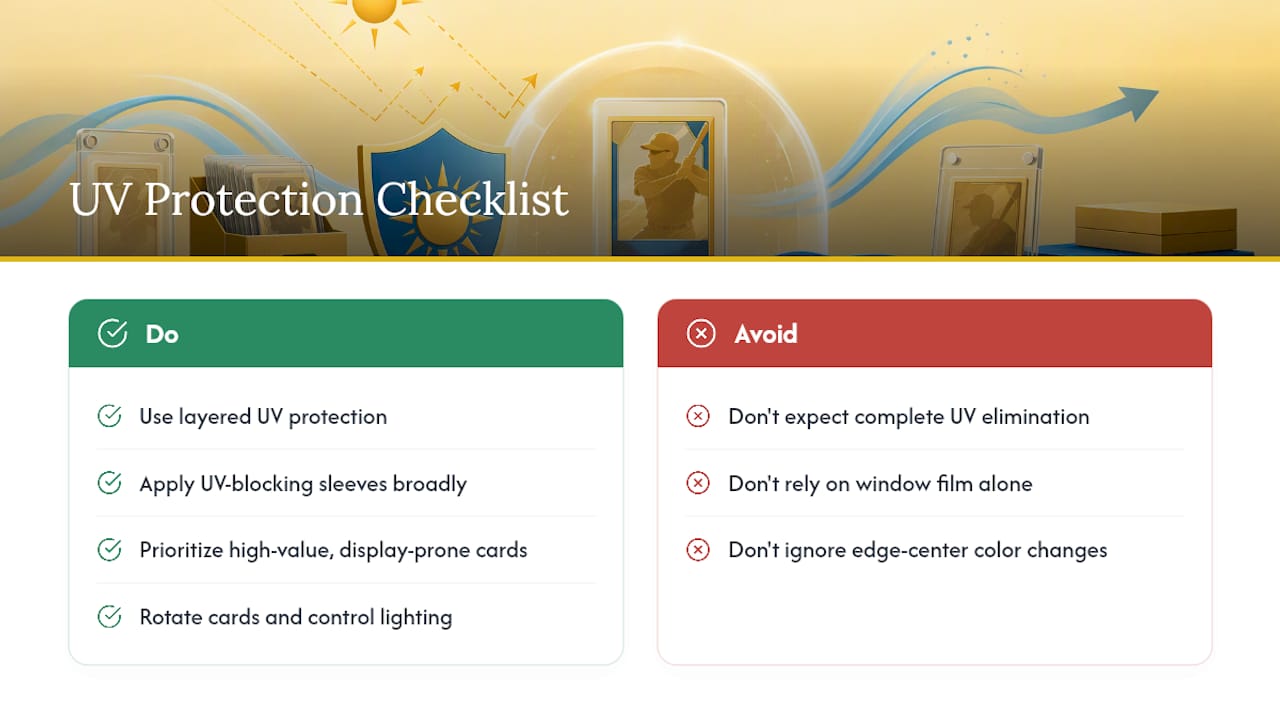
How do I know if my current display setup is already causing damage? Compare a displayed card’s edges (often shielded by the holder) against its exposed center under bright light. Visible color difference between the two areas is an early warning sign worth acting on immediately.
Sources
- NEDCC — Protection from light damage (preservation leaflet)
- CARLI — Importance of environmental monitoring
0 comments