

A rookie card production year is the official season in which a player first appears on a licensed trading card within their sport’s top professional league. This definition sounds simple, but rookie card production info varies significantly across baseball, basketball, and hockey due to different licensing standards and manufacturer conventions. The RC logo standardization that MLB introduced in 2006 changed how collectors identify and verify rookie cards, and understanding that shift is the foundation of smart collecting. Whether you’re building a portfolio around Shohei Ohtani’s debut cards or hunting for vintage prospects, knowing how to date rookie cards accurately protects both your collection and your investment.
How is the rookie card production year officially determined?
The production year for a rookie card is not a universal standard. Each major sport applies its own rules, and those rules have evolved considerably over the past two decades.
Baseball (MLB)
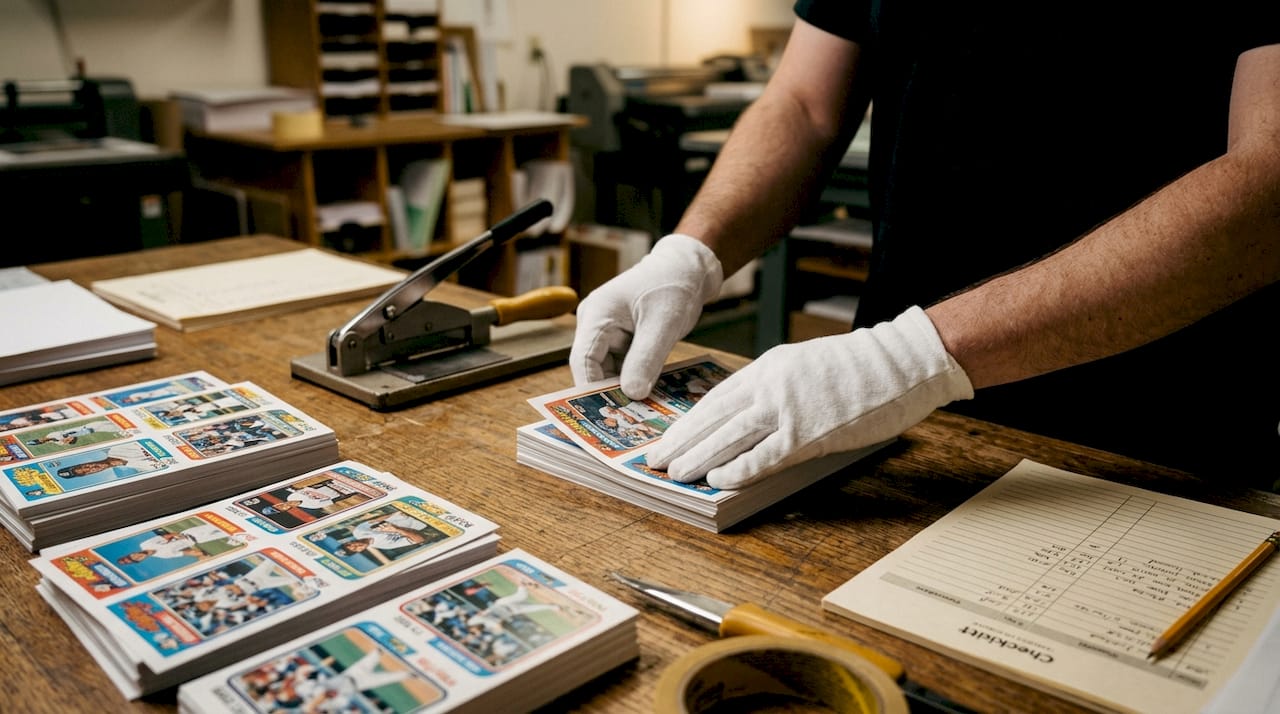
MLB and the MLBPA standardized the rookie card designation in 2006 by introducing the RC logo. This logo appears on the first major-license base-set card issued in the year a player debuts on an Opening Day 25-man roster. Before 2006, collectors had no reliable marker, and multiple cards from the same season were all informally called rookies. The RC logo system resolved that confusion by tying the designation to one specific base card per brand per debut year.
Basketball (NBA)
The NBA shifted to Panini as its exclusive card manufacturer in 2009. Panini’s rookie card convention follows a similar principle: the official rookie card appears in the flagship base set of the player’s debut season. Panini Prizm and Panini Select are the most recognized flagship sets, and their base rookie cards carry the highest market recognition among NBA collectors.
Hockey (NHL)
Upper Deck’s Young Guns checklist functions as the rookie card baseline in hockey. The checklist release year anchors the rookie designation rather than all contemporaneous printings. This means a Young Guns card from a specific Upper Deck Series 1 release is the definitive rookie card for that player, regardless of other cards printed in the same season.
Several additional rules apply across all three sports:
- Prospect cards issued before a player’s major league debut are not official rookie cards, even if they carry high market value.
- Multiple rookie cards can exist per player in a debut year because multi-brand licensing allows several manufacturers to produce base set cards simultaneously.
- Insert cards, autograph parallels, and relic cards within a debut-year set may carry the RC logo but are distinct from the base rookie card in terms of scarcity and pricing.
- Collectors distinguish primary rookies (flagship base sets) from secondary rookies and prospect cards when assessing long-term value.
Understanding these sport-specific standards is the first step in applying rookie card eligibility rules correctly when building or evaluating a collection.
Vintage vs. modern rookie cards: how production year identification differs
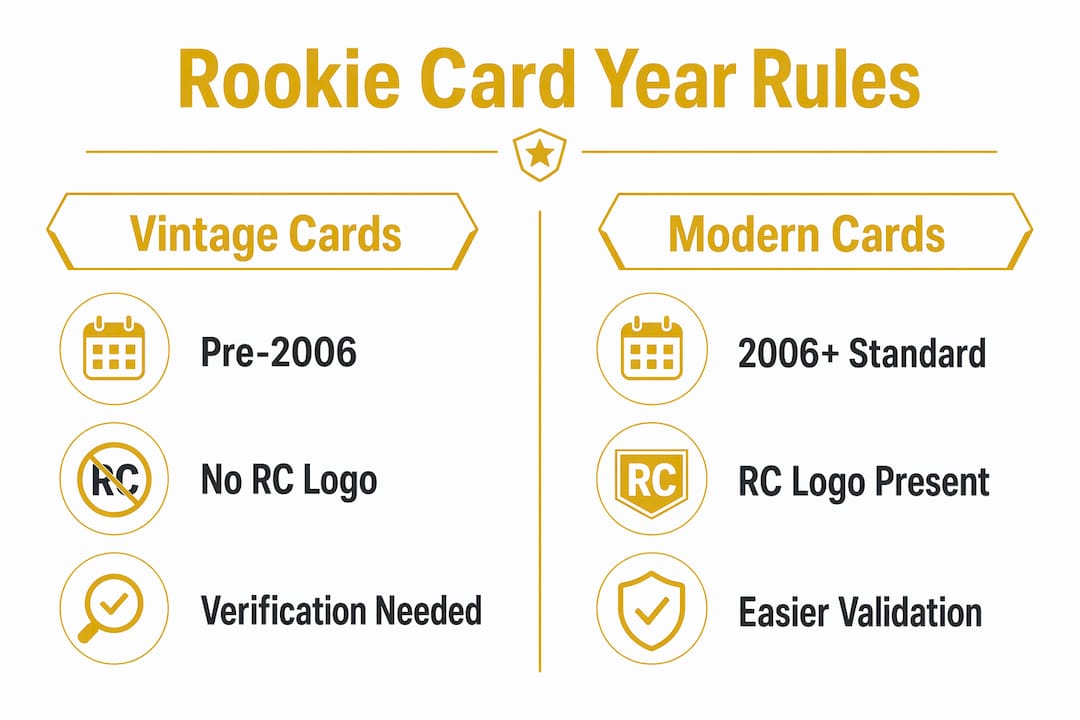
The absence of the RC logo before 2006 is the single biggest challenge for collectors working with vintage cards. Without that marker, confirming a card’s rookie status requires a different verification process entirely.
For cards produced before 2006, verification requires checking the player’s debut year against the card year and manufacturer details printed on the card back. A 1984 Topps Don Mattingly card, for example, carries no RC logo, but its production year aligns with Mattingly’s MLB debut, confirming its rookie status through historical cross-referencing rather than a printed designation.
Modern cards from 2006 onward carry the RC logo on qualifying base set cards, which makes identification faster and more reliable. The logo limits the official rookie designation to one major base card per brand per debut year, reducing the ambiguity that plagued the hobby for decades. This clarity directly supports market liquidity: buyers and sellers share a common language when the RC logo is present.
Rarity and value implications also differ sharply between eras. Vintage rookie cards from the pre-overproduction period (roughly pre-1986) are genuinely scarce because print runs were limited and documentation was minimal. Modern rookie cards benefit from grading services like PSA and BGS, which authenticate and grade condition, adding a layer of market trust that vintage cards often lack unless they have been submitted for grading retroactively.
Pro Tip: When evaluating a vintage rookie card, check the card back for both the copyright year and the set year. These are not always the same, and confusing one for the other is one of the most common rookie card classification errors in the hobby.
One frequently overlooked detail is that the copyright year printed on a card can lag the actual release year. A card with a 1988 copyright may have been physically released and distributed in 1989. This matters because copyright year can lag the actual production year by one full season, which directly affects whether a card qualifies as a true rookie card for a player who debuted in 1989.
Key methods to verify rookie card production year and eligibility
Confirming that a card is a genuine rookie card requires more than a visual check. These steps apply whether you are evaluating a modern Topps Chrome card or a 1986 Fleer Michael Jordan.
-
Confirm the player’s major league debut date. Cross-reference the card’s production year against the player’s first official game in the top professional league. Resources like Baseball Reference, Basketball Reference, and Hockey Reference provide exact debut dates. If the card year matches the debut season, it qualifies as a potential rookie card.
-
Check for the RC logo on post-2006 cards. For baseball cards produced after the RC logo standard was introduced, the presence of the RC logo on a base set card confirms official rookie status. Its absence on a post-2006 base card is a red flag.
-
Read the card back carefully. The card back contains the set year, manufacturer name, and licensing information. For vintage cards, the set year printed on the back is more reliable than the copyright year for determining production year.
-
Use a jeweler’s loupe for small print inspection. Fine print on card backs, particularly on older cards, can be difficult to read without magnification. A 10x jeweler’s loupe reveals set year text, licensing details, and print run information that is invisible to the naked eye.
-
Consult the official set checklist. In hockey, the Upper Deck Young Guns checklist is the authoritative reference. In baseball and basketball, flagship set checklists from Topps and Panini identify which cards carry RC designations within a given year’s release.
-
Distinguish base cards from inserts. The rookie card designation applies to debut-season products, but not every card in a debut-year set qualifies. Short prints, autograph-only inserts, and redemption cards may carry the RC logo but are categorized separately from the standard base rookie card.
Pro Tip: When buying certified autograph rookie cards, always verify that the autograph card also carries the RC logo if it was produced after 2006. A signed card without the RC logo from a post-2006 set is an autograph insert, not an official rookie card, and the market prices these differently.
How does rookie card production year affect collector value?
The production year of a rookie card is one of the most direct drivers of market value. Collectors and investors consistently pay premiums for cards that represent a player’s true debut season over second-year or prospect cards.
- Debut-year premium: Rookie cards command premiums over second-year cards because they represent the first official licensed representation of a player in their professional league. A second-year card of the same player in the same condition will typically sell for less, even if the player’s performance improved in year two.
- Official designation and liquidity: The RC logo on modern cards creates market trust. Buyers on platforms like eBay and PWCC Marketplace filter specifically for RC-designated cards, which means officially designated rookie cards sell faster and at more consistent prices than undesignated cards from the same era.
- The Junk Wax effect: Cards produced during the overproduction era of roughly 1987 to 1993 suffer from depressed values regardless of rookie status. Manufacturers printed cards in quantities that far exceeded collector demand, and the resulting oversupply means that even legitimate rookie cards from this period carry minimal value unless graded at PSA 10 or BGS 9.5.
- Grading amplifies production year value: A PSA 10 rookie card from a player’s debut year commands a multiple of the raw card price. For players like Aaron Judge and Shohei Ohtani, the combination of debut-year production, RC logo designation, and high grade creates the most sought-after cards in the hobby.
“The RC logo on modern cards confirms rookie status, but it does not automatically denote scarcity or ultimate value. Supply, demand, and grading status determine final market value.” Source: CardZN
Understanding rookie card value factors means looking beyond the RC logo to production era, print run size, and the player’s trajectory. A correctly identified debut-year card from a flagship set is the starting point, not the finish line.
Key takeaways
Rookie card production year is the single most important factor in determining a card’s official status, market value, and long-term collectibility across baseball, basketball, and hockey.
| Point | Details |
|---|---|
| RC logo standardization (2006) | MLB’s RC logo ties rookie status to Opening Day roster debut, eliminating pre-2006 ambiguity. |
| Sport-specific standards vary | Baseball uses RC logo rules, basketball follows Panini flagship sets, hockey anchors to Upper Deck Young Guns checklists. |
| Vintage verification requires cross-referencing | Pre-2006 cards lack RC logos; confirm rookie status using player debut dates and card back set year. |
| Copyright year can mislead | A card’s copyright year may lag its release year by one season, causing misclassification if not checked. |
| Production year drives market value | Debut-year RC-designated cards command consistent premiums over second-year cards and prospect cards. |
Why production year details matter more than most collectors realize
I’ve seen collectors overpay for prospect cards because they assumed any card featuring a player before their breakout season qualifies as a rookie card. It does not. A prospect card issued before a player’s official major league debut carries zero RC designation, regardless of how scarce or visually impressive it is. That distinction costs collectors real money when they try to resell.
The other mistake I see constantly is treating the copyright year as the production year on vintage cards. I’ve handled 1989 Topps Ken Griffey Jr. cards where the buyer was convinced the card was from 1988 because of the copyright print on the back. The copyright year mismatch is a well-documented issue, and it trips up even experienced collectors who skip the verification step.
Modern licensing changes have also shifted collector behavior in ways that are not always obvious. The Panini exclusive NBA deal and the Upper Deck NHL arrangement mean that the “right” rookie card is now brand-specific in a way it was not before. Collecting the flagship base rookie from the licensed manufacturer is the standard that the market rewards. Chasing parallel versions or insert rookies from unlicensed sets produces cards with uncertain long-term liquidity.
My practical advice: focus on flagship set rookie autographs from the debut year, verify the RC logo on post-2006 cards, and always cross-check the production year against the player’s debut date before committing to a purchase. Diligence at the point of acquisition is the difference between a collection that appreciates and one that stagnates.
— Richard
Find verified rookie cards at Nextgencards
Nextgencards specializes in exactly the cards this article describes: authenticated debut-year rookie autographs and relics from flagship sets, with verified production years and RC designations. The inventory includes rare offerings from players like Shohei Ohtani and Aaron Judge, organized for easy navigation by player and debut season.
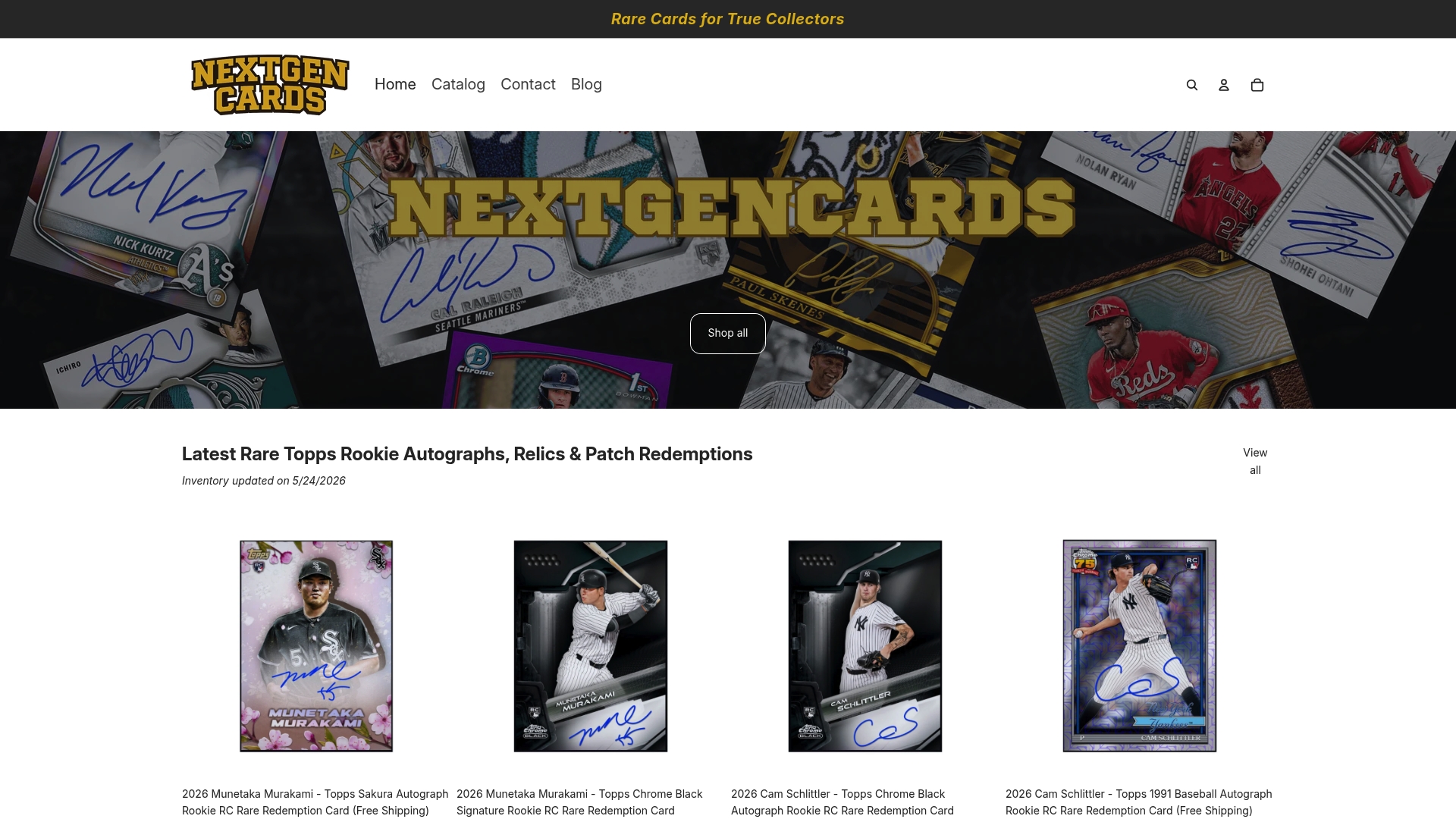
If you’re looking to add a confirmed debut-year rookie autograph or relic to your collection, Nextgencards’ rookie autographs and relics collection is the place to start. Select items ship free, and every card is sourced for authenticity. For collectors who want the confidence of buying from a trusted source, Nextgencards delivers the specificity and curation that generic marketplaces cannot match. Browse the full rare Topps rookie card selection to find the debut-year cards that belong in your collection.
FAQ
What is a rookie card production year?
A rookie card production year is the official season in which a player first appears on a licensed trading card in their sport’s top professional league. The card must be part of a base set issued during that debut season to qualify as an official rookie card.
When did the RC logo standard start for baseball?
MLB introduced the RC logo standard in 2006, tying the official rookie card designation to a player’s appearance on an Opening Day 25-man roster. This replaced the prior system where multiple cards from the same season were all informally labeled rookie cards.
How do I verify the production year on a vintage rookie card?
Check the card back for the set year and manufacturer details, then cross-reference that year against the player’s confirmed major league debut date. Do not rely solely on the copyright year, as it can lag the actual release year by one full season.
Are prospect cards the same as rookie cards?
Prospect cards issued before a player’s major league debut are not official rookie cards. They may carry significant collector interest and market value, but they do not meet the debut-season licensing requirement that defines a true rookie card.
Does the RC logo guarantee high value?
The RC logo confirms official rookie status but does not automatically determine value. Production era, print run size, player performance, and grading condition all influence final market price alongside the RC designation.
Recommended
- Why Rookie Year Cards Matter for Serious Collectors – Next Gen Cards LLC
- NBA Rookie Class Card Explained: 2026 Collector’s Guide – Next Gen Cards LLC
- Rarest Rookie Card Variations: Collector’s 2026 Guide – Next Gen Cards LLC
- Examples of Appreciating Rookie Cards: 2026 Collector Guide – Next Gen Cards LLC
0 comments