

Vintage MLB grails generally win on long-term capital preservation because their scarcity comes from decades of attrition, while rare modern NBA rookie cards with serial numbering or autograph patches tend to win on short-term upside because their scarcity is manufactured and their fan bases skew younger and more digital. Collectors chasing stability should anchor a portfolio in graded vintage baseball icons; investors chasing speculative gains should look at numbered NBA rookie autographs and patches, including curated redemption-card inventories specialized for exactly this purpose.
TL;DR:
- Vintage MLB rookie cards are more stable long-term assets because their scarcity results from decades of attrition, not manufactured copying.
- Modern NBA rookie cards rely on fixed serial numbers and limited print runs, making their value more volatile and dependent on short-term hype cycles.
- Verifying rarity in modern cards involves checking serial numbers and PSA population reports, while vintage cards require provenance research and auction history analysis.
- Modern NBA cards can surge over 40% in value overnight on standout performances, whereas vintage MLB grails appreciate steadily over multiple years.
Table of Contents
- Rare NBA vs. MLB Rookie Card Comparison: How Scarcity Gets Made
- Auction Evidence: Which Market Moves Faster
- How to Value Any Rookie Card in Five Steps
- Matching Rarity Types to Real Catalog Examples
- Grading and Condition: How PSA and BGS Multipliers Work
- Hype Cycles vs. Buy and Hold: Setting Your Time Horizon
- Typical Price Ranges: What Top Outcomes Actually Look Like
- Why Collecting Culture Shaped What Counts as Rare
- Production Volumes and Distribution: A Different Numbers Game
- Season Length and Turnover: The Hidden Scarcity Driver
- Career Trajectories and League Popularity: The Long Game
- Authentication Risks: What to Watch For in Each Sport
- What I’d Actually Buy: A Risk-Based Allocation
- Find Rare Modern Rookie Redemption Cards at Nextgencards
- Where to Verify Populations, Prices, and Grading Standards
- Sources
- FAQ
Rare NBA vs. MLB Rookie Card Comparison: How Scarcity Gets Made
Rarity in modern cards is engineered on a printing press. Rarity in vintage cards is decided by fifty or ninety years of basements, floods, bicycle spokes, and bad storage. That single distinction drives almost everything else in a rare NBA vs. MLB rookie card comparison, and it’s the first thing a serious buyer needs to internalize before looking at a single price tag.
Modern scarcity is intentional. A manufacturer decides a parallel gets printed to exactly 2,018 copies, or 99, or one. Topps and Panini stamp the serial number right on the card, so buyers know the ceiling on supply the moment the box breaks. Redemption cards, short prints, and autograph patches fall into this category. The number is fixed and disclosed. Nobody has to guess.
Vintage scarcity is forensic. Nobody printed a fixed run of the 1933 Goudey Babe Ruth with a number on the back. The population that exists today reflects decades of survival and provenance research rather than a manufacturer’s original intent. Grading services and auction houses have spent years trying to pin down exactly how many high-grade copies survive, and even now the answer is closer to an educated estimate than a hard count.
Why brand and set matter differently in each sport
Basketball collectors treat Prizm as the flagship benchmark. A Prizm rookie base card is the card everyone compares everything else against, the way baseball collectors treat a Topps Chrome or Topps flagship rookie as the liquidity benchmark for pricing in that sport. But the parallel structure differs. NBA sets lean heavily on color and pattern parallels stacked on top of numbered print runs, so a single rookie can have dozens of distinct printed variants ranked by scarcity. MLB flagship sets do this too, but the hobby’s most valuable MLB cards still skew toward pre-1980s base cards with no parallel structure at all, just condition and survival.
Consider the contrast directly: a 1933 Goudey Babe Ruth in high grade sells as a blue-chip asset precisely because nobody can print more of them and few high-grade copies remain. A modern numbered NBA rookie patch autograph, like the kind of low-print redemption cards Nextgencards lists, is rare because the manufacturer chose to make it that way, not because copies got lost to time.
That difference changes how you verify rarity, too. For a modern card, you check the serial number against the manufacturer’s stated print run and cross-reference the PSA population report for how many have been graded at each level. For a vintage card, you’re doing something closer to archival research: tracing auction history, checking known census lists, and asking whether the card’s story (which collection it came from, who has handled it) holds up.
A few practical checks matter regardless of sport:
- Confirm the card is actually the player’s recognized rookie card, not a prospect or pre-rookie insert with a similar look.
- Cross-check the serial number on a modern card against the set’s officially stated print run, not just the number printed on the card itself.
- Pull the current PSA population report before buying a graded vintage card. Numbers move as more copies get submitted.
- For ungraded vintage cards, ask for provenance. A card with a known collection history is easier to trust and easier to resell.
- For modern redemption cards, confirm the redemption has already been fulfilled or has a clear fulfillment history, since unredeemed cards carry real risk.
Auction Evidence: Which Market Moves Faster
Modern NBA rookies swing hard and swing fast. A standout rookie season, a signature win, or a viral highlight can move a card’s price by 40% or more overnight, and a slump or injury can erase those gains just as quickly. That volatility is the price of admission for the modern market’s upside.
Key data point: Experts tracking rookie-season cards report that a single standout on-court performance can drive price jumps exceeding 40% within days, which is why demand velocity, not just price, is the metric serious buyers watch.
Vintage MLB grails behave differently. They don’t spike on a single game. Their appreciation shows up across multi-year windows, tracked through auction comps at houses like Heritage and Goldin rather than day-to-day marketplace listings. A PSA 9 or PSA 10 Ruth, Mantle, or Mays doesn’t care whether the current Yankees roster is having a good month. Its value curve is slower, steadier, and far less correlated to any single season.
That said, modern cards can occasionally reach grail territory in a single transaction. High-end modern rookie autographs and rare inserts have produced six-figure realized sales, proving that a tiny enough print run combined with the right player can rival vintage pricing almost immediately, without decades of waiting.
Three metrics matter more than the headline sale price when you’re deciding what to watch:
- Sell-through rate. What percentage of listed copies actually sell at asking price versus sit and get relisted lower?
- Realized price movement. Compare the last three to five actual sales, not asking prices, to see the real trend line.
- PSA population changes. A jump in newly graded copies can quietly soften a card’s scarcity story even while raw prices look stable.
Demand velocity often leads price during hype cycles. Volume moving up before price moves is usually your earliest warning that a modern card is heating up, and it’s the same signal in reverse when a hyped rookie starts cooling.
For timing purposes, volatility cuts both ways. It means the modern NBA market rewards buyers who move early and sell into strength, while punishing anyone who buys at the emotional peak of a hype cycle. Vintage MLB grails punish patience far less. Holding a well-provenanced Mantle rookie for a decade rarely feels like a mistake, even if you bought at a slightly high point.
How to Value Any Rookie Card in Five Steps
Whether you’re comparing NBA rookie card value or MLB rookie card prices, the process for figuring out what a specific card is actually worth doesn’t change much sport to sport. Here’s the framework.
- Confirm it’s the true rookie card. RC logos and manufacturer rookie designations matter, but baseball complicates this: a first Bowman Chrome prospect card can sometimes outrank the officially designated MLB rookie card in market value, a nuance that basketball grading conventions rarely produce. Know which card actually carries the premium before you buy.
- Check the print run and population count. Pull the manufacturer’s stated numbering for modern cards and the current PSA population report for both modern and vintage. A card numbered to 99 with 40 already graded gem mint isn’t nearly as scarce as the number on the front suggests.
- Assess the player’s staying power. Awards fade from memory faster than sustained popularity does. A player’s longer-term relevance tends to matter more for long-term price support than any single MVP trophy or Rookie of the Year plaque.
- Weigh the grading math before you submit. Compare recent PSA 10 sold comps against PSA 9 comps to find the real grade multiplier, then subtract grading fees, shipping, and turnaround time. Factor in a realistic gem-rate discount. Grading a card that only nets $30 in upside after a $25 grading fee and a six-month wait rarely makes sense.
- Run a liquidity check. Look at how many comparable copies sold in the last 90 days, how fast they sold, and at what discount to asking price. A card with strong headline value but almost no recent trading volume is a hard card to exit.
Pro Tip: Before submitting any card for grading, price out three recent PSA 10 sold comps, three PSA 9 comps, and your all-in grading cost including return shipping. If the gap between those comps doesn’t clear your grading cost by a healthy margin after accounting for the odds your card actually comes back a 10, keep it raw and sell it that way.
As a rough decision rule: treat serial-numbered rookies under 25 copies with strong current-season performance as speculative flip candidates, best sold within twelve to eighteen months of the hype peak. Treat graded vintage MLB rookies with established Hall of Fame trajectories as long-term holds, where a five-to-ten-year window is the more realistic play. If you’re building a mixed collection, Nextgencards’s rarest rookie card variations guide walks through how to spot which parallels actually carry scarcity weight before you commit capital.
Matching Rarity Types to Real Catalog Examples
Richard has spent years cataloging exactly where a card lands on the scarcity spectrum, and that framework only means something when it’s applied to real inventory instead of abstract theory. A well-curated catalog built around that principle maps each listing to a specific rarity mechanism, not just a player name.
Examples like autograph rare redemption and jersey patch cards illustrate manufactured scarcity at its most direct. Such cards typically carry a disclosed print run and an on-card signature or memorabilia swatch, the combination that drives short-term speculative demand.
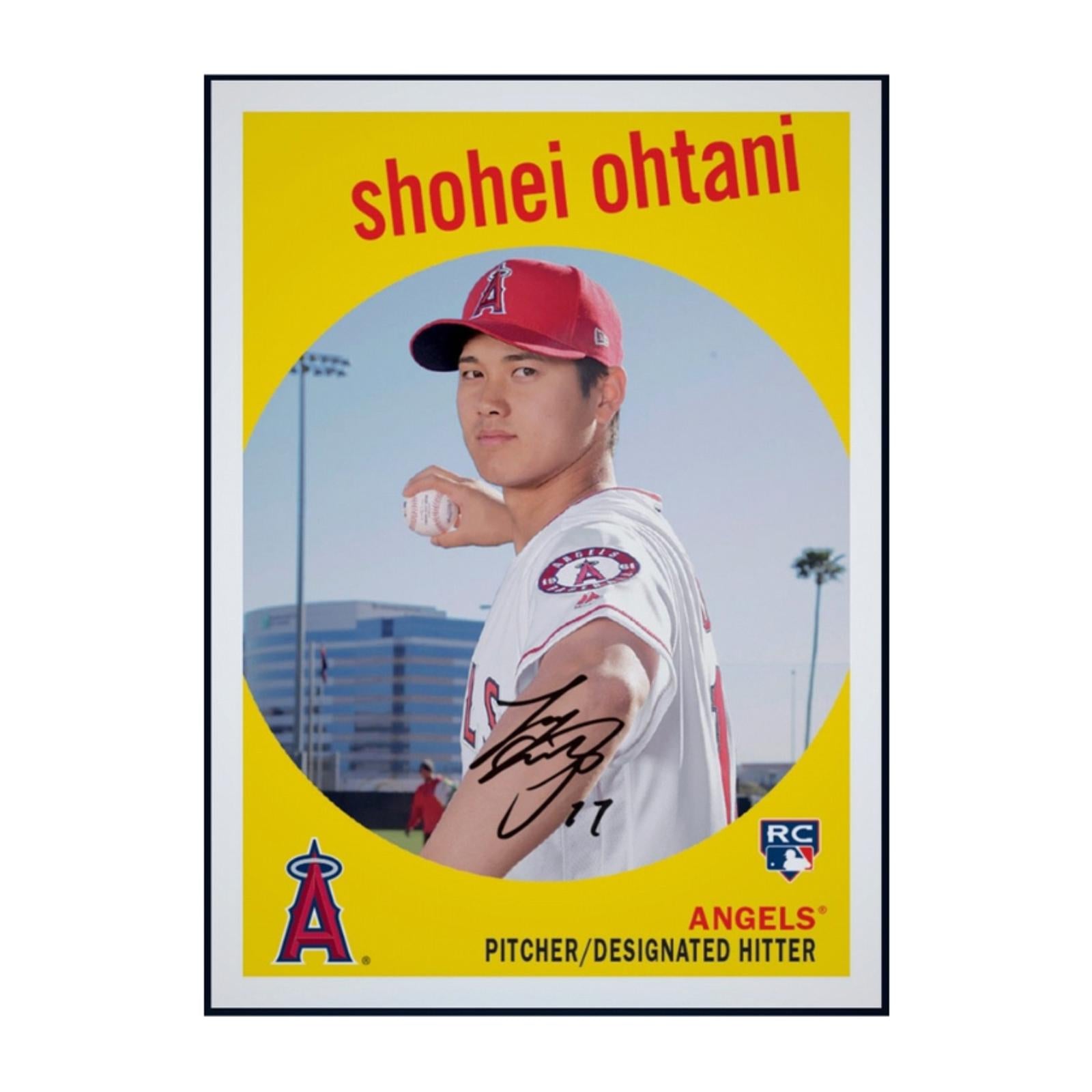
Modern MLB rookie redemption cards often show how a single prospect can carry multiple numbered parallels across different print tiers within one release cycle. Adding examples of rare autograph rookies and event-driven pieces illustrates the cross-section of modern MLB scarcity types discussed earlier.
A few things worth doing before buying any of these:
- Ask for current photos of the actual card, not stock images, especially for redemption cards awaiting fulfillment.
- Request the population count Nextgencards has on file or verify it directly through PSA’s own tools.
- Confirm free-shipping eligibility and any authentication documentation included with the listing.
Richard’s collector guides, including the breakdown of why rookie-year cards matter, go deeper into how the site vets each listing before it goes live.
Grading and Condition: How PSA and BGS Multipliers Work
A grade isn’t a label. It’s a price multiplier, and the gap between grades often dwarfs the gap between two entirely different cards. A PSA 10 copy of a modern rookie can sell for two to five times what the same card fetches in PSA 9, depending on how tight the gem-mint population is. For vintage cards, that multiplier gets more extreme. A PSA 9 vintage grail can be a five-figure card while a PSA 10 of the same issue, if one even exists, moves into an entirely different pricing tier because so few survived in that condition.
BGS grading adds a wrinkle modern collectors care about more than vintage buyers: the subgrade breakdown. A BGS 9.5 with four perfect 10 subgrades often commands a premium over a straight PSA 9.5 because the subgrades signal near-flawless centering, corners, edges, and surface. Vintage buyers care less about this granularity and more about whether the card has been trimmed, recolored, or otherwise altered, issues that show up more often in cards handled loosely for decades.
Before paying a grading premium, check the population report at each grade level for your specific card. A “PSA 10” price you saw quoted somewhere may reflect a sale from when only three copies existed; if forty more have graded since, that multiplier has likely shrunk.
Hype Cycles vs. Buy and Hold: Setting Your Time Horizon
Modern NBA rookies live and die by the hype cycle. A rookie having a strong first season can see card values climb fast, then cool just as quickly if performance regresses or a healthier prospect steals the spotlight. That’s a market built for short-term flips, not patient holding, and treating it otherwise usually means watching gains evaporate.
Vintage MLB grails run on a different clock entirely. Their multi-year appreciation tracks closer to blue-chip collectibles than to sports performance. Nobody’s Ruth rookie dropped in value because the Yankees had a bad month a century after he retired.
The practical rule: if you’re buying a numbered modern NBA autograph or patch, set an exit window before you buy, usually somewhere between six months and two years, tied to the player’s season performance and hype trajectory. If you’re buying a graded vintage MLB rookie, plan to hold through multiple market cycles rather than chase short-term spikes. Mixing both strategies in one collection isn’t just common, it’s often the smarter approach: vintage MLB grails anchor the portfolio while modern NBA numbered pieces provide the swing-for-the-fences upside.
Typical Price Ranges: What Top Outcomes Actually Look Like
Numbers ground this comparison better than adjectives. A modern NBA numbered rookie autograph or patch, depending on print run and player, can range from low hundreds of dollars for a deeper parallel up through the six-figure territory for a true one-of-one or ultra-low-numbered piece tied to a breakout star.
Vintage MLB grails occupy a narrower but consistently higher floor at the top end. A high-grade pre-war icon routinely trades in the mid-six-figure to seven-figure range at major auction houses, a level modern cards only occasionally touch and almost never sustain across multiple sales. The difference isn’t that modern cards can’t hit grail numbers. It’s that vintage grails hit those numbers reliably, sale after sale, while modern six-figure results tend to cluster around a handful of standout players and print runs.
Mid-tier examples matter more to most collectors than headline sales anyway. A well-known MLB rookie in Topps Chrome from a strong rookie class might run several hundred to a few thousand dollars raw, climbing meaningfully once graded gem mint. A comparable NBA rookie in a numbered Prizm parallel can land in a similar range, with autograph versions pushing higher depending on how tight the print run is. Neither market has a monopoly on affordable entry points, which is part of why so many collectors run both.
Why Collecting Culture Shaped What Counts as Rare
Baseball card collecting is older than the hobby’s modern grading infrastructure by nearly a century, and that history shapes what MLB collectors consider genuinely rare. Cards from the 1950s and earlier were never designed to be preserved. They rode in bicycle spokes, got sorted into shoeboxes, and disappeared by the thousands. Scarcity in that world is a byproduct of neglect, and the hobby’s reverence for surviving high-grade copies reflects just how much attrition happened before anyone thought to protect them.
NBA card collecting matured largely alongside the modern grading and parallel era. Basketball’s boom coincided with manufacturers already understanding that print-run transparency and serial numbering drove secondary-market excitement. That means NBA collecting culture never really experienced the same “unknown survivors” mystery that defines vintage baseball. Rarity in basketball collecting was built to be legible from day one: the number on the card tells you the ceiling.
That historical split explains a lot of the perception gap between the two hobbies. MLB collectors often treat rarity as something to be discovered through research and provenance. NBA collectors more often treat rarity as something to be confirmed through a serial number and a population report. Neither approach is wrong, but conflating them, expecting a modern numbered rookie to behave like a mysterious survivor story, is a common and costly mistake for newer collectors crossing over from one sport to the other.
Production Volumes and Distribution: A Different Numbers Game
MLB card production has historically run at a larger scale than NBA production, partly because baseball fielded far more rookies per season across deeper minor-league systems feeding into the majors. More players means more base rookie cards flooding the market, which historically diluted scarcity at the low end while concentrating true rarity into short-printed inserts and low-numbered parallels.
NBA production runs leaner by comparison. Fewer active roster spots league-wide and a shorter draft class each year mean fewer total rookies get cards made in the first place. That structural scarcity at the roster level compounds with intentional print-run limits on parallels, stacking two layers of scarcity where MLB often has just one.
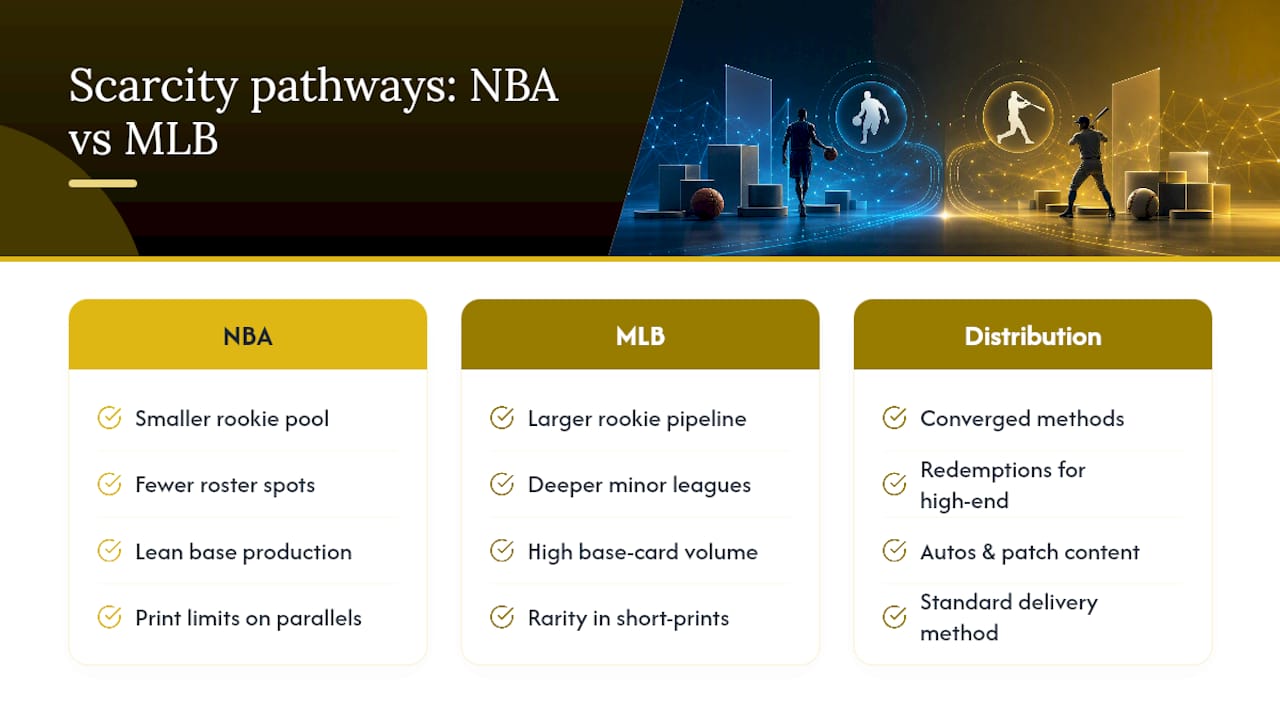
Distribution methods have converged over the last decade, though: both sports now rely heavily on redemption cards for high-end autograph and patch content, since manufacturers frequently can’t get physical signatures secured before a print deadline. That’s precisely why redemption products, like the numbered examples Nextgencards stocks, have become the standard delivery method for the rarest modern content in both sports rather than an occasional workaround.
Season Length and Turnover: The Hidden Scarcity Driver
An 82-game NBA season generates a completely different data set than a 162-game MLB season plus a deep minor-league pipeline. NBA players face more immediate scrutiny; a rookie’s performance across 82 games gets dissected constantly, and that concentrated attention feeds hype cycles faster and harder than baseball’s slower, more marathon-like rookie evaluation process.
MLB’s roster turnover works differently too. Prospects can spend years in the minors before a true MLB debut, meaning a player might have multiple “first” cards, a Bowman prospect card, a Bowman Chrome parallel, an eventual flagship rookie, years apart. That staggered pipeline is exactly why prospect cards can occasionally outrank the official rookie card in market value, since collectors sometimes bet on the earliest available card rather than waiting for the technically correct rookie designation.
NBA turnover is more binary. A player is drafted, and the rookie card comes out almost immediately in the following season’s flagship products. There’s rarely a multi-year staggered rollout the way baseball’s minor-league system produces. That means NBA rookie scarcity gets locked in early and stays relatively stable, while MLB rookie scarcity can shift for years as the market decides which of a prospect’s several early cards actually deserves the premium.
Career Trajectories and League Popularity: The Long Game
A rookie card’s ceiling is set the day it’s printed. Its floor and its long-term trajectory are set by everything the player does afterward. A modern NBA rookie autograph tied to a player who sustains stardom for a decade behaves nothing like the same card tied to a player who fades after two seasons, even if both cards had identical print runs on release day.
League-wide popularity trends compound this. Basketball’s global reach and social media presence tend to accelerate both the rise and the fall of a rookie card’s value, since attention itself is a major driver of demand in a hobby increasingly influenced by younger, digitally native collectors. Baseball’s audience skews older on average and reacts less to single highlight moments, which is part of why sustained popularity matters more than any single award for long-term MLB card value.
The practical takeaway: betting on a modern NBA rookie is partly a bet on the league’s continued cultural momentum, not just the player. Betting on a vintage MLB grail is a bet that’s already been proven right by decades of sustained interest, which is exactly why it costs more upfront and moves less violently after you buy it.
Authentication Risks: What to Watch For in Each Sport
Counterfeiting risk differs by sport mostly because of what’s being faked. Vintage MLB cards face trimming, recoloring, and reprint fraud, alterations designed to fool graders into assigning a higher grade or to pass a reprint off as an original from a decades-old print run. Spotting these often requires expert-level knowledge of period-correct card stock, ink patterns, and printing artifacts that a general collector can’t easily judge from photos.
Modern NBA cards face a different threat: fake autographs and forged serial numbering on parallels that never actually existed at that print count. Because the entire value proposition of a numbered modern card rests on that serial number being accurate, a forged or altered number undermines the whole premise instantly. Authentication for autograph patches also requires verifying the signature against the manufacturer’s certified process, not just a visual match.
For grading standard questions and choosing between graders, a resource like MagicFranco’s comparison of PSA and CGC breaks down how different grading companies approach authentication, useful background whether you’re grading a vintage MLB card or a modern NBA parallel. Buying only from sellers who provide clear photos, population documentation, and fulfillment history for redemption cards remains the most reliable defense in both sports.
What I’d Actually Buy: A Risk-Based Allocation
Conservative collectors should weight heavily toward graded vintage MLB grails. Capital preservation matters more than upside, and a well-provenanced Hall of Fame rookie rarely loses its long-term footing. Balanced collectors should split roughly down the middle, holding a vintage anchor while allocating a meaningful slice to numbered NBA autographs or patches tied to players with genuine long-term trajectories, not just a hot rookie month.
Aggressive collectors, the ones comfortable with real volatility, should lean into low-numbered modern NBA redemption cards and set a firm exit window before buying. The upside can be extraordinary, but only if you treat the hype cycle as a clock, not a guarantee. None of these allocations are static: reassess every time a player’s season performance meaningfully shifts the story.
— Richard
Find Rare Modern Rookie Redemption Cards at Nextgencards
The comparison above only matters if you can actually act on it, and that’s where Nextgencards fits. Nextgencards is the direct source for the exact numbered redemption cards discussed throughout this piece, curated specifically around verified print runs and authenticated autographs and patches rather than a generic marketplace grab bag.
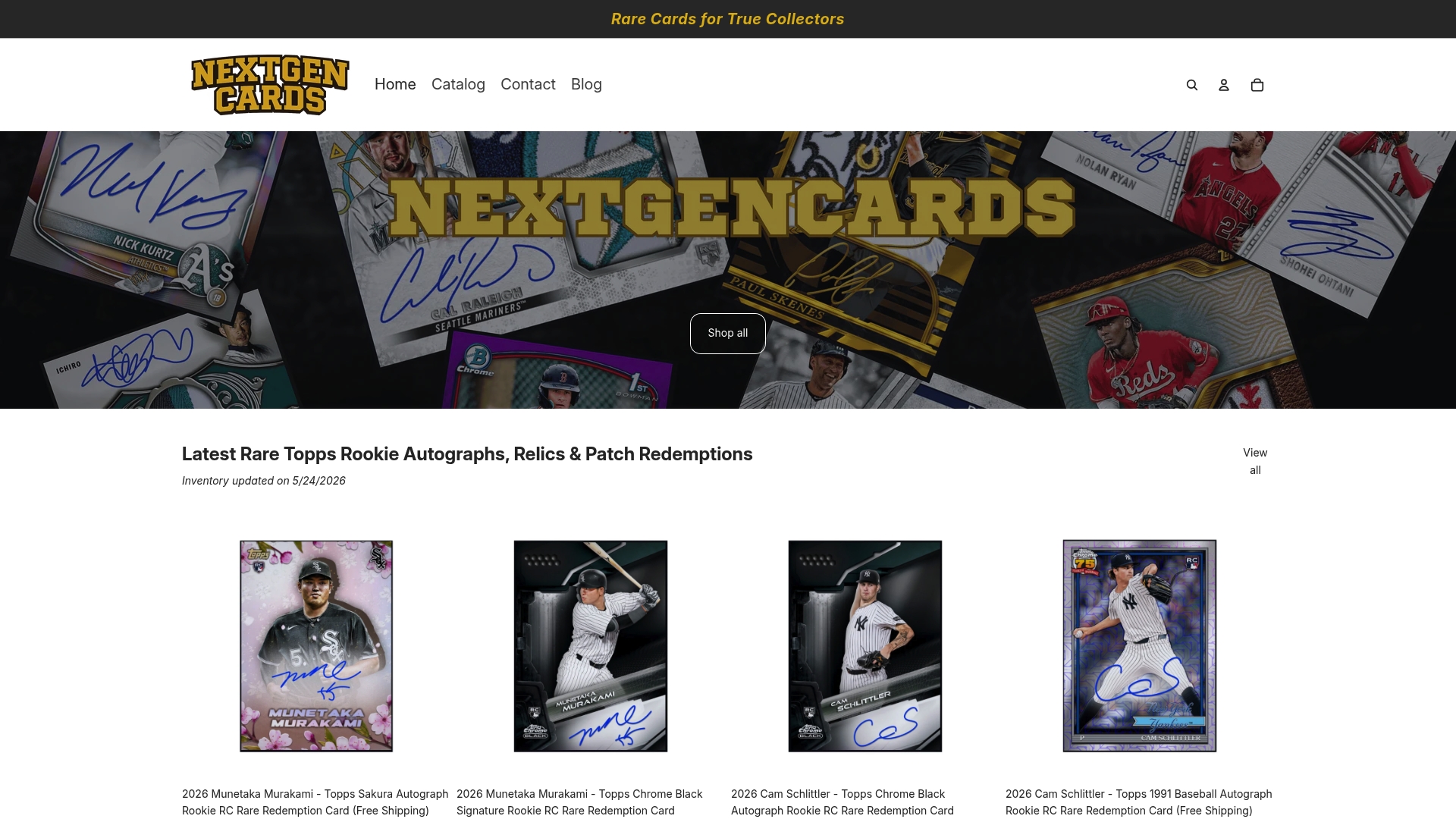
Browse the rookie autographs and relics collection to see current NBA, MLB, and NFL redemption listings side by side, filtered by player and card type. If you want a concrete example of the modern MLB scarcity discussed earlier, the 2023 Mason Miller Topps Chrome Platinum Anniversary Autograph rookie card shows exactly how a numbered parallel gets structured. Before buying any redemption card, ask for the current population count and confirm fulfillment status directly with the listing. Ready to add a numbered piece to your collection? Check the Yoshinobu Yamamoto Topps Now World Series Hero redemption card for a current example of event-driven MLB scarcity, or explore the full catalog to start building your allocation today.
Where to Verify Populations, Prices, and Grading Standards
Check PSA’s population and price tools for grading data, review realized sales at major auction houses for price comps, and read long-form valuation analysis before making a large purchase.
Sources
- Shohei Ohtani vs. Babe Ruth for the best card investment
- Tracking rookie season cards: key for collectors
- Best sports cards: rookie Kaboom debut and rare patch sales
- Sports Card Value: PSA price guide and population tools
FAQ
Which NBA rookie card is worth the most?
The most valuable NBA rookie cards tend to be ultra-low-numbered autograph patches or one-of-one parallels tied to generational stars, with top examples reaching six-figure realized sales when supply is tiny and demand is intense. Value shifts constantly with player performance, so a specific dollar figure today can look very different in a year.
What are the hottest rookie cards right now?
The hottest cards right now are almost always tied to whichever rookies are outperforming preseason expectations, since a single standout performance can drive price jumps of 40% or more within days. Checking current sell-through rates and population counts gives a clearer read than relying on hype alone.
What are the most undervalued sports cards right now?
Undervalued cards typically belong to players whose sustained popularity outpaces their current market price, since long-term demand tracks staying power more closely than individual awards. Numbered NBA and MLB rookies from strong draft or prospect classes that haven’t yet hit their performance peak often fit this pattern.
What’s the rarest NBA card?
The rarest NBA cards are typically one-of-one printing plate parallels or ultra-low-numbered autograph patches, where the print run itself, not survival over time, defines the scarcity. You can verify how rare a specific numbered card actually is by checking its PSA population report against the manufacturer’s stated print run before buying.
0 comments