

A raw card is any ungraded card in its original, unencapsulated state. A PSA-graded card has been authenticated and assigned a numeric grade from 1–10 by Professional Sports Authenticator, then sealed in a tamper-evident plastic slab. The one rule that drives every smart grading decision: only submit when your expected return across all possible grades exceeds your total cost, including fees, shipping, and the time your money sits idle.
Before you pull out a submission form, run three quick checks:
- Current raw price: Search recent eBay sold listings for your card in comparable raw condition.
- PSA 10 and PSA 9 market premium: Look up the same card’s sold comps in PSA 9 and PSA 10 on eBay or PWCC. The gap between raw and graded is your potential upside.
- Turnaround tolerance: PSA’s current service tiers vary from economy to express, with some taking longer processing times. If the card’s hype window is short, that delay is a real financial cost.
Math over emotion. Every time.
Table of Contents
- What do “raw,” “graded,” and “slab” actually mean?
- How grading typically changes market value
- Break-even math: does grading make financial sense for your card?
- When does grading actually make sense?
- How to submit to PSA, what it costs, and how long it takes
- How we built the examples and where the numbers come from
- How PSA grading affects market liquidity and buyer confidence
- Common misconceptions about grading and other grading companies
- Key Takeaways
- The math saved me from a costly mistake
- Useful sources for running your own due diligence
What do “raw,” “graded,” and “slab” actually mean?
Collectors use a small set of terms that carry precise meanings. Getting them right prevents costly misunderstandings when buying or selling.
- Raw card: — Any card that has never been submitted to a grading company. It sits in a penny sleeve, top loader, or binder pocket in whatever condition it left the factory or a previous owner’s hands. Condition is self-reported by the seller, which is the core source of buyer uncertainty.
- PSA-graded card: A card that PSA has authenticated and graded on its 1–10 scale, then sonically sealed in a hard plastic holder. The label on the slab displays the card’s name, year, set, grade, and a unique certification number you can verify online.
- Pop count (population report): — The total number of copies of a specific card that PSA has graded at each grade level. A low pop count at PSA 10 signals scarcity and often supports a higher market price.
Other grading companies collectors encounter include BGS (Beckett Grading Services), CGC (Certified Guaranty Company, which expanded into cards), and SGC (Sportscard Guaranty). Each uses its own scale and holder design, though PSA remains the dominant standard for resale liquidity in the U.S. market.
How grading typically changes market value
The relationship between grade and price is not linear. Grade multipliers vary significantly by card type and era, and a PSA 8 on a modern base card can actually sell for less than the same card raw because the slab adds no meaningful buyer confidence at that grade level.
| Card Type | Typical Raw Price | Typical PSA 9 Price | Typical PSA 10 Price |
|---|---|---|---|
| Modern base card | $2–$5 | $5–$10 | $15–$30 |
| Modern key rookie | $80 | $150 | $800 |
| Vintage key (pre-1980) | $200 | $500 | $8,000 |
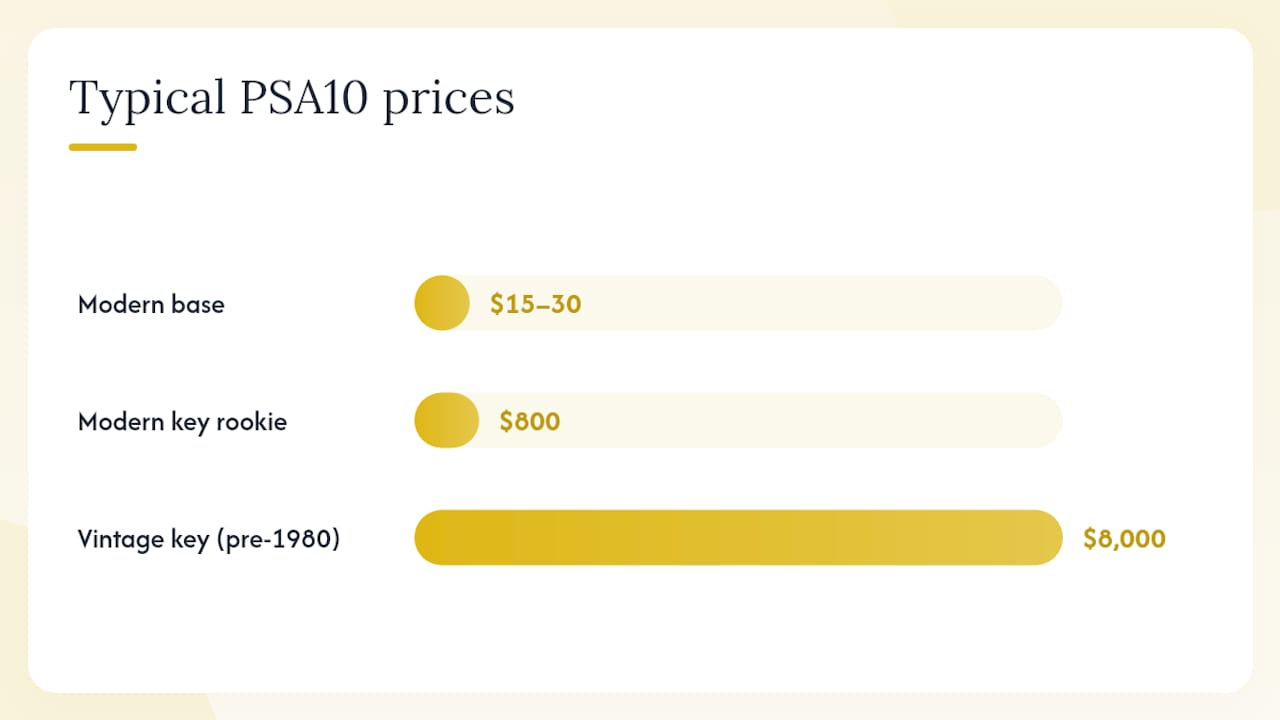
These are illustrative ranges based on general market patterns, not specific card data. Always verify with current eBay sold comps before submitting.
A worked example: You hold a modern key rookie raw at $100. A PSA 9 of the same card sells for $200, and a PSA 10 sells for $500. If grading costs $25 in fees plus $15 in shipping (round trip), your break-even on a PSA 9 outcome is $100 + $40 = $140. At $200, you net $60 after costs. At PSA 10, you net $360. But if the card grades PSA 8, which might sell for $110, you lose money after fees. Whether grading makes sense depends entirely on how likely that PSA 10 outcome actually is.
Break-even math: does grading make financial sense for your card?
Treat grading as a probabilistic investment, not a guaranteed upgrade. The formula:
Expected Net = [P(10) × Value₁₀ + P(9) × Value₉ + P(8) × Value₈ + P(7-) × Value₇₋] − (Grading fee + Shipping + Seller fees)
Where P(grade) is your estimated probability of receiving that grade.
Conservative grade-rate assumptions
| Grade Outcome | Conservative Probability (Near-Mint Raw) |
|---|---|
| PSA 10 | 15–25% |
| PSA 9 | ~13% |
| PSA 8 | 20–30% |
| PSA 7 or below | 10–20% |
Rates vary by card era, print quality, and how carefully the card has been handled. Vintage cards and cards with known print defects grade out at PSA 10 far less frequently.
Grade-rate reality: Analysis of grading outcomes shows that grading can add 30–50% in value on the right cards and little or negative value on the wrong ones. Selective grading is the professional approach.
Example 1: Grading makes sense
A vintage 1986 Fleer Michael Jordan raw card sells for $800. PSA 9 comps: $2,500. PSA 10 comps: $8,000. Grading fee: $150 (express tier). Shipping: $30. Seller fees on resale: ~13%.
Expected net = (0.20 × $8,000 × 0.87) + (0.40 × $2,500 × 0.87) + (0.25 × $1,200 × 0.87) + (0.15 × $600 × 0.87) − $180 = $1,392 + $870 + $261 + $78.30 − $180 = $2,421.30 expected return on an $800 raw card. Grading clearly makes sense.
Example 2: Grading does not make sense
A modern base card raw at $8. PSA 9 comps: $12. PSA 10 comps: $25. Grading fee: $25. Shipping: $15.
Expected net = (0.20 × $25 × 0.87) + (0.40 × $12 × 0.87) + (0.25 × $8 × 0.87) + (0.15 × $5 × 0.87) − $40 = $4.35 + $4.18 + $1.74 + $0.65 − $40 = −$29.08. Sell it raw.
When does grading actually make sense?
The math above translates into a practical checklist you can run at a card show or on your phone.
- Raw price above $50–$100: Below that threshold, grading fees rarely pay off unless the PSA 10 pop count is extremely low and the grade premium is outsized.
- Low PSA 10 pop count: Check the PSA population report before submitting. A PSA 10 pop of 5 on a popular card is a strong signal. A pop of 2,000 means the market is saturated.
- Key modern rookies with strong long-term demand: Think first-year cards of players with sustained star power. A rookie autograph from a player in their prime can hold or grow its PSA 10 premium for years.
How to submit to PSA, what it costs, and how long it takes
Fee tiers and turnaround
PSA offers multiple service tiers, from economy (lowest cost, longest wait) to express and super express (higher cost, faster turnaround). Current fee structures and turnaround estimates are published on PSA’s site and have shifted as demand fluctuates. Economy tiers have historically taken several months during peak periods.
Turnaround as a real cost: If a card’s market value is driven by a current hype cycle (a player’s playoff run, a record-breaking season), a multi-month wait can mean the premium evaporates before your slab arrives. Selling raw during the hype window often beats waiting for a grade.
Autograph grading and authentication carry additional fees. Return shipping is also billed separately. Factor all of these into your break-even calculation, not just the base grading fee.
How we built the examples and where the numbers come from
The worked examples and grade-rate tables in this article are built on the following sources and assumptions:
- PSA’s official grading pages — for grade definitions, submission workflows, and the 1–10 scale.
- Independent collector guides — (The Card Shop Finder, PreGradeCards, BallcardGenius) for grade multiplier ranges and break-even frameworks.
Richard is a contributor to Nextgencards’ collector education series. For identifying undervalued cards before you decide whether to grade or sell, the Nextgencards blog covers market comp methodology in detail.
How PSA grading affects market liquidity and buyer confidence
The core value of a PSA slab is not the grade itself. It is the removal of condition uncertainty for the buyer. A raw card requires the buyer to trust the seller’s condition description and photos. A PSA-graded card carries a third-party certification that any buyer anywhere can verify by serial number.

That trust has a measurable effect on liquidity. PSA-graded cards, particularly PSA 9s and PSA 10s of desirable cards, tend to sell faster and attract more bidders on eBay than equivalent raw cards because the buyer pool is larger. Collectors who would never buy a raw card at $300 will confidently buy a PSA 9 at $350 because the condition risk is eliminated.
For high-value vintage cards, this effect is dominant. A raw 1952 Topps Mickey Mantle requires significant buyer expertise to evaluate. The same card in a PSA slab, even at PSA 4, trades in a liquid market because the authentication removes the counterfeiting and alteration risk that makes raw vintage cards difficult to price with confidence.
The liquidity advantage shrinks for modern base cards and low-value commons, where the buyer pool is price-sensitive and the condition uncertainty on a raw card is low enough that buyers accept it. Understanding how sports card companies and marketplaces interact with graded inventory helps collectors choose the right resale channel for their specific cards.
Common misconceptions about grading and other grading companies
Misconception 1: Grading always adds value. It does not. For modern base cards under $20 raw, grading fees typically exceed any premium a slab creates. Grading adds value selectively, not universally.
Misconception 2: PSA is the only grading company that matters. PSA has the largest population database and the deepest resale liquidity in the U.S. market, but BGS, CGC, and SGC each have legitimate collector bases. BGS (Beckett) uses a 10-point scale with half-point increments and is particularly respected for its subgrade transparency (centering, corners, edges, surface each receive their own score). CGC expanded from comics into cards and has built credibility for modern cards. SGC is well-regarded for vintage cards and uses a clean, collector-friendly holder design. For resale on eBay and major platforms, PSA 10s typically command the highest prices, but a BGS 9.5 or BGS 10 (Black Label) can exceed PSA 10 prices on certain cards.
Misconception 3: A PSA 9 is almost as good as a PSA 10. In condition terms, yes. In market value, often no. On key rookie cards, the PSA 10 premium over PSA 9 can be 3–5× or more. The gap is not linear.
Misconception 4: You can predict your grade accurately from photos. Photos miss surface scratches, subtle corner wear, and print defects that graders catch under magnification. Treat any grade prediction as an estimate with real uncertainty, not a guarantee.
Misconception 5: Cracking a slab and resubmitting is a reliable upgrade strategy. It rarely works out financially. You pay fees again, accept grading risk in both directions, and the card is unprotected during transit. Only consider it when the PSA 10 premium is large enough to absorb two rounds of fees and the downside risk.
Key Takeaways
A PSA-graded card commands a meaningful premium over raw only when the expected value across all grade outcomes exceeds total grading costs, including fees, shipping, and the opportunity cost of waiting.
| Point | Details |
|---|---|
| Raw vs. graded defined | A raw card is ungraded; a PSA card is authenticated, scored 1–10, and sealed in a tamper-evident slab. |
| Run the break-even math | Calculate expected net across all grade probabilities before submitting, not just the PSA 10 scenario. |
| Grade threshold matters | Cards with a raw value below $50–$100 rarely justify grading fees; vintage and key rookies are the strongest candidates. |
| PSA 10 pop count is critical | A low pop count supports a higher PSA 10 premium; a saturated pop compresses it. |
| Selling raw is a valid strategy | Speed, avoiding grade risk, and targeting pre-grade buyers are all legitimate reasons to skip grading entirely. |
The math saved me from a costly mistake
There is a temptation, especially early in collecting, to grade everything that looks clean. A card comes out of a pack with sharp corners and vivid color, and the instinct is to send it straight to PSA before it gets damaged. That instinct is understandable, but it is expensive without the math to back it up.
The break-even framework in this guide is the single most useful tool for making that decision clearly. Before submitting, check the raw price, check the PSA 9 and PSA 10 sold comps, estimate your grade probabilities conservatively, and subtract every cost including return shipping and seller fees on the back end. If the expected net is not meaningfully above the raw price, selling raw is the right call.
One lesson worth carrying: the cards most worth grading are often not the ones that look the best in hand. They are the ones where the PSA 10 pop is low, the market premium is large, and the card has long-term demand behind it. A rare rookie autograph from a player still ascending fits that profile far better than a common from a recent set, no matter how pristine it looks.

Useful sources for running your own due diligence
Before submitting any card, check these resources directly:
- Services | Trading Card Grading — PSA
- Grading standards — PSA
- Grade explanation — PSA Support
- Selling Graded vs Raw Cards: Which Pays More? | The Card Shop Finder
- Raw vs Graded Cards: When the Slab Actually Adds Value — PreGradeCards
- PSA 10 or Bust? Comparing Graded Values vs. Raw Price (+ Other Grading Thoughts) — BallcardGenius
- Raw vs Graded Cards – What’s the Difference? | Majesty Grading
- PSA Grading Scale Explained: Grades & Costs (2026) — Phantom Display
This article provides general collector education and is not financial or investment advice. Card values fluctuate with market conditions. Verify current PSA fees, turnaround times, and grading standards directly with PSA before submitting.
0 comments