

A bat barrel card is a relic card that contains a physical piece of a player’s bat barrel, often including the nameplate itself, and it ranks among the scarcest categories in the entire hobby. Beckett’s own database catalogs only a small population of these cards, which pushes prices for the best examples past what full game-used bats fetch at auction. This guide covers what separates a nameplate barrel piece from a generic sliver, where to buy with confidence, and how to spot a fake before it costs you.
TL;DR:
- Nameplate barrel relics are the rarest and most valuable type, including the section of the bat where the player’s name or number is stamped.
- The total population of barrel relic cards is limited, with only a few thousand cataloged, and scarcity is highest for cards containing verified nameplates.
- Authenticating a barrel card involves confirming the presence of a nameplate, serial number accuracy, wood grain authenticity, proper printing, and provenance documentation.
- Major auction houses yield the highest prices for authenticated, documented nameplate relics, while online marketplaces require extra diligence to avoid scams.
- Prioritizing nameplate presence, proper grading, and seller reputation is essential for collectors seeking long-term value and authenticity in rare relics.
Table of Contents
- What Are Bat Barrel Cards and Which Sets Made Them Famous?
- Why Are Bat Barrel Cards So Rare?
- How Do You Identify and Authenticate a Bat Barrel Card?
- Where and How Should You Buy Bat Barrel Cards?
- Why Serious Collectors Should Prioritize Nameplate Barrel Relics
- Where to Find Rare Barrel Relics and Redemption Cards
- Sources
- FAQ
What Are Bat Barrel Cards and Which Sets Made Them Famous?
Not every “barrel” relic is created equal, and that distinction is the first thing any serious collector needs to understand. Manufacturers cut bats into several types of relic pieces, and where the cut falls on the bat determines what you actually own.
Three main categories show up in the hobby:
- Nameplate barrel relics — contain the section of the barrel where the player’s name or number was stamped or painted, the single most desirable cut on the whole bat.
- Outer-surface barrel slivers — come from the wide part of the barrel but exclude the nameplate area, still game-used but far more common.
- Knob relics — cut from the base of the bat handle; collectors researching these should also look at bat knob cards for comparison, since knob and barrel pieces are often confused.
Manufacturers historically inserted these relics at low rates. 2002 Topps Prime Cuts barrel relics landed in roughly one of every 7,824 hobby packs, with an even tighter one-in-2,063 rate for the HTA series, and some configurations were serial numbered to as few as 50 copies. Other landmark releases followed the same low-print philosophy, including SP Legendary Cuts and Sweet Spot, both of which relied on cut-up game bats to produce relic pieces numbered in the dozens rather than the thousands.
Why Are Bat Barrel Cards So Rare?
Beckett’s database lists a few thousand unique barrel cards cataloged as of 2014 — a figure that covers every major manufacturer and every player across decades of production. That number has grown since, but not by much, because the source material (actual game-used bats with intact barrels) is finite and manufacturers can only cut so many nameplates from a single bat.
Two forces compound that scarcity:
- A single historic bat might get cut into several relic cards across different sets, but it only has one nameplate, which means nameplate-inclusive cards are always the rarer subset of any given player’s barrel output.
- Generic barrel slivers, by contrast, can be cut in multiples from the same bat, so their population runs higher even within the same low overall category.
That combination of a tiny total population and an even tinier nameplate subset explains why certain barrel cards outprice the bat they came from. A stripped-down bat with no card attached is just a bat. A barrel card with a verified nameplate and a known player attached is a documented, one-of-a-kind artifact, and the market treats it that way.
How Do You Identify and Authenticate a Bat Barrel Card?
Buying a barrel relic sight unseen, or from a seller you don’t know, is where most collectors get burned. Work through this checklist before you commit:
- Confirm nameplate presence. Look at the actual photo, not the listing title. A large share of cards marketed loosely as “barrel” relics contain only the outer surface, not the nameplate, and that single detail can cut the value dramatically.
- Check the serial number against the set checklist. Compare the card’s stated print run to the manufacturer’s published numbers for that release. Prime Cuts, for example, ran specific serialized tiers, so a card claiming a number outside that range is a red flag.
- Inspect wood grain and cut consistency. Genuine relic pieces show natural grain irregularities; a piece that looks too uniform or too clean for a game-used bat deserves a second look.
- Verify the printing and labeling on the card stock itself, comparing font, foil stamping, and card back design against confirmed images from the same set.
- Request or review provenance documentation — auction house records, a letter of authenticity, or a documented chain of custody from a known seller.
For anything approaching four figures in value, sending the card to a grading service is worth the fee, since a graded holder both confirms authenticity and makes the card easier to resell later. Grading also standardizes condition language, which matters when you’re negotiating with a buyer who has never held the card in hand.
Pro Tip: Cross-reference the seller’s auction history before bidding on a high-value barrel card. A seller with a consistent track record of documented game-used memorabilia sales is a far safer bet than one listing a rare relic for the first time with no history behind it.
Watch for sellers who won’t answer direct questions about serial numbers, who use stock photos instead of actual card images, or who price a supposedly ultra-rare card well below comparable sales. All three are common scam signals in this corner of the hobby.
Where and How Should You Buy Bat Barrel Cards?
Barrel cards surface across three main channels, and price behavior differs meaningfully between them. Major auction houses tend to produce the highest hammer prices for documented nameplate pieces, because bidders there are actively competing and provenance has usually already been vetted. Specialty card shops price more conservatively but offer the advantage of an in-person look before you buy. Online marketplace listings vary the most, ranging from fair deals to significantly overpriced or misrepresented cards, so extra diligence matters most there.
Because many barrel relics from sets like SP Legendary Cuts and Sweet Spot were produced in very limited runs, often fewer than a dozen copies., published pricing simply doesn’t exist for most of them. Collectors instead triangulate value using three references: recent auction hammer prices for comparable serials, the set’s documented print run and the player’s current market profile.
A few practical habits will save you money and frustration:
- Set aside a separate budget line for grading fees before you bid, not after you win.
- Compare raw versus already-graded lots for the same card. A graded copy costs more up front but often resells faster.
- Watch for bundled lot sales that pair a barrel card with lower-value filler. You may be paying more for the bundle than the barrel piece alone is worth.
Autograph-and-barrel combo cards typically command a real premium over a barrel-only piece of the same player, since you’re paying for two forms of authentication on one card. The exact premium varies widely by player and print run, so treat any specific dollar figure you see quoted online cautiously and lean on comparable sales instead.
Why Serious Collectors Should Prioritize Nameplate Barrel Relics
Barrel cards reward patience more than almost any other category in the hobby. A nameplate piece from a documented bat, properly graded and stored away from light and humidity, holds its value better than most relics because the supply simply cannot grow. Display cases with UV-filtering glass and stable indoor humidity protect the wood grain from the warping that flat storage alone won’t prevent.
At NextGenCards.shop, sourcing rare relics means vetting nameplate presence, serial documentation, and seller history before a card ever reaches the shop’s rookie autograph and relic collection. When you’re deciding what to chase, rank nameplate presence first, grading and condition second, and provenance paperwork third. Get those three right and the rest of the decision takes care of itself.
— Richard
Where to Find Rare Relics and Redemption Cards
Nextgencards offers a curated selection of rare game-used relics with documented sourcing, and select items ship free, avoiding stacking shipping costs on scarce purchases.
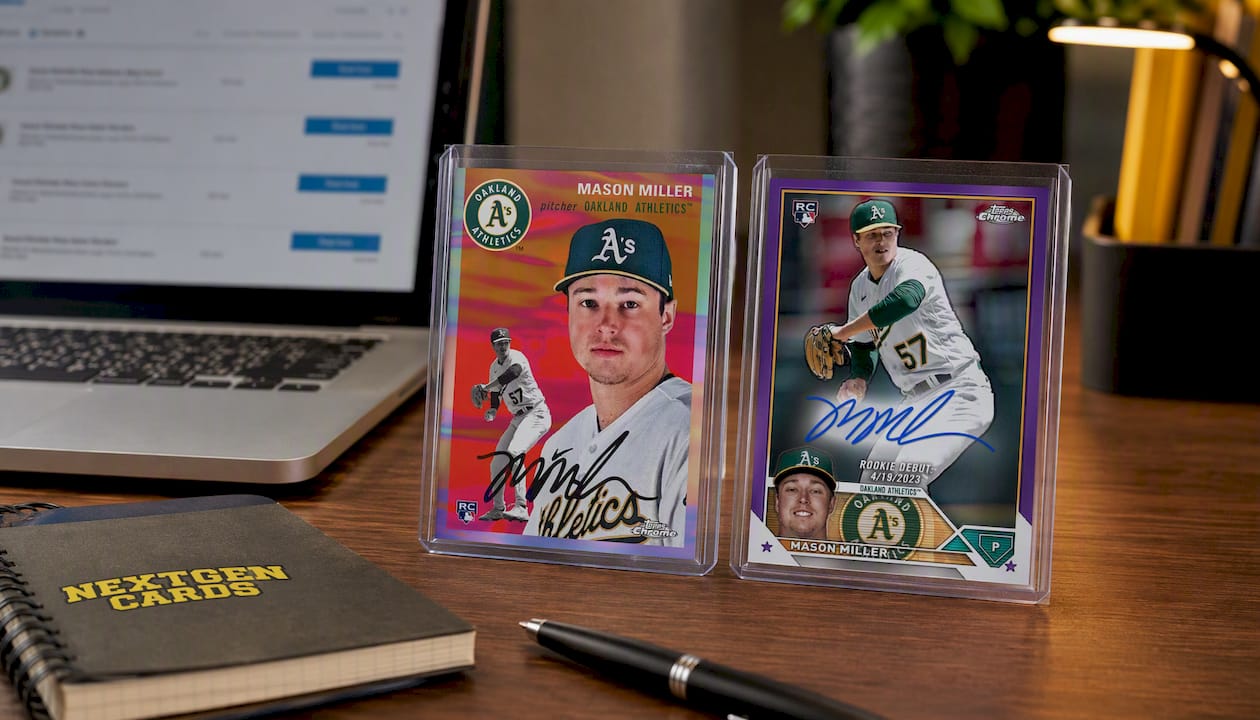
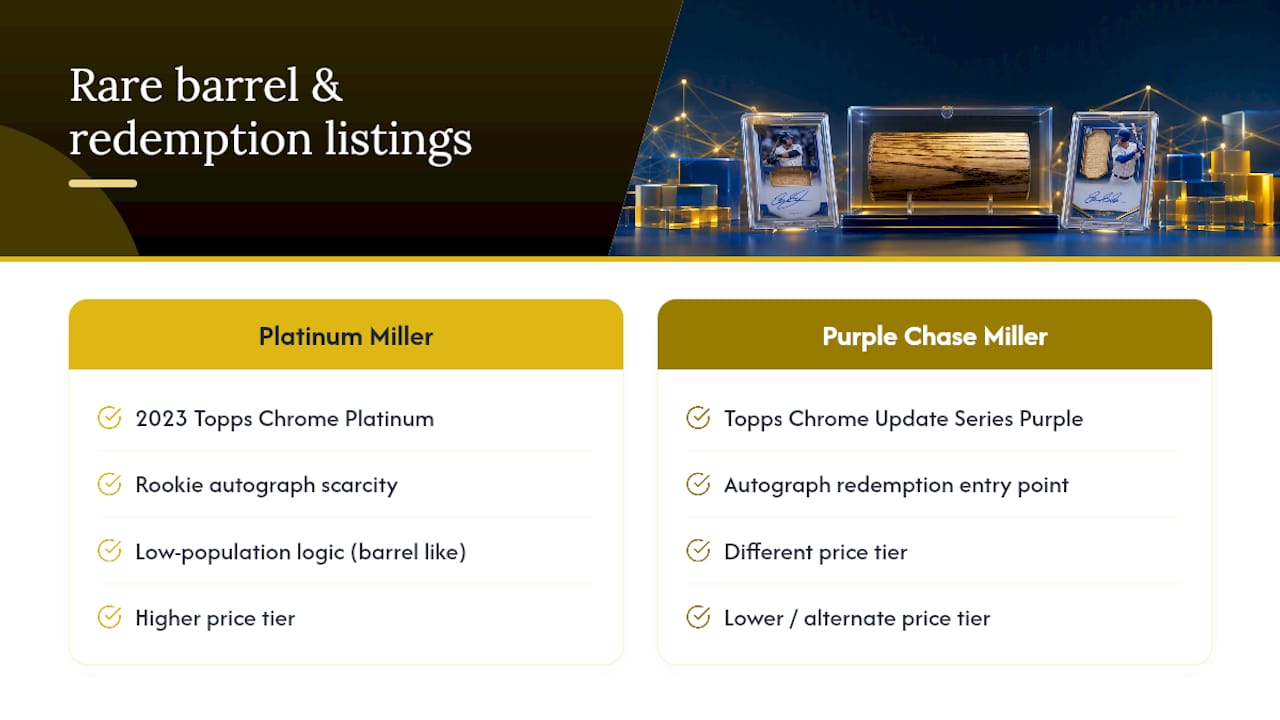
Two current listings show exactly the kind of rare, provenance-backed cards worth chasing right now. The 2023 Mason Miller Topps Chrome Platinum Anniversary autograph redemption card pairs rookie autograph scarcity with the same low-population logic that drives barrel relic pricing. The Topps Chrome Update Series Purple Chase autograph redemption card offers a second entry point into Miller’s rookie class at a different price tier.
Before you buy any high-value card, whether it’s a redemption card or a documented barrel relic, ask for serial verification and seller history. NextGenCards.shop provides that documentation up front. Browse the current rookie autograph and relic collection to see what’s available today.
FAQ
What Is a Bat Barrel Card?
A bat barrel card is a relic trading card that contains a physical piece cut from the wide, hitting end of a player’s game-used bat, sometimes including the nameplate itself.
What Do MLB Players Spray or Apply on Bat Barrels?
Many players apply pine tar or grip-enhancing substances near the handle rather than the barrel, and any residue or wear pattern on a relic piece can actually help authenticate game use when compared against known photos of that player’s bat.
What Are Common Bat Barrel Sizes?
Standard MLB bat barrels vary in diameter depending on manufacturer and player preference, and this size affects how a cut piece looks once mounted on a card.
Are Larger Barrel Bats Legal in Little League?
Little League bat rules govern length, weight drop, and certification marks rather than barrel diameter alone, so any bat used in sanctioned play must carry the required USABat stamp regardless of barrel size.
Why Do Some Barrel Cards Cost More Than a Full Bat?
A documented nameplate barrel card is a one-of-a-kind, authenticated artifact tied to a single card, while an uncut bat without that documentation and packaging often has a smaller pool of buyers competing for it.
0 comments