

2025-26 Topps Definitive Basketball is the NBA debut of Topps’ most exclusive trading card format, an all-serial-numbered, hit-every-card release built entirely around framed on-card autographs, single-letter jersey nameplates, and rookie patch autographs. Every card ships numbered, print runs stay deliberately small, and Topps sells the product almost exclusively through Topps.com. Collectors chasing rookie signatures from Cooper Flagg or Dylan Harper, or veteran hits from Victor Wembanyama, should treat this as a top-shelf, high-cost target rather than a casual pack break.
TL;DR:
- Every card in Topps Definitive Basketball is serial-numbered and produced in small print runs, with distribution almost exclusively through Topps.com.
- The product features high-end sets like Framed Autographs, Nameplates, Rookie Patch Autos, and Triple Autos, each targeting different collector interests.
- Autographs and relics are sourced through direct signed agreements with players and NBA teams, ensuring authenticity and limited supply.
- Flagger rookies such as Cooper Flagg, Dylan Harper, and veteran stars like Victor Wembanyama drive most demand and resale value.
- Targeted buying of verified cards from trusted sellers like Nextgencards often offers less risk than gambling on random box pulls.
Table of Contents
- What Is 2025-26 Topps Definitive Basketball?
- Understanding the Autograph and Relic Chase Lines
- How Are Definitive Boxes and Cases Configured?
- Which Rookies and Stars Headline the Checklist?
- Parallels and Short Prints Worth Chasing
- Buyer’s Checklist: What to Verify Before You Buy
- Where NextGenCards Fits for Definitive Collectors
- How Are Definitive Autographs and Relics Sourced?
- What’s Happening in the Secondary Market Right Now
- How to Protect and Store Your Definitive Cards
- Where to Buy Authentic Definitive Cards
- 2025-26 Topps Definitive Basketball: What Collectors Need to Know
- Get Definitive-Caliber Cards Without the Box Gamble
- Sources
- FAQ
What Is 2025-26 Topps Definitive Basketball?
Topps built Definitive as its flagship “every hit” NBA product, and the official product page frames it around three headline collections: Framed Autograph Collection, Definitive Nameplates, and Definitive Rookie Patch Autographs, with Triple Autos rounding out the top-tier chase pool. There is no base set to speak of in the traditional sense. Every card in the box carries a serial number, an autograph, a relic, or some combination of the three.
Topps distributes Definitive almost entirely through Topps.com rather than flooding hobby shops nationwide, and past Definitive launches have used a limited allocation process on the site itself, sometimes structured as a queue or launch event rather than an open, unlimited sale. That distribution model keeps the product scarce from day one.
The headline collections collectors should know before buying include:
- Framed Autograph Collection — on-card signatures set inside a card frame designed for display.
- Definitive Nameplates — single-letter jersey relic cards meant to be collected and spelled into full player names.
- Definitive Rookie Patch Autographs — rookie-class signatures paired with jersey patches.
- Triple Autos — multi-signature cards pairing three players on one piece.
Understanding the Autograph and Relic Chase Lines
Each Definitive collection targets a different kind of collector, and knowing the difference matters before you spend real money chasing one.
The Framed Autograph Collection puts an on-card signature inside a physical frame built for the card, which gives it a finished, display-ready look straight out of the pack and tends to photograph well for grading submissions. Definitive Nameplates work differently: each card carries a single embroidered jersey letter, and the appeal comes from assembling multiple letters into a complete player name. That build-a-name mechanic gives Nameplates a set-collecting angle that autograph-only cards don’t have.
Rookie Patch Autographs combine a rookie signature with a jersey patch, while Triple Autos and Definitive Moments-style multi-signature cards trade some individual rarity for the novelty of three signatures on one card.
- Framed Autographs: display-first, grading-friendly.
- Nameplates: relic-first, set-building appeal.
- Rookie Patch Autos: signature plus patch, tied to rookie-class demand.
- Triple Autos: multi-player format, harder to complete but easier to find visually striking.
Pro Tip: When you’re evaluating a patch or nameplate pull, look at the letter or patch pattern itself. A clean, full color-matched letter or a patch with visible team logo elements almost always outsells a plain, single-color swatch of the same player.
How Are Definitive Boxes and Cases Configured?
Definitive doesn’t behave like a standard hobby release, and collectors need to plan around that before buying in.
- Every card is serial-numbered. The Collector Nation confirmed that Topps serial-numbers every single card in Definitive to low print runs, with no unnumbered filler cards anywhere in the box.
- Distribution runs through Topps.com. Rather than a broad hobby shop rollout, Topps’ own launch page shows the product sold directly through a controlled Topps.com process, which has historically included limited-quantity launch events for high-end Topps products.
- Boxes sell out fast. Because allocations are capped, collectors serious about landing a box should watch Topps.com launch announcements closely and be ready to buy the moment the window opens.
That structure changes the math for buyers. There’s no such thing as a “weak” box in Definitive the way there is in a $100 retail product. Every box guarantees hits, but the specific player, parallel, and relic type still varies wildly from box to box.
Which Rookies and Stars Headline the Checklist?
Rookie class strength drives demand for any high-end release, and Definitive is no exception. Beckett’s checklist coverage names Cooper Flagg and Dylan Harper among the rookies collectors are chasing hardest across Topps’ 2025-26 basketball line, alongside other first-year names getting attention in the autograph and patch categories.
On the veteran side, established stars like Victor Wembanyama tend to anchor autograph and Nameplate demand in high-end Topps products, since their names carry crossover appeal beyond any single team’s fan base.
- Cooper Flagg: top rookie chase across nearly every 2025-26 Topps basketball product.
- Dylan Harper: consistently named alongside Flagg in checklist coverage.
- Victor Wembanyama: a marquee veteran name driving autograph and Nameplate interest.
Rookie-class autographs typically carry the highest resale ceiling in a product like this, since a first licensed rookie signature only exists in a handful of products per season. Fans looking for a specific rookie name outside of box-breaking can browse rookie autograph and relic listings directly rather than gambling on a full case.
Parallels and Short Prints Worth Chasing
Topps’ Definitive Collector’s Guide lists a run of parallel tiers collectors track closely across the 2025-26 basketball line, including names like Golden Mirror, Sandglitter, Victory, Diamante, and Crackleboard, some of which extend into Definitive’s own autograph and relic checklists as extremely low-numbered variations.
A prime patch with a large, multicolor swatch or an inscribed autograph almost always out values a standard low-numbered parallel of the same player, even when the parallel carries a flashier name. Rarity alone doesn’t guarantee value. A 1-of-1 nameplate letter on a bench player will typically sell for less than a mid-numbered rookie patch auto from a top prospect.
- Judge parallels by patch size and color variety first, serial number second.
- Inscriptions and jersey-number-matched serials tend to command premiums over generic low numbers.
- A flashy parallel name means little if the underlying player has no market demand.
Buyer’s Checklist: What to Verify Before You Buy
Before paying premium money for a Definitive card, run through a short list of checks that separates a strong pull from an overpriced one.
- Confirm autograph placement and clarity. On-card signatures should be clean, fully visible, and free of major ink smudging.
- Check patch size and pattern. Larger, multi-color patches with visible seams or logo pieces outsell single-color swatches.
- Look at the serial number itself. Low numbers, jersey-number matches, and “1/1” markings all carry collector premiums.
- Inspect corners and centering. Definitive cards ship as premium products, so condition matters as much as content when you plan to grade.
Pro Tip: Before buying a listed Definitive card secondhand, cross-reference recent sold listings for that exact player, parallel, and serial number range. Prices on ungraded high-end cards can swing 30% or more based on eye appeal alone, so never anchor on asking price.
If you’re planning to grade, submit only cards with sharp corners and centering close to 55/45 or better. Marketplace buyers should always verify seller history and ask for timestamped photos of the actual card before sending payment.
Where NextGenCards Fits for Definitive Collectors
Chasing a full Definitive box means accepting real variance. Nextgencards takes a different approach, specializing in individually sourced rookie autographs, patch relics, and rare redemption cards rather than sealed product. The site’s rookie autograph and relic collection lets collectors target a specific player, like Derik Queen’s rare rookie autograph redemption, without gambling on box contents. Nextgencards offers a curated selection of rookie autographs and relic cards with verified authenticity. For collectors who want a guaranteed name rather than a random pull, buying a specific card often beats chasing a case.
How Are Definitive Autographs and Relics Sourced?
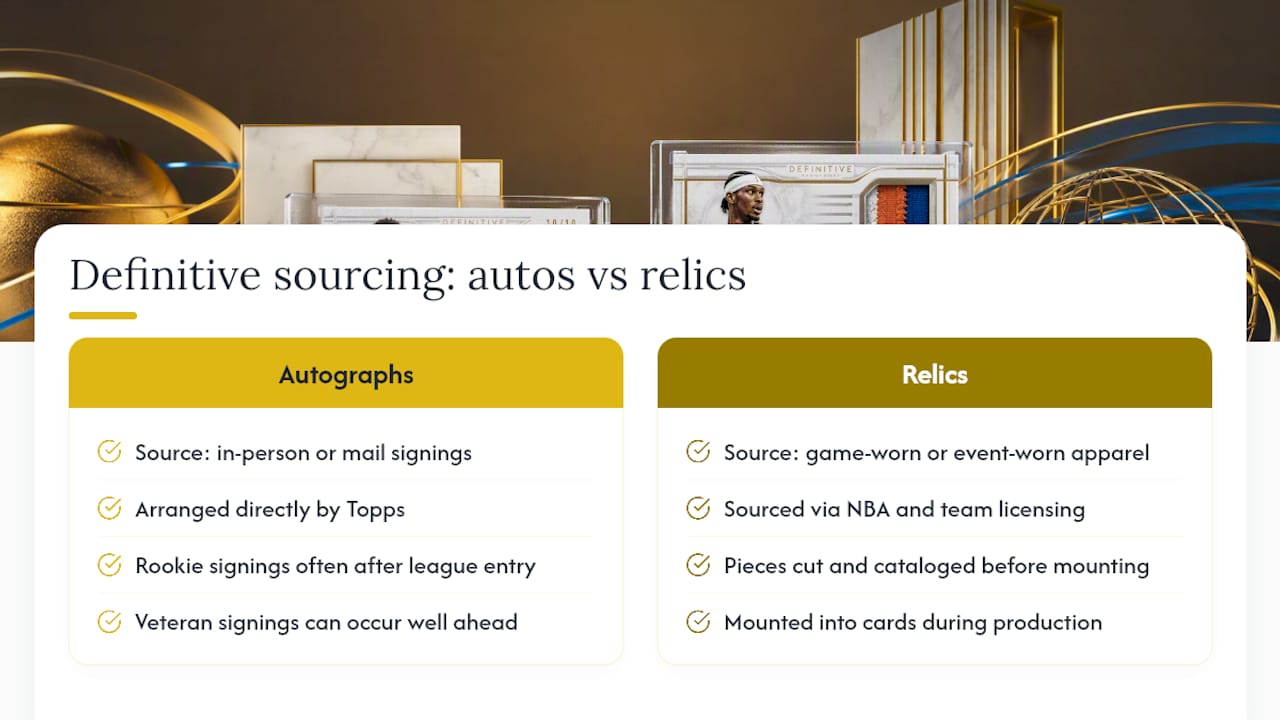
High-end Topps products like Definitive rely on signing arrangements set up directly between Topps and its licensed players, typically through in-person signing sessions or mail-away card stock sent to a player’s team or agent. Rookie signings usually happen shortly after a player enters the league, which is why rookie patch autographs sometimes trail their base rookie card release by weeks or months. Veteran signings can happen well ahead of a set’s release, since Topps maintains longer-term signing relationships with established stars.
Relic material, including the jersey pieces used in Nameplates and patch autos, comes from game-worn or event-worn apparel that Topps sources through licensing agreements with the NBA and its teams. Each relic piece gets cut and cataloged before it’s mounted into a card, which is part of why relic supply, unlike autograph supply, is finite and non-renewable once a particular jersey has been fully used across a print run.
Authentication for autographed cards typically happens at the point of signing, with Topps controlling chain of custody from signing session to final packaged card. That’s different from third-party autograph authentication you might see on vintage memorabilia, where a signature gets verified after the fact. Because Topps controls the process end to end, a factory-sealed Definitive box or an unopened redemption card carries a level of built-in trust that loose secondary-market autographs simply don’t have. That’s one reason buying sealed or verified redemption product tends to carry less risk than buying a raw autographed card with no paper trail.
What’s Happening in the Secondary Market Right Now
Demand for Definitive tends to spike hardest in the days immediately following a Topps.com launch, then settle into a steadier rhythm as the initial supply gets absorbed by the hobby. Because the product sells through a controlled, allocation-based channel rather than an open hobby case market, resale pricing on unopened boxes often trades at a real premium over the original Topps.com price almost immediately after a launch sells out.
Individual card values inside the product vary enormously depending on player, parallel, and relic quality. A base-tier rookie autograph might trade modestly, while a low-numbered patch auto from a top rookie or a Nameplate letter from a marquee veteran can command a much higher price. Because every card is serial-numbered and unique in some way, there’s no such thing as a truly “common” card in Definitive, which keeps the floor price on even minor pulls higher than in a typical retail product.
Rookie-driven demand tends to be the biggest swing factor. A strong rookie season, an All-Star selection, or a breakout playoff run can push autograph prices up sharply within weeks, while a slow start can just as quickly cool interest. Veteran cards move more predictably, tracking closer to a player’s overall career market rather than swinging on a single season.
Collectors watching the market closely should track recent sold listings rather than active asking prices, since asking prices on rare pulls are frequently set well above what buyers are actually paying.
How to Protect and Store Your Definitive Cards
Definitive cards carry real dollar value the moment they’re pulled, and storage habits matter from the first minute you open a box.
Start every card in a penny sleeve immediately, before it ever touches a table or a display case. From there, move it into a rigid top loader for handling and short-term storage, since top loaders protect corners and surfaces far better than a sleeve alone. For long-term storage, a one-touch magnetic holder offers a step up in protection and display quality, particularly for framed autographs and patch cards you want to showcase without risking damage.
Cards you intend to submit for grading should stay in a top loader or card saver until submission, with no bending, taping, or writing anywhere near the card surface. Handle by the edges only, and avoid direct sunlight for any card on long-term display, since UV exposure can fade ink and discolor card stock over time.
For a full collection, a hard-sided storage box with dividers keeps cards organized by player or parallel type without stacking pressure on any single card. Humidity control matters more than most collectors realize. A dry, stable environment protects both the card stock and any embroidered jersey material used in relic cards far better than a humid closet or garage.
Cards intended for display, particularly framed autographs, do best in a UV-protective screw-down holder or magnetic case rather than a standard top loader left out in open air indefinitely.
Where to Buy Authentic Definitive Cards
The safest starting point for sealed Definitive product is Topps.com itself, since that’s the primary channel Topps uses for the release, and the official Topps launch page confirms allocation and box details directly from the manufacturer. Buying sealed product from the source eliminates any question about tampering or reseal risk.
For individual cards, whether pulled from a box or bought as a standalone card, provenance matters. Reputable specialty sellers who authenticate inventory and list detailed photos of the actual card, not stock images, are far safer than anonymous marketplace listings with no seller history. Nextgencards, for example, curates individual rookie autographs and relic cards with an authentication emphasis rather than mixing in unverified inventory.
A few practical checks apply no matter where you buy. Compare the serial number and parallel name on a listing against Beckett’s published checklist to confirm the print run and naming match. Ask for timestamped photos showing the card’s front, back, and any autograph or patch up close. Be wary of any listing priced dramatically below recent sold comps, since that’s often the first sign of a reprint, an altered card, or a misrepresented parallel. Established checklist sites like Beckett and Collector Nation are useful reference points precisely because they track official print details rather than relying on secondhand claims.
2025-26 Topps Definitive Basketball: What Collectors Need to Know
Definitive rewards patience and research more than raw spending power, and that’s the part conventional hobby chatter tends to gloss over. Every box guarantees a hit, but “guaranteed hit” and “guaranteed value” are not the same thing. A collector who understands patch quality, serial number desirability, and rookie-class strength will consistently pull more value from the same box than someone chasing names alone.

The all-serial-numbered format also changes how you should think about grading and resale. Base-set completion, the traditional hobby goal, simply doesn’t apply here. Your strategy should shift toward individual player and parallel outcomes, not filling out a checklist. That means doing your homework on a handful of rookies you believe in, rather than spreading bets thin across the whole class.
My honest read: the smartest move for most collectors isn’t chasing a full case. It’s identifying one or two rookies you’re confident in, then buying a specific verified card rather than gambling on box contents. That approach controls risk in a product where box-to-box variance can be enormous.
— Richard
Get Definitive-Caliber Cards Without the Box Gamble
Nextgencards gives collectors a different path into the Definitive era: skip the sealed-box variance and buy the exact rookie signature or relic card you actually want. That’s the real advantage over case-breaking, where a $400 box can just as easily return a bench player Nameplate letter as a top rookie patch auto.
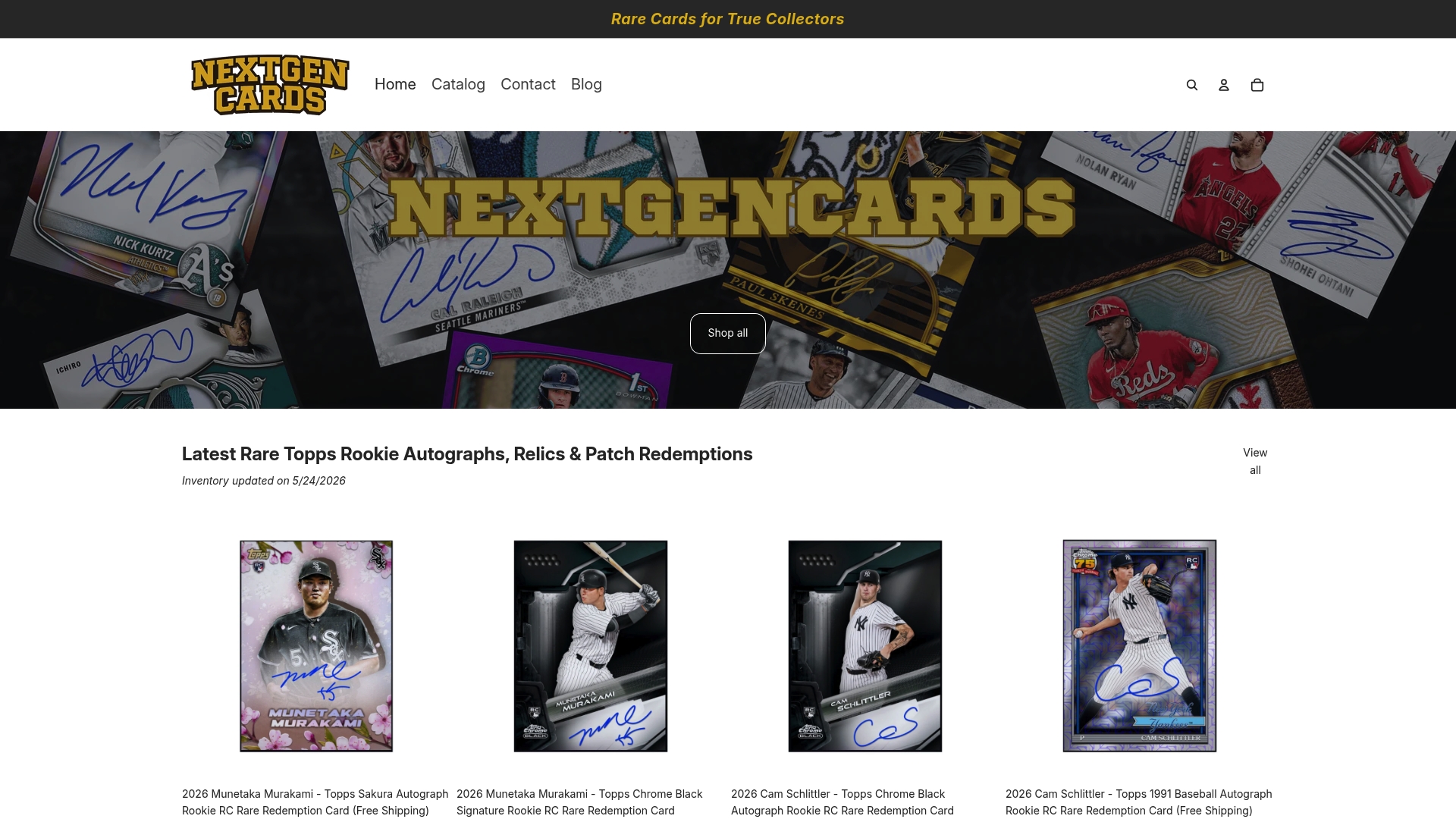
The rookie autographs and relics collection features curated inventory built specifically for collectors chasing verified names rather than random pulls, and select items ship free. If you’re set on a Yamamoto redemption, a Jalen Brunson patch card, or another marquee name, browse the full rookie autograph and redemption catalog and add a verified card to your collection today instead of leaving it to chance.
Sources
- 2025-26 Topps Definitive Basketball Hobby Boxes
- 2025-26 Topps Basketball Checklist, Team Set Lists and Details
- 2025-26 Topps Definitive Collection Basketball: Box Guide (The Collector Nation)
FAQ
What Are the Most Valuable 2025-26 Topps Basketball Cards?
Rookie patch autographs and Framed Autograph Collection cards from top 2025-26 rookies like Cooper Flagg and Dylan Harper typically command the highest prices, according to Beckett’s checklist coverage. Veteran autographs from established stars like Victor Wembanyama also drive strong secondary market demand.
What Should I Look for in 2025-26 Topps Basketball Cards?
Check the autograph clarity, patch size and color, and serial number desirability before buying any high-end card. Cards with large multi-color patches, clean on-card signatures, and low or jersey-matched serial numbers consistently outsell plainer versions of the same player.
How Much Does the 2025-26 Topps Definitive Basketball Set Cost?
Topps has not published a fixed retail price on its public pages, and pricing runs through limited Topps.com allocations rather than a standard set list price. Individual verified cards, like those listed on Nextgencards, offer current pricing on specific players without requiring a box purchase.
What Basketball Cards Is Topps Releasing in 2026?
Topps’ 2025-26 basketball lineup includes Definitive alongside its flagship and other premium releases, each with its own checklist and insert structure detailed in Beckett’s coverage. Definitive stands apart as the all-serial-numbered, hit-only tier of that lineup.
0 comments