

A serial number on an MLB autograph card is a fractional stamp that identifies each card’s exact copy within its total print run, making it the single most important rarity indicator in the hobby. This MLB autograph card serial number guide covers everything collectors and investors need: how to read the format, verify authenticity, spot scams, and assess value. Industry standards set by grading services like PSA, Beckett, and SGC treat serial numbers as primary authentication data points. Understanding them correctly separates informed buyers from collectors who overpay for common cards or miss genuinely scarce pieces.
What do serial numbers on MLB autograph cards mean?
Serial numbers follow a fractional format where the numerator is your card’s specific copy number and the denominator is the total print run. A card marked “047/100” is the 47th copy produced out of 100 total. That denominator is the number that drives value.
Print run size creates distinct rarity tiers that the market prices very differently:
- /99 or /100: Entry-level limited editions. Scarce but widely available in the secondary market.
- /50: Mid-tier scarcity. Noticeably harder to find and commands a meaningful premium.
- /25 or /10: High scarcity. These cards appear rarely at auction and attract serious investor interest.
- /5 or /3: Extremely rare. Often tied to superfractor or color parallel variants.
- 1/1: True one-of-one. The rarest print run in the hobby, with modern auction records exceeding $5 million as of march 2026.
One detail many collectors miss: foil-stamped serial numbers are the only ones that indicate a limited print run. Printed numbers embedded in the card’s design are part of the artwork, not a rarity indicator. Only the foil stamp drives scarcity and market value.
Parallel cards add another layer of complexity. A base autograph set might include gold, refractor, and superfractor parallels, each with its own serial number and print run. Collectors should verify parallel versions to understand where a specific card sits within the full rarity hierarchy. A gold refractor numbered /50 and a base parallel numbered /50 are not equivalent in value, even though the denominator matches.
The 2025 Topps Archives Signature Series illustrates how manufacturers use serialization by design. That product features over 120 subjects with serial runs of /99 or fewer per card. That structure guarantees scarcity from the production stage, not as an afterthought.
Pro Tip: When evaluating a card’s serial number, always check whether the set includes parallel variants. A card numbered /10 sounds rare until you discover a superfractor version numbered 1/1 exists in the same set.
How do you verify the authenticity of an MLB autograph card?
Authentication goes well beyond reading the serial number. Collectors must cross-reference serial numbers with official manufacturer databases and grading company registries. PSA, Beckett, and SGC each maintain online lookup tools that confirm whether a specific serial number has been previously graded or registered. Relying solely on the visible serial number is insufficient because label-swap scams and AI-generated fakes have made surface-level checks unreliable.
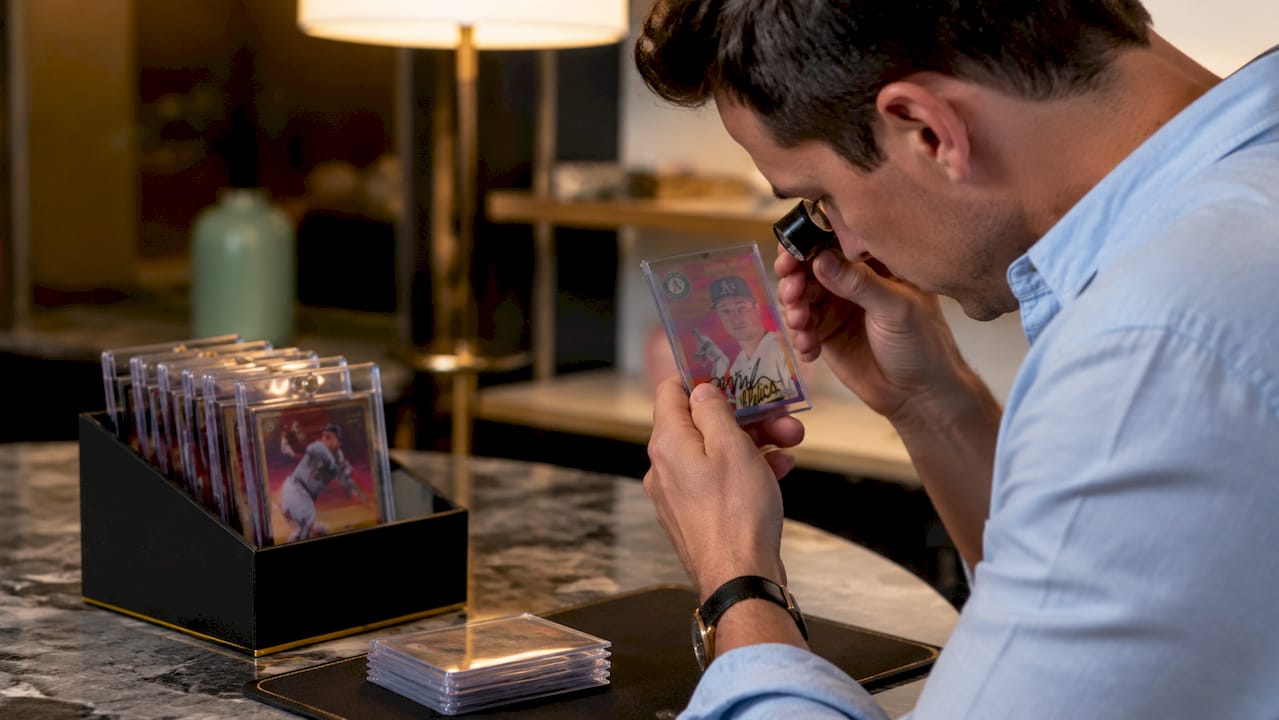
Physical inspection is the next step. Use a jeweler’s loupe at 10x magnification to examine the foil stamp. Genuine foil-stamped serial numbers integrate with the card surface in a specific way. The texture is consistent, the edges are clean, and the stamp sits flush. Irregularities like bubbling, misalignment, or uneven ink distribution are red flags.
Autograph verification requires its own process. On-card autographs carry more value than sticker autographs because the ink is applied directly to the card surface. Collectors use magnification and ink color matching to confirm the signature’s authenticity. A genuine on-card autograph shows natural ink flow, pressure variation, and slight surface texture from the pen.
Modern high-value cards include embedded security features. COAs with QR codes or holograms are verifiable through official manufacturer apps. Scan the QR code and confirm the result matches the card’s stated serial number and player. If the app returns no result or a mismatch, treat the card as suspect.
Third-party grading remains the strongest authentication tool available. A card graded and slabbed by PSA, Beckett, or SGC has passed physical inspection by trained authenticators. Graded cards carry lower counterfeit risk and command better prices in the secondary market.
What are the most common scams in serial-numbered autograph card collecting?
Label-swap fraud is the most dangerous scam in the hobby. Fraudsters take an authentic graded slab, carefully open it, swap the card inside for a counterfeit or lower-grade copy, and reseal it. The serial number on the label still matches a real card in the database, which makes the fraud difficult to detect without physical inspection. Signs of slab tampering include glue residue along the slab seam, fine scratches near the label, and non-aligned holographic seals.
Collectors also frequently misread printed numbers as serial numbers. A card might display “Card 47 of 100” as part of its design without any foil stamp. That number has no rarity value. Only the foil-stamped fraction on the card front indicates a genuine limited print run.
Inscriptions create a separate valuation trap. A card personalized to a non-famous individual can lose significant market value. Personalized inscriptions can reduce a card’s resale price by 30–50%, which makes provenance documentation even more critical when buying from private sellers.
Sophisticated AI tools now replicate holograms, foil stamps, and even signature patterns with enough accuracy to fool casual buyers. Any high-value autograph card purchase without third-party grading or direct manufacturer verification carries real financial risk in 2026.
Provenance documentation protects collectors from most fraud scenarios. COAs, original receipts, and purchase photos establish a card’s history and reduce the chance of unknowingly buying a manipulated piece. Request full documentation from any seller before completing a high-dollar transaction.
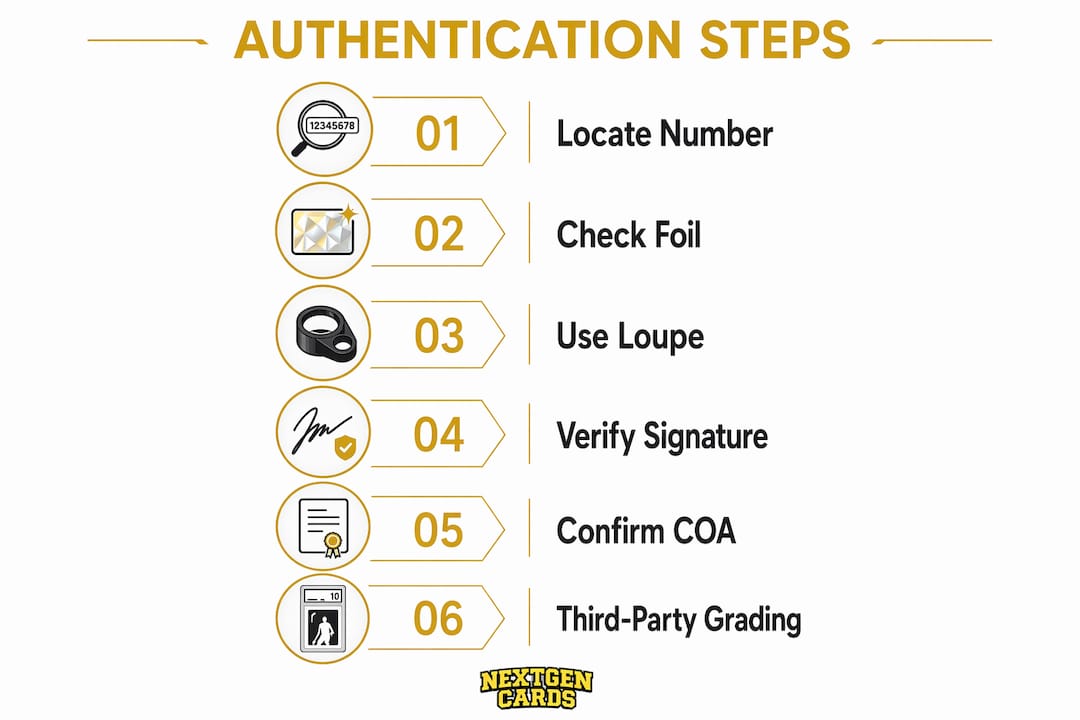
Step-by-step process for reading and authenticating MLB autograph cards
Follow these six steps every time you evaluate a serial-numbered autograph card.
-
Locate the serial number. Check the front lower corners of the card first. The serial number appears as a foil-stamped fraction. Confirm it is foil-stamped, not printed. If you cannot feel any texture difference with your fingernail, it may be a printed design element with no rarity value.
-
Cross-reference with official databases. Enter the card’s details into the PSA, Beckett, or SGC online registry. Confirm the serial number matches a registered card for that player, set, and year. A mismatch or missing entry is a serious warning sign.
-
Inspect physical card features. Use a jeweler’s loupe to examine the foil stamp, hologram, and autograph. Check for ink flow consistency on the signature. Confirm the hologram aligns correctly and shows no signs of removal or reapplication. For reading rookie autograph serial numbers specifically, compare the card’s design details against known authentic examples from the same set.
-
Verify provenance. Ask the seller for the original COA, purchase receipt, and any photos taken at the time of acquisition. A seller who cannot provide basic documentation on a high-value card is a risk. Check the seller’s feedback history on any platform before buying.
-
Assess scarcity within the full set. Identify whether parallel versions of the card exist. A card numbered /25 in a set that also has a /10 and a 1/1 parallel sits in the middle of the rarity hierarchy, not at the top. Understanding the full parallel structure gives you an accurate picture of true scarcity.
-
Consult pricing guides and population reports. PSA and Beckett publish population reports showing how many copies of a specific card have been graded. Fewer graded copies generally means less market supply and stronger price support. Cross-reference with recent auction results to confirm current market value.
| Step | Focus | Key Tool |
|---|---|---|
| Locate serial number | Confirm foil stamp vs. printed design | Fingernail test, jeweler’s loupe |
| Database check | Match serial number to official registry | PSA, Beckett, SGC lookup |
| Physical inspection | Autograph, hologram, foil texture | 10x jeweler’s loupe |
| Provenance review | COA, receipts, seller history | Documentation request |
| Parallel check | Full rarity hierarchy of the set | Manufacturer checklist |
| Market valuation | Population report and auction comps | PSA Pop Report, auction records |
Pro Tip: Population reports are underused by newer collectors. A card graded PSA 10 with only three copies in the population is worth significantly more than the same card with 300 graded copies, even if the serial number is identical.
For collectors building a position in authenticated rookie autographs, this six-step process applies to every acquisition regardless of price point.
Key Takeaways
Serial-numbered MLB autograph cards derive their value from foil-stamped print run denominators, verified authenticity through grading registries, and documented provenance that protects against fraud and supports resale liquidity.
| Point | Details |
|---|---|
| Foil stamp is the only rarity signal | Printed design numbers carry no scarcity value; only foil-stamped fractions indicate limited print runs. |
| Lower denominators drive higher value | Cards numbered /10 or fewer command the strongest premiums; 1/1 cards have set auction records above $5 million. |
| Database verification is non-negotiable | Cross-reference every serial number with PSA, Beckett, or SGC registries before any purchase. |
| Label-swap fraud requires physical inspection | Check slab seams, hologram alignment, and label adhesion to detect tampered graded cards. |
| Provenance documentation protects value | COAs, receipts, and purchase photos support resale liquidity and reduce fraud risk on high-dollar cards. |
What I’ve learned after years of watching the serial number market evolve
The single biggest mistake I see collectors make is treating the serial number as the whole story. A card numbered 1/1 from a player who never made the majors is worth far less than a card numbered /99 from a generational talent like Shohei Ohtani or Aaron Judge. Scarcity and player quality work together. Neither factor alone determines value.
The counterfeit problem has gotten genuinely serious. AI-generated fakes in 2026 are not the crude photocopies of a decade ago. They replicate foil texture, hologram patterns, and even signature flow with alarming accuracy. I’ve seen experienced collectors fooled by cards that passed a casual visual check. The only reliable defense is third-party grading combined with database verification. There is no shortcut.
My advice for newer collectors is to start with graded cards and build your authentication skills from there. Buying raw cards at high price points before you can confidently inspect foil stamps and slab integrity is a fast way to lose money. Graded cards cost more upfront, but the authentication has already been done by professionals. That premium is worth paying until your own inspection skills are sharp.
Provenance documentation is the most overlooked protection in the hobby. Keep every receipt, every COA, and every photo from the moment of purchase. That paper trail is what separates a card you can sell quickly at full value from one that sits unsold because buyers cannot verify its history.
— Richard
Rare serial-numbered MLB autograph cards at Nextgencards
Nextgencards curates a focused inventory of serial-numbered rookie autograph cards built specifically for serious collectors and investors.

The current inventory includes three Mason Miller Topps Chrome autograph rookie cards, each carrying guaranteed authenticity and limited serial runs. The Topps Chrome Platinum Anniversary autograph is a standout piece with free shipping included. The Purple Chase autograph rookie offers a color parallel variant for collectors building a complete run. The Topps Chrome Update Series autograph completes the trio with strong demand from the prospect collector market. Browse the full selection of rookie autographs and relics to find serial-numbered cards that match your collection goals.
FAQ
What does the serial number on an MLB autograph card mean?
The serial number is a foil-stamped fraction showing your card’s copy number out of the total print run. A lower total print run means greater scarcity and higher market value.
How do I tell a real serial number from a printed design number?
Genuine serial numbers are foil-stamped and sit slightly above the card surface. Run your fingernail lightly across the number. A printed design number feels flat; a foil stamp has a distinct texture.
What is a label-swap scam in sports card collecting?
A label-swap scam involves opening an authentic graded slab, replacing the real card with a fake or lower-grade copy, and resealing it. Inspect slab seams, hologram alignment, and label adhesion to detect tampering.
Does a personalized inscription affect MLB autograph card value?
Yes. A card inscribed to a non-famous individual can lose 30–50% of its market value compared to a clean signature, making provenance research critical before any purchase.
Which grading services authenticate MLB autograph card serial numbers?
PSA, Beckett, and SGC are the three primary grading services. Each maintains an online registry where collectors can verify whether a specific serial-numbered card has been authenticated and graded.
0 comments