

A redemption card is a placeholder insert with a hidden code that promises a specific premium card — usually an autograph, memorabilia piece, or rare parallel — to be delivered later. According to Topps’ own definition, the code sits beneath a scratch-off coating on the card’s back, and scratching it carefully with a coin is the first physical action you’ll take. Before you do anything else, check three things:
- Flip the card over and look for a printed expiration date.
- Keep the card unscratched until you’re ready to submit it on the manufacturer’s portal.
- Locate the correct redemption page for the brand that produced the card (Upper Deck, Topps, or Panini).
Pro Tip: Never photograph or broadcast the code on social media, livestreams, or box-break videos. A visible code can be intercepted and submitted by someone else before you get the chance.
Key Takeaways
Redemption cards are placeholder inserts with hidden codes that promise a premium card later — protecting the code and acting quickly on expiration dates are the two most consequential actions a new collector can take.

| Point | Details |
|---|---|
| Check expiration immediately | Flip the card over the moment you pull it and record the printed deadline before doing anything else. |
| Protect the code | Keep the scratch-off panel intact until submission; never photograph or broadcast the code publicly. |
| Use the right portal | Upper Deck, Topps, and Panini each have dedicated redemption pages — submit only through the manufacturer that issued the card. |
| Expect weeks to months | Typical fulfillment ranges from a few weeks to several months; player-related delays are the most common cause of longer waits. |
| Nextgencards vets listings | Nextgencards reviews expiration status and card details on every redemption in its inventory, with fulfilled hits also available for collectors who prefer certainty. |
Table of Contents
- How do redemption cards work, and why do manufacturers use them?
- Step-by-step: how to redeem a card and what affects your wait time
- Where to redeem: Upper Deck, Topps, and Panini compared
- What to do if your redemption is expired or delayed
- Practical tips for protecting, transferring, and selling redemptions
- Do redemption cards have market value?
- How brand reputation shapes redemption value
- A note on how Nextgencards approaches redemptions
- Nextgencards: where to find verified redemptions and fulfilled hits
- Official redemption portals and hobby resources
- Sources
How do redemption cards work, and why do manufacturers use them?
A redemption card functions as a formal IOU. The manufacturer inserts it into a pack in place of the actual premium card, which isn’t physically ready at the time the product ships. The card itself typically looks like a standard insert, with the promised item described on the front and a scratch-off panel concealing the unique redemption code on the back.
The reason manufacturers use them comes down to production timing. On-card autographs require a print-then-sign workflow: the card stock is printed first, then sent to the athlete for signing, then returned for quality control and packaging. That sequence often misses the product’s pack-out deadline. Rather than substitute a sticker autograph (widely considered lower-quality by collectors) or delay the entire product release, manufacturers insert a redemption card that holds the athlete’s spot on the checklist. As BaseballCardPedia notes, redemptions function like coupon-like inserts that companies use precisely when the physical insert isn’t ready at packout.
The result is that collectors get the product on schedule, and the manufacturer retains the ability to deliver the promised hit once the autograph is signed and processed. Understanding sports card companies and their production cycles helps explain why redemptions appear more often in high-end products, where on-card signatures are the standard rather than the exception.
Step-by-step: how to redeem a card and what affects your wait time
The redemption card process follows a clear sequence, though the details vary slightly by manufacturer.
- Scratch the code carefully. Use a coin and apply light, even pressure. A damaged or illegible code can create fulfillment problems.
- Create an account on the manufacturer’s portal. Upper Deck, Topps, and Panini each maintain dedicated redemption pages (linked in the sources section below).
- Enter the code and your shipping address. Double-check both before submitting. An incorrect address is one of the most common causes of lost fulfillments.
- Follow any mailing instructions. Some manufacturers require you to mail the physical redemption card after entering the code online. Missing this step can void the submission.
- Monitor your submission status. Most portals provide a status page where you can track progress from submission through shipment.
Timelines vary considerably. Select Cards’ guide to redemption workflows reports typical processing ranges of 1–20 weeks, with an average around 7 weeks, though that data reflects an Australian regional issuer. For major U.S. manufacturers, collectors routinely report waits of several weeks to several months, and high-profile rookie autographs can take longer if the athlete’s signing schedule is delayed.
Several variables affect how long you’ll wait:
- Player availability. An athlete who hasn’t returned signed cards to the manufacturer is the single most common cause of extended delays, as Panini has acknowledged.
- Product type. Predictor and instant-win redemptions often carry hard legal deadlines that differ from standard autograph redemptions.
- Submission errors. Mixing ready and pending redemptions in one batch, mailing delays, or scratched/illegible codes all slow the process.
- Publicly revealed codes. Showing a code during a box break or on social media creates fraud risk and can complicate resolution if the code is used by someone else.
Where to redeem: Upper Deck, Topps, and Panini compared
Each of the three major U.S. manufacturers handles redemptions through its own portal, with distinct policies on turnaround time, expiration, and support.

Upper Deck operates a dedicated redemptions portal where collectors enter codes, track submissions, and contact customer care. Upper Deck is known for producing premium hockey and basketball products with on-card autographs, and its redemption program reflects that high-end focus. Turnaround times vary by product, and customer-care contact routes are documented on the portal itself.
Topps maintains a card redemptions page with submission instructions and a support path for expired or problematic codes. Topps covers MLB, NFL, and other licensed products, and its redemption policies include expiration dates printed on the card. The support page also addresses what collectors can do when a code has passed its deadline.
Panini requires collectors to enter the code on its portal, follow any mailing instructions for the physical card, and contact Panini’s support pages for international shipping or escalation questions. Panini’s NBA and NFL products generate a high volume of redemptions, and player-related delays are a documented and frequently cited issue.
Expiration dates are typically set a few years after a product’s release date, though the exact window differs by issuer. Sports Collectors Daily’s coverage of Topps’ redemption extension program confirms that manufacturers occasionally run extension programs, but these are not guaranteed and vary by issuer.
What to do if your redemption is expired or delayed
Discovering an expired or long-delayed redemption is frustrating, but there are concrete steps worth taking before writing it off.
- Photograph the card front and back. Document the code, the printed expiration date, and any other identifying information before contacting anyone.
- Contact manufacturer support directly. Provide the code, your original submission confirmation (if you have one), and proof of purchase. Be specific and polite; support teams handle high volumes.
- Check for official extension announcements. Manufacturers occasionally announce redemption extension programs. Search the manufacturer’s news page and hobby reporting sites for any active programs covering your product.
- Escalate if needed. If a manufacturer fails to honor a valid, in-window redemption, consumer protection resources such as the Better Business Bureau or your state attorney general’s consumer protection office are available options. Third-party hobby watchdog communities can also document patterns of non-fulfillment.
Manufacturer responses to expired redemptions vary widely. Some issuers offer goodwill replacements or alternative cards; others may offer store credit or raffle entries. Many simply cannot honor a redemption once the expiration window has closed, particularly if the athlete’s signed cards are no longer available.
Pro Tip: Instant-win and predictor redemptions often carry hard legal deadlines that are shorter than standard autograph redemptions; for more ideas on contest prizes, see contest prize ideas for sports fantasy players. Check the back of the card the moment you pull it — these deadlines can be as short as 30 to 90 days.
Practical tips for protecting, transferring, and selling redemptions
Handling a redemption card correctly from the moment you pull it protects both its value and your ability to redeem it.
- Sleeve it immediately. A penny sleeve and a top loader protect the card from damage that could make the code unreadable.
- Keep the code private. Photograph only the card’s face for social media or sale listings. Never post an image that shows the scratch-off panel or the revealed code.
- Record the back-of-card details. Write down or photograph the code, expiration date, and any submission instructions before scratching, in case the coating damages the print.
- Disclose fully when selling. List the expiration date, the manufacturer, and the promised card’s details. Buyers expect a discount compared to a fulfilled card, and omitting expiration information can create disputes.
- Consider escrow for high-value redemptions. For a redemption promising a low-numbered parallel or a high-profile rookie autograph, a third-party escrow arrangement protects both buyer and seller during the transfer.
Pricing on the secondary market reflects both the underlying card’s specs and the seller’s fulfillment reputation. For guidance on evaluating raw and unfulfilled cards before buying, Nextgencards’ buyer’s guide covers the key quality checks worth running.
Do redemption cards have market value?
Unfulfilled redemptions can carry real market value, sometimes approaching the value of the fulfilled card itself. The gap depends on several factors.
When a redemption promises a low-numbered parallel, a confirmed 1/1, or a high-profile rookie autograph from a player like a top NBA draft pick or a first-year MLB star, collectors are often willing to pay close to the fulfilled card’s market price. The speculative upside is clear: if the card delivers as promised, the buyer acquires a premium piece at a discount. Specialty dealers and experienced collectors sometimes purchase redemptions specifically for this arbitrage opportunity, particularly when the manufacturer has a strong fulfillment track record.
The value gap widens when the manufacturer’s reputation is uncertain, the expiration date is approaching, or the promised player’s career trajectory is unclear. A redemption for a player who hasn’t yet established themselves carries more risk than one for a proven star.
Key value drivers for any unfulfilled redemption:
- Card numbering. Lower print runs command higher prices, even before fulfillment.
- Player profile. Established stars and high-upside rookies retain stronger demand.
- Product rarity. Premium product lines with limited checklists produce more sought-after redemptions.
- Manufacturer fulfillment reputation. Issuers with documented histories of timely fulfillment see their redemptions trade closer to fulfilled-card values.
- Expiration risk. A redemption with two years remaining is worth more than one expiring in three months.
For collectors comparing redemptions to already-fulfilled cards, Nextgencards’ collection of authenticated rookie autographs and relics offers a direct look at what fulfilled premium cards look like at market.
How brand reputation shapes redemption value
The secondary-market price of an unfulfilled redemption is partly a bet on the manufacturer. Boardroom’s analysis of redemptions in the hobby makes the dynamic explicit: redemptions shift the wait-time and administrative burden entirely to the collector, and when manufacturers demonstrate consistent fulfillment, those redemptions trade closer to the fulfilled card’s value. When they don’t, the discount widens.
A practical checklist for assessing redemption risk before buying or holding:
- Does the manufacturer have a public record of fulfilling redemptions from this product line?
- Has the manufacturer announced any extension programs for this set?
- Are there community reports of extended delays or unfulfilled redemptions from this specific product?
- Is this a predictor or instant-win redemption with a hard legal expiry, or a standard autograph redemption?
Hobby reporting has documented both ends of the spectrum. Some collectors have waited well over a year for high-profile autograph redemptions, only to receive the card in excellent condition once the athlete’s signing was complete. Others have held redemptions through expiration without resolution. The pattern is consistent: manufacturers with transparent communication and documented fulfillment histories produce redemptions that the hobby treats as near-equivalent to the finished card.
Pro Tip: Before purchasing a redemption on the secondary market, search the manufacturer’s name plus the product name in hobby forums. Community reports of fulfillment patterns are often more current than any official policy page.
A note on how Nextgencards approaches redemptions
At Nextgencards, every redemption card listed in our inventory is reviewed for expiration status, manufacturer, and the specific card promised before it goes live. We focus on rare and scarce pieces — rookie autographs, patch cards, relics, and limited-edition parallels — and that same standard applies to the redemptions we carry. If you have questions about a specific redemption listing or need guidance on the process, our customer-service team is available to help. Collectors who prefer the certainty of a fulfilled card can browse our verified autograph and relic inventory directly.
Nextgencards: where to find verified redemptions and fulfilled hits
Pulling a redemption card is exciting, but the wait and the uncertainty aren’t for everyone. Nextgencards offers a direct alternative: a curated inventory of rare sports trading cards, including physical redemption cards with verified expiration status, alongside already-fulfilled rookie autographs, patch cards, and relics featuring current MLB, NBA, and NFL players.
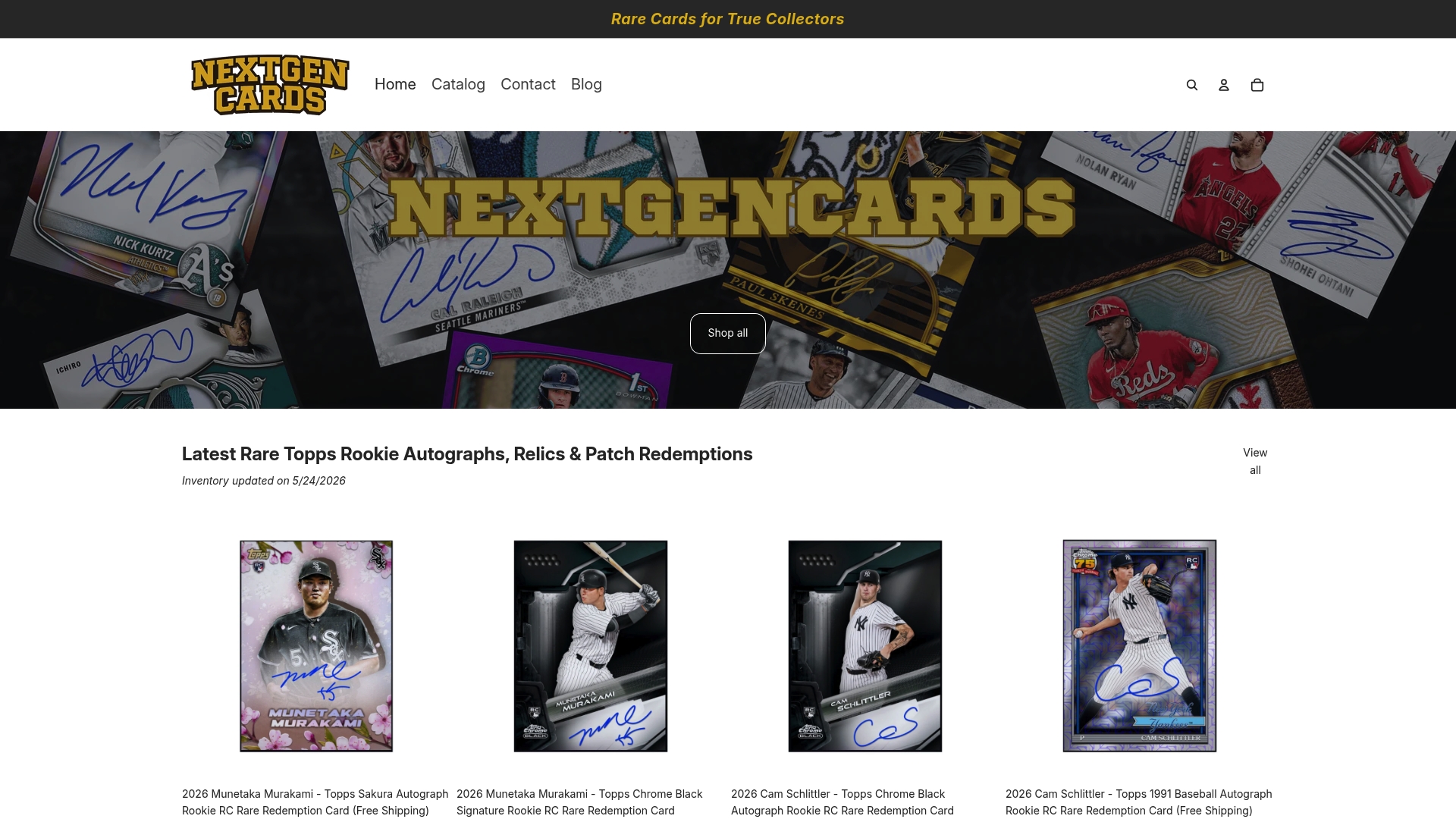
The difference is curation. Every card in the Nextgencards catalog is selected for rarity, authenticity, and collector appeal — not volume. Free shipping is available on select items, and the inventory includes pieces from players like Shohei Ohtani and Aaron Judge. Whether you want to hold a redemption for its speculative upside or skip the wait entirely with a fulfilled hit, the catalog has both. Browse the full selection at Nextgencards and check current listings for rare rookie autographs, relics, and redemption cards with free shipping.
Official redemption portals and hobby resources
Use these links to act immediately after pulling a redemption card or to research a manufacturer’s current policies.
- Panini America Support: paniniamerica.net/support.html — redemption help, international shipping guidance, and escalation contacts.
- Topps Redemption Definition (Ripped by Topps): Ripped — clear definition and safe-handling advice for new collectors.
- Sports Collectors Daily — Topps Redemption Extension Coverage: sportscollectorsdaily.com — hobby reporting on extension programs and expiration policy context.
- Panini Redemption Process Guide (ClutchPoints): Clutchpoints — detailed walkthrough of Panini’s portal workflow and common delay causes.
Always check the back of your card for the manufacturer’s printed deadline and any specific mailing or submission instructions before attempting to redeem. Policies differ by product line, and the printed card takes precedence over any general guidance.
Sources
Recommended
- NextGenCards Collector’s Guide – Next Gen Cards LLC
- Rarity & Value Guide: 2025 Cam Schlittler Topps Now 12-K Gem Postseaso – Next Gen Cards LLC
- Collector’s Guide to the 2026 Konnor Griffin Topps Bowman Chrome Refractor Prospect Signature RC Rare Redemption Card – Next Gen Cards LLC
- Why Collectors Want This 2026 Cooper Flagg Topps Flagship Rookie Jersey Patch Rare RC Redemption Card – Next Gen Cards LLC
0 comments