

Aaron Judge home run cards are defined as the most premium modern baseball collectibles on the market, driven by extreme card scarcity, professional grading standards, and Judge’s historic on-field achievements. The 2013 Bowman Chrome Draft Superfractor Autograph 1/1 sold for $5.2 million, setting a record for modern sports cards. That single sale tells you everything about why judge home run cards premium status is no accident. Rarity, authentication, and a generational player’s legacy combine to create demand that most sports cards never approach.
What factors determine the premium value of Aaron Judge home run cards?
The premium on Judge cards starts with scarcity. The 2013 Bowman Chrome Draft Superfractor is a 1/1 card, meaning exactly one copy exists in the world. That absolute rarity places it in a different category from any numbered parallel or standard rookie card.
Professional grading from PSA and BGS is the second major driver. A PSA 10 versus a PSA 9 can mean a difference of hundreds or even thousands of dollars on the same card. Collectors treat a PSA 10 as the definitive version of any card, and that designation directly controls what buyers will pay.
Several specific card features push values even higher:
- Autograph presence: On-card signatures from Judge add immediate premium. Authenticated autograph cards, especially from his earliest professional years, carry the highest demand.
- Game-used patches: Cards containing a piece of Judge’s actual jersey or bat are called relic cards. A patch from a pinstriped Yankees jersey adds both visual appeal and provenance.
- Numbered parallels: Cards numbered to 10, 5, or 1 command far more than base versions. The lower the print run, the higher the ceiling.
- Dual and triple autographs: A 2025 Topps Chrome Dual Gold Logoman featuring Judge and Shohei Ohtani sold for $2.16 million. Multi-player cards multiply scarcity and collector appeal simultaneously.
- Earliest pro cards: Collectors prioritize Judge’s first pro-issued cards over later official rookies. The 2013 Bowman Chrome Draft series is the foundation of any serious Judge collection.
Pro Tip: When evaluating a Judge card for investment, check the population report from PSA or BGS before buying. If fewer than 10 copies exist at a given grade, you are looking at a genuinely scarce asset.
The 2021 Aaron Judge Derek Jeter Topps Museum Collection Dual Autograph is a strong example of how dual autographs from two Yankees legends create a card that appeals to both Judge collectors and Jeter collectors at once. That overlap in demand is a direct value multiplier.

How does Judge’s on-field performance drive home run card value?
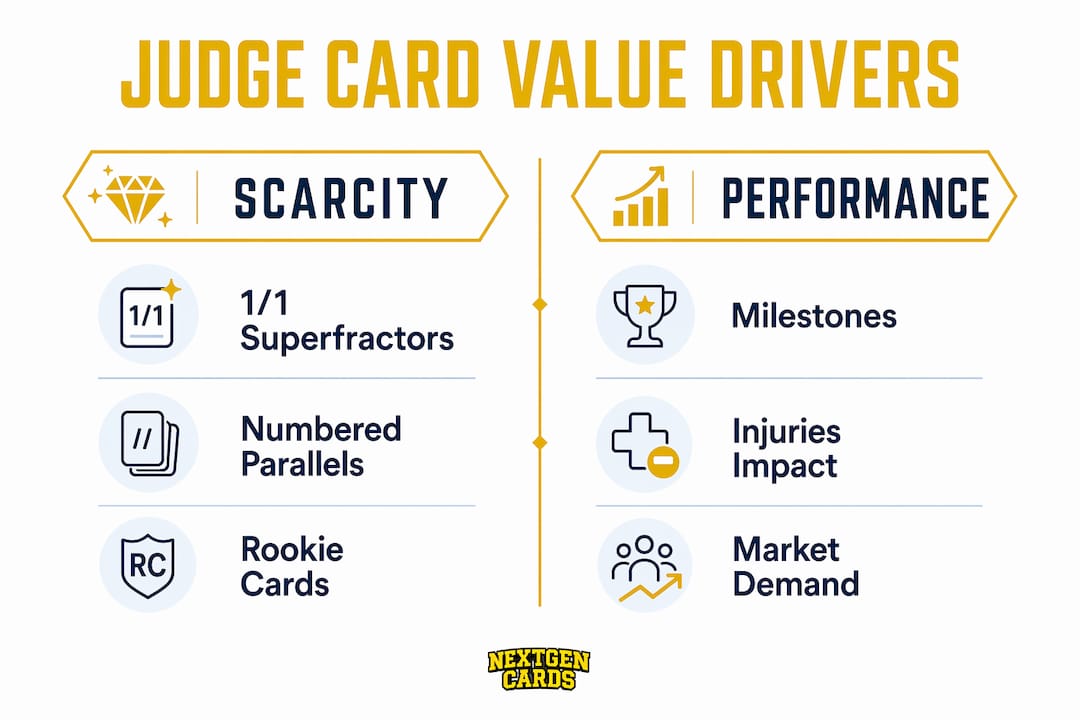
Aaron Judge’s career statistics directly fuel collector demand. Judge reached 300 home runs in 955 games, the fastest pace in Major League Baseball history. That record places him in a conversation with the sport’s all-time greats, and collectors price his cards accordingly.
The relationship between milestones and card prices follows a clear pattern:
- Record-setting home run seasons: Each time Judge breaks or approaches an AL home run record, search volume and auction activity for his cards spike. The market responds to news in real time.
- MVP awards: Judge’s AL MVP recognition confirmed his status as the best player in the American League. Award seasons historically produce sustained price increases, not just short-term spikes.
- Yankees fan base: The New York Yankees carry the largest and most passionate fan base in baseball. That audience creates a floor of demand that players on smaller-market teams simply do not have.
- Historical comparisons: Analysts compare Judge’s trajectory to Ken Griffey Jr. and Mike Trout. Griffey’s cards held value for decades after his peak. Trout’s 2009 Bowman Chrome Draft Superfractor sold for $3.936 million before Judge’s record eclipsed it. These comparisons set a credible long-term ceiling for Judge’s market.
- Performance dips and injuries: Short-term setbacks do not erase long-term value. Collectors who understand the market treat dips as entry points rather than warning signs.
The Aaron Judge rookie card guide at Nextgencards covers how specific milestones have moved prices across different card editions. Tracking those correlations helps collectors time purchases more effectively.
How do market trends and collector behavior shape the premium?
The sports card market for Judge cards behaves like the luxury alternative asset market. 1/1 Superfractors function as status symbols for high-net-worth collectors, often decoupling from Judge’s day-to-day performance entirely. A collector who pays $5.2 million for a card is not making a bet on Judge’s next season. They are acquiring a one-of-a-kind cultural artifact.
“Unique one-of-one cards gain remarkable premiums as luxury alternative assets. The buyer is not purchasing a baseball card. They are purchasing the only one that exists, and that distinction places the transaction in a different market entirely.”
Seasonality also shapes the market in ways that create real opportunities. During Judge’s IL stint, base cards actually increased in sales and value while rare refractor parallels saw decreased volume. That split behavior reveals two distinct buyer groups: everyday collectors who buy on news, and serious investors who hold or accumulate during quiet periods.
Short-term volume changes do not equal long-term value shifts. A card numbered to 5 does not become less scarce because Judge missed two weeks. Collectors who confuse temporary market softness with permanent devaluation often sell at the wrong time.
Pro Tip: Track auction results on a 90-day rolling basis rather than reacting to single sales. One outlier auction, high or low, rarely reflects true market value for a given card.
The speculative layer of the market also matters. Collectors buy in anticipation of Judge’s legacy, not just his current stats. If he finishes his career with 600-plus home runs, the demand for his earliest cards will reflect that legacy permanently.
What practical advice should collectors follow when buying Judge cards?
Buying Judge cards without a clear strategy leads to overpaying for the wrong editions. These are the most important principles for collectors and investors:
- Prioritize graded cards: Raw, ungraded cards carry uncertainty. A PSA 10 or BGS 9.5 removes doubt about condition and commands the strongest resale prices.
- Target early editions first: The 2017 Topps Bowman’s Best Rare Rookie RC Redemption Card represents the kind of early, authenticated Judge card that serious collectors prioritize. Early editions from 2013 and 2017 carry more historical weight than later releases.
- Avoid mass-produced base cards for investment: Scarcity-driven value separates premium cards from mass-produced ones. A base card printed in the hundreds of thousands will not appreciate the way a numbered parallel will.
- Watch pricing signals during performance peaks: Card prices spike after record-setting games. Buying during those spikes means paying a premium on top of an already premium card. Patience pays.
- Consider multi-player cards carefully: The 2022 Judge Jeter Jackson Topps Definitive Collection Triple Autograph appeals to collectors of all three players. That cross-collector demand creates a wider buyer pool at resale.
The table below outlines how different card types compare on key investment criteria:
| Card type | Scarcity | Grading impact | Long-term demand |
|---|---|---|---|
| 1/1 Superfractor | Absolute (one copy) | Extreme | Highest |
| Numbered parallel (to 10 or fewer) | Very high | Very high | Strong |
| Autograph rookie card | High | High | Strong |
| Game-used relic card | Moderate | Moderate | Moderate |
| Base rookie card | Low | Low | Limited |
Pro Tip: The 2017 Topps Bowman Wave 1 Rookie RC Redemption Card is a strong entry point for collectors who want authenticated early Judge cards without the six-figure price tags of 1/1 editions.
For deeper guidance on autograph card collecting, Nextgencards has a dedicated resource covering which Judge autograph editions offer the best combination of scarcity and market liquidity.
Key Takeaways
Aaron Judge home run cards command a premium because scarcity, professional grading, historic performance, and luxury asset dynamics combine to create demand that no mass-produced card can replicate.
| Point | Details |
|---|---|
| Scarcity drives the ceiling | 1/1 Superfractors like the 2013 Bowman Chrome Draft hold absolute rarity and the highest prices. |
| Grading determines resale value | A PSA 10 versus PSA 9 difference can shift a card’s value by thousands of dollars. |
| Milestones move markets | Judge’s record-setting pace to 300 home runs directly fuels collector demand and auction activity. |
| Injuries create buying windows | Base card values can rise during IL stints, while refractors soften, creating entry opportunities. |
| Multi-player cards multiply demand | Dual and triple autograph cards attract buyers from multiple collector bases, widening the market. |
Richard’s take on where the Judge card market goes from here
The $5.2 million sale of the 2013 Bowman Chrome Draft Superfractor was a market-defining moment. My honest read is that prices at that level will not repeat quickly. The market needs time to absorb a record like that, and the next buyer at that tier will need a compelling reason to go higher.
What I find more interesting is the mid-tier market. Numbered parallels, authenticated rookie redemption cards, and dual autograph editions are where I see the most sustainable value right now. These cards are accessible enough to trade, scarce enough to hold value, and tied to a player who is still actively building his legacy.
Judge’s career trajectory genuinely resembles Griffey Jr.'s in terms of fan loyalty and historical weight. Griffey’s cards never stopped being desirable, even decades after his peak. I expect the same pattern for Judge, with the strongest long-term demand concentrated in his earliest authenticated editions from 2013 and 2017.
The collectors who will regret their decisions are the ones who overpay for base cards during record-setting news cycles and the ones who sell numbered parallels during short injury stints. Both mistakes come from reacting to short-term noise instead of holding a long-term view on a generational player.
— Richard
Nextgencards has the Judge cards serious collectors want
Nextgencards curates a selection of authenticated, high-premium Aaron Judge cards built for collectors who take their collections seriously.
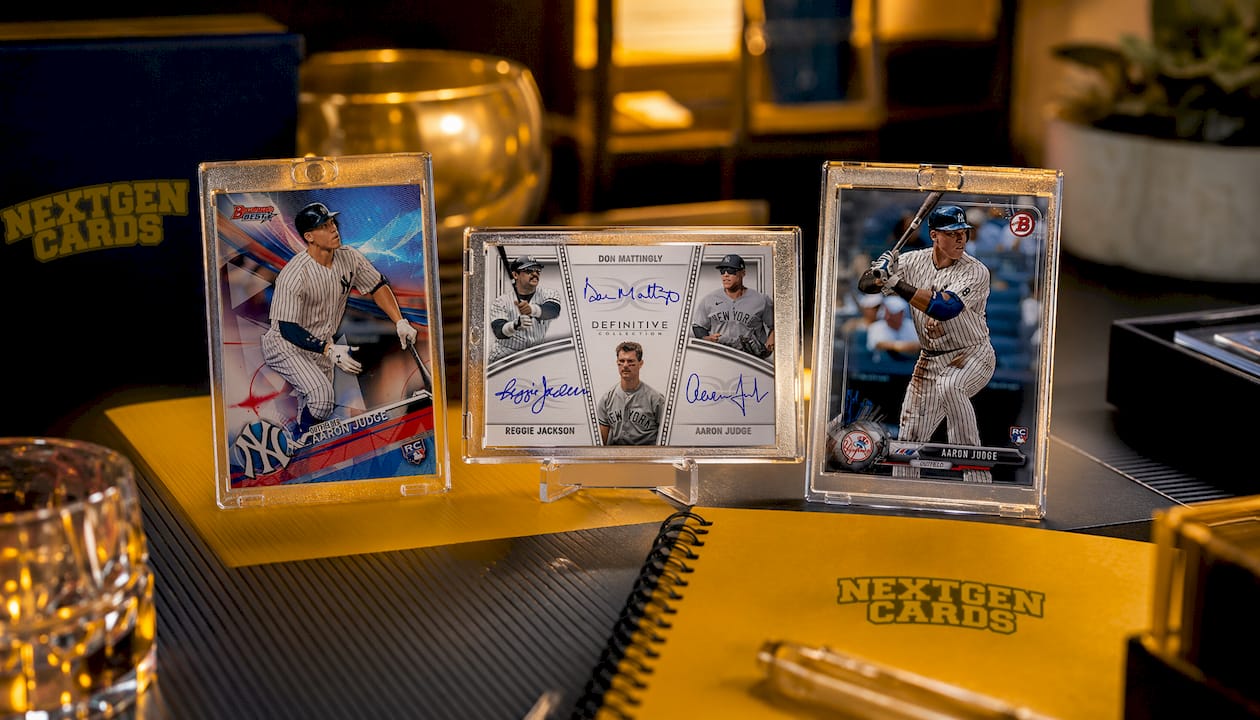
The inventory includes the 2017 Topps Bowman’s Best Rare Rookie RC, one of the most sought-after early Judge redemption cards, alongside the 2022 Triple Autograph Redemption Card featuring Judge, Derek Jeter, and Bo Jackson. Every card is authenticated and backed by Nextgencards’ trusted sourcing standards. Free shipping is available on select items. If you are building a serious Judge collection or adding a premium sports card investment to your portfolio, Nextgencards is the right place to start.
FAQ
What made the 2013 Bowman Chrome Draft Superfractor so valuable?
The 2013 Bowman Chrome Draft Superfractor Autograph is a 1/1 card, meaning only one copy exists. It sold for $5.2 million, making it the most expensive modern baseball card ever sold.
Does a PSA 10 grade really matter that much for Judge cards?
Yes. The price gap between PSA 9 and PSA 10 on the same Judge card can reach thousands of dollars. PSA 10 is the standard that serious buyers demand.
Do injuries hurt the long-term value of Judge’s cards?
Short-term volume drops during injury stints, but long-term value on scarce cards holds. Base cards actually gained value during one of Judge’s IL stints, showing that market behavior splits by card type.
Are multi-player Judge autograph cards worth collecting?
Multi-player cards like the 2025 Topps Chrome Dual Gold Logoman with Judge and Ohtani sold for $2.16 million. They attract buyers from multiple collector bases, which supports stronger demand at resale.
Which Judge cards are the best entry points for new collectors?
Authenticated rookie redemption cards from 2017, such as the Topps Bowman’s Best and Topps Bowman Wave 1 editions, offer genuine scarcity and historical significance without the six-figure price tags of 1/1 editions.
Recommended
- Best Place to Buy the 2017 Aaron Judge Topps Gypsy Queen Autograph Rookie RC Rare Redemption Card Free Shipping – Next Gen Cards LLC
- Before You Buy: 2024 Aaron Judge Juan Soto Topps Museum Collection Rare Dual Autograph Redemption Card Insights – Next Gen Cards LLC
- Top Places to Buy Aaron Judge Rookie Cards (2025 Guide) – Next Gen Cards LLC
- Aaron Judge Rookie Card Explained: 2026 Collector’s Guide – Next Gen Cards LLC
0 comments