

Auction houses sit at the center of the rare sports trading card market, setting price benchmarks, authenticating cards, and driving competitive demand that ripples through every private sale and dealer transaction. Their core functions are straightforward but consequential:
- They rely on third-party grading services like PSA, BGS, and SGC to establish condition baselines before any card reaches the block.
- They aggregate population scarcity data from grading databases to quantify how rare a given grade truly is.
- They compile comparable sales, or “comps,” from recent auction results to anchor pre-sale estimates in real market data.
- They handle the full consignment process, from intake and cataloging to marketing and final transaction, collecting fees from both sellers and buyers.
- Their public, authenticated results serve as transparent benchmarks that influence pricing across the entire hobby, from private sales to dealer asking prices.
Understanding the role of auction houses in card sales is the first step toward buying and selling smarter, whether you use them or not.
Table of Contents
- How auction houses price rare sports cards
- Why auction hammer prices have real limitations
- How auction houses are evolving beyond the sale room
- How Nextgencards supports collectors navigating this market
- Auction house pricing mechanisms: what actually moves the number
- How auction houses shape the broader card market
- The consignment process: what selling through an auction house actually involves
- Auction house sales versus direct private sales
- How auction house marketing affects what cards sell for
- Risks of relying solely on auction houses
- Alternatives to auction houses for buying and selling
- Nextgencards: curated rare cards without the auction house overhead
- Key Takeaways
How auction houses price rare sports cards
Auction house pricing for rare cards rests on four pillars: grading, population scarcity, comparable sales, and market timing.
Third-party graders like PSA, BGS, and SGC each use a 1–10 scale, but the standards differ. PSA 10 is the most widely recognized top grade and commands the strongest premiums in the sports card market. The jump from a PSA 9 to a PSA 10 is not linear. On a vintage card with few surviving high-grade copies, that single grade point can multiply value several times over.
Population reports are the next layer. If only three PSA 10 copies of a 1986 Fleer Michael Jordan rookie exist in the registry, that scarcity is a hard data point auction specialists factor directly into their estimates. Scarcity also accumulates over time through handling damage and lost collections, so a card printed in large quantities decades ago may have very few surviving examples in top condition today.
Comparable sales data is the most reliable pricing anchor because it reflects what real buyers paid under current market conditions. Auction specialists pull recent results for the same card in the same grade, not what a price guide published months ago suggests. Broader market conditions also matter. During a rapid run-up, estimates lag behind actual sale prices. During a correction, estimates can be sticky on the high side, leading to unsold lots.
- Fee structures vary by house and affect net returns materially. Heritage Auctions charges sellers a 5% consignment fee with a 20% buyer’s premium. Goldin Auctions charges sellers 9% with negotiable buyer’s premiums on higher-value lots. Huggins and Scott sits at 10% consignment.
- On a card that hammers at $100,000, the Heritage seller keeps roughly $95,000 before any additional fees.
Why auction hammer prices have real limitations
Auction hammer prices exclude buyer’s premiums and consignment fees, so the headline number is not what the seller receives or what the buyer actually pays. A card that hammers at $1,000 at Heritage nets the seller $950. That gap matters when you are using auction results to price your own cards.
High-profile results can also be skewed by marketing intensity, elite buyer competition, and the rarity of the auction event itself. Auction results can mislead individual collectors when treated as universal price indicators rather than data points from exceptional transactions with exceptional examples.
Auctions excel at price discovery for illiquid or untested cards where no recent comp exists. For cards that trade frequently with established values, the auction premium may not be worth the fees. Private sales and direct transactions often avoid those costs entirely and can offer better liquidity for mid-tier cards.
Pro Tip: Track sell-through rates alongside hammer prices. The percentage of lots that actually find buyers is a leading indicator of real market health, more reliable than any single headline sale.
How auction houses are evolving beyond the sale room
The auction house business model has shifted considerably. Major houses now focus less on chasing record prices and more on bidder participation, sell-through rates, and diverse revenue streams that retain clients across multiple sales cycles.
- Private sales, art financing, loans against assets, and advisory services have become core offerings alongside traditional auctions.
- Collector loans against cards and collectibles are expanding, deepening auction houses’ financial service footprint well beyond the sale room.
- Heritage Auctions posted more than $2 billion in sales in a recent year, its highest total ever, driven partly by its early investment in collectibles categories like sports cards and Pokémon.
- Media coverage of marquee sales amplifies market visibility. The exceptionally high-value Pikachu Illustrator sale generated coverage across CNN, financial outlets, and sports media, drawing new participants into the hobby.
For serious collectors, this evolution means auctions are useful for discovery pricing on rare or untested cards, but direct sales and private transactions remain the better route for mid-tier cards where fees erode returns.
How Nextgencards supports collectors navigating this market
Nextgencards was built specifically for collectors who want to buy and sell rare sports trading cards without the friction of traditional auction intermediaries. The inventory focuses on rookie autographs, relics, and rare redemption cards from athletes like Shohei Ohtani and Aaron Judge, curated for collectors who know exactly what they are looking for.
- Expert guides and market analyses help collectors identify undervalued cards before they reach auction, giving buyers an edge on timing and pricing.
- Transparent pricing and authentication standards build the trust that serious collectors require when buying outside the auction environment.
- Knowledge of auction market dynamics informs the buying and selling guidance Nextgencards provides, helping collectors decide when to use auction price discovery and when a direct transaction makes more financial sense.
- Fast shipping on select items reduces the wait time that often accompanies auction house consignment cycles.
Auction house pricing mechanisms: what actually moves the number
The pricing process at a major auction house is part data analysis, part specialist judgment. Grading establishes the condition baseline. Population reports quantify scarcity. Comps anchor the estimate. But the specialist’s read on current demand, cultural significance, and collector appetite fills the gap where hard data runs thin.
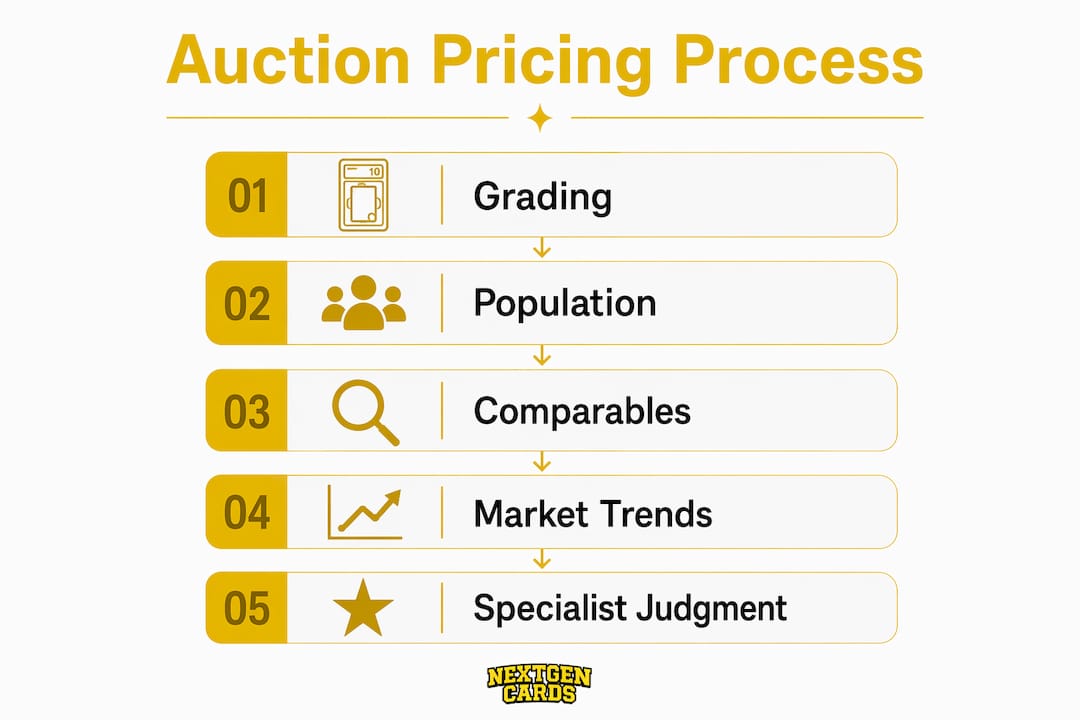
For a card like a 1952 Topps Mickey Mantle, the floor is well-established and estimates tend to be tight. For a modern ultra-rare rookie autograph with limited sales history, the estimate can swing widely with hype cycles. Auction house estimates for blue-chip vintage cards are generally more reliable than estimates for cards in the speculative middle of the market.
Vendor premium waivers and buyer’s premium adjustments are also negotiable for high-value consignments, a detail most guides overlook. If you are consigning a card worth six figures, the published fee schedule is a starting point, not a ceiling.
How auction houses shape the broader card market
High-profile auction sales democratize pricing information and establish value hierarchies that ripple through private sales and dealer pricing across the entire hobby. A card that sat unknown in a collection for years can suddenly be understood as worth substantially more once an authenticated example sells publicly at a major venue.

This process creates both opportunity and risk. Dealers and individual collectors reference the same auction databases to set asking prices, creating an interconnected market where a single headline sale reshapes expectations for similar cards in lower grades. That cascading effect can push prices on lower-grade examples beyond what their condition actually warrants. Understanding auction market dynamics helps you spot those distortions before you overpay.
The consignment process: what selling through an auction house actually involves
Consigning a card to a major auction house follows a defined sequence. You submit the card for review, the house evaluates condition and authenticity, and specialists assign a pre-sale estimate based on grading, comps, and population data. The card is then cataloged with professional photography and provenance documentation before appearing in a scheduled sale.
Marketing is a significant part of what you pay for. Heritage and Goldin invest heavily in catalog production, media outreach, and promotion for marquee lots. That visibility is part of the value proposition for truly rare cards. For mid-tier cards, the marketing spend may not justify the consignment fee when a direct sale could close faster and net more.
The timeline from consignment to payment typically runs several weeks to a few months, depending on the house and the sale schedule. Sellers who need liquidity quickly often find that timeline incompatible with their goals.
Auction house sales versus direct private sales
The core tradeoff is price discovery versus cost efficiency. Auctions deliver competitive bidding and transparent pricing for rare or illiquid cards. Direct private sales avoid buyer’s premiums and consignment fees but sacrifice the discovery mechanism that competitive bidding provides.
For a 1-of-1 rookie patch autograph with no recent comp, an auction is often the right call. The competitive dynamic can push the final price well above any private offer you would have received. For a PSA 10 modern parallel that trades regularly on secondary markets, a direct sale or fixed-price listing will typically net more after fees. Auction versus Buy It Now research shows auctions close at lower prices on average for cards with established demand, though they outperform for illiquid inventory.
You can also learn how auction experts identify hidden value in collectibles to sharpen your own valuation approach before deciding which route to take.
How auction house marketing affects what cards sell for
Marketing is not a neutral variable in auction outcomes. The photography, catalog copy, provenance research, and media outreach that major houses invest in for marquee lots directly influence bidder participation and final prices. A card presented with full provenance documentation and professional imagery in a high-profile sale attracts a different pool of bidders than the same card listed with a smartphone photo.
Starting auctions at low opening bids builds early engagement and algorithmic visibility, which improves final sale prices compared to high starting bids or fixed-price listings. The psychological effect of competitive bidding, where early bidders become emotionally invested and respond when outbid, is a documented driver of price escalation. Auction houses understand this and structure their sales accordingly.
Risks of relying solely on auction houses
Treating auction results as the only pricing reference is one of the most common mistakes serious collectors make. Auction prices represent exceptional transactions with exceptional examples, not the typical experience for most cards in most grades.
The “Lambda variable,” or hassle factor, describes how auction participation has declined as digital distractions compete for bidder attention. Research comparing auction and Buy It Now prices on eBay found that the gap between auction closing prices and fixed-price listings widened from 4.7% in 2003 to 16.5% in 2009, with the trend continuing since. Relying on auction results to set Buy It Now prices can lead to overpricing and stale inventory.
Auction results also represent a snapshot in time. A card that sold for $10,000 last year may be worth less today if the market has cooled or if a newly discovered variation has changed the rarity picture. Collectors who use auction results as their sole valuation method risk overpaying when conditions shift.
Alternatives to auction houses for buying and selling
Direct sales platforms, private transactions, and specialized dealers each offer distinct advantages over the traditional auction route.
- Fixed-price platforms and secondary marketplaces allow sellers to set prices based on recent comps without paying buyer’s premiums or waiting for a scheduled sale.
- Private transactions between collectors eliminate fees on both sides and can close faster, though they require both parties to agree on value without the price discovery that competitive bidding provides.
- Specialized dealers offer immediate liquidity and expertise, particularly for mid-tier cards where auction fees would erode returns. The tradeoff is that dealers buy at a discount to resell at a margin.
- For cards with no recent comp, a low-opening-bid auction remains the most reliable way to establish market value through competitive bidding.
The collectors who navigate this market most effectively use auction data for context while building independent judgment about value based on rarity, condition, demand trends, and personal collecting goals.
Nextgencards: curated rare cards without the auction house overhead
Serious collectors who want direct access to rookie autographs, relics, and rare redemption cards without consignment timelines or buyer’s premiums will find Nextgencards built for exactly that purpose.
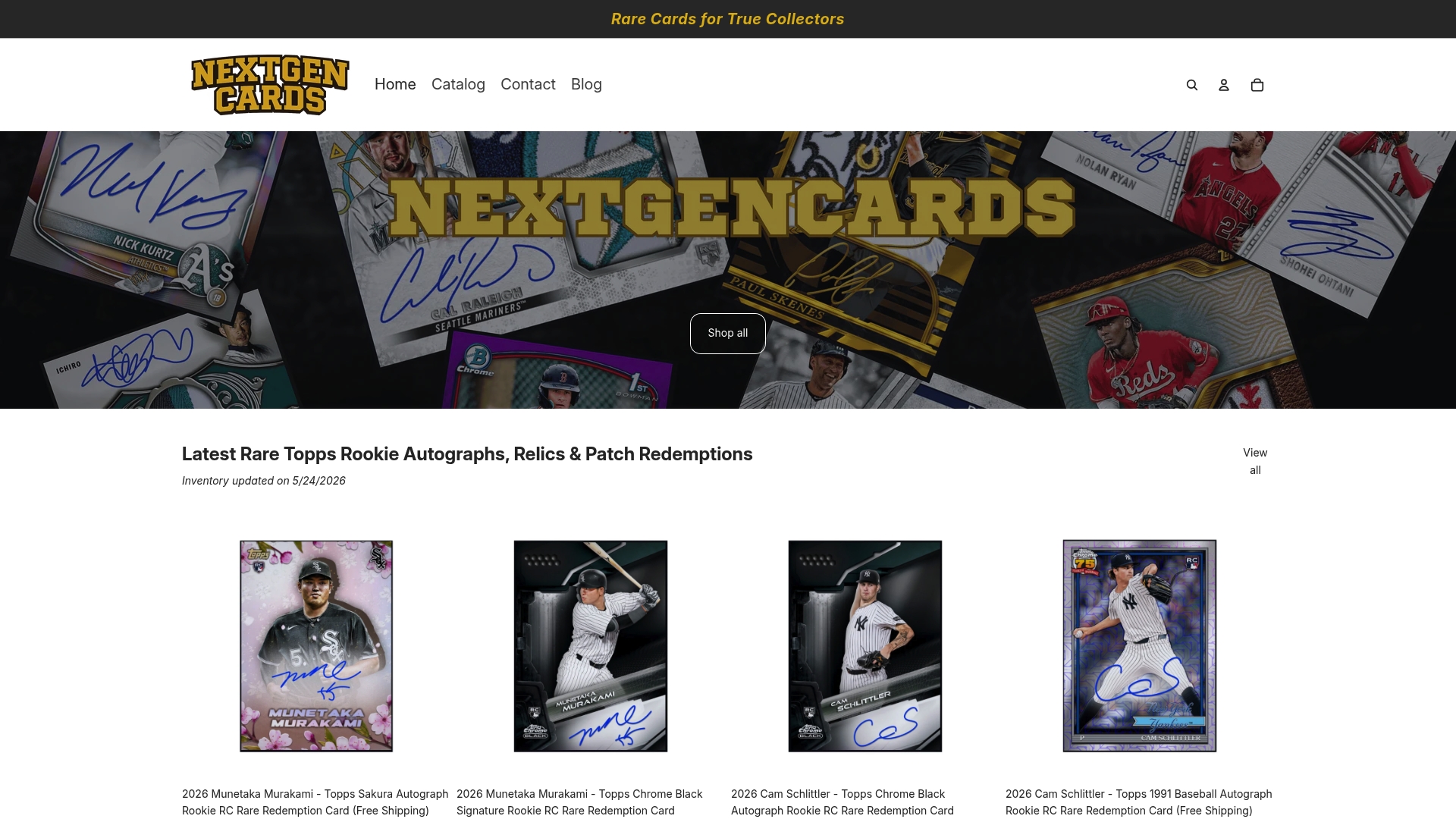
The inventory at Nextgencards is curated specifically for collectors who know what they want. Rookie autographs from athletes like Shohei Ohtani and Aaron Judge, limited-edition relics, and rare redemption cards are available with transparent pricing and free shipping on select items. There is no waiting for a scheduled sale, no buyer’s premium stacked on top of the hammer price, and no uncertainty about what you will actually pay. Richard and the team at Nextgencards bring genuine hobby expertise to every listing, informed by the same auction market dynamics covered throughout this article. Browse the full selection of rookie autographs and relics and add to your collection today.
Key Takeaways
Auction houses set the pricing benchmarks that shape the entire rare sports card market, but their results are exceptional transactions, not universal price guides for every collector.
| Point | Details |
|---|---|
| Grading drives value | PSA 10 commands the strongest premiums; the jump from PSA 9 to PSA 10 is exponential, not linear. |
| Fees reduce net proceeds | Heritage charges a 5% seller fee plus a 20% buyer’s premium; Goldin charges 9% with negotiable premiums on high-value lots. |
| Auctions win on illiquid cards | For cards with no recent comp, competitive bidding creates discovery pricing that fixed-price listings cannot match. |
| Auction results are not universal benchmarks | High-profile sales reflect exceptional examples and elite buyer competition, not typical market prices for most grades. |
| Nextgencards offers a direct route | Curated rookie autographs, relics, and redemption cards are available with transparent pricing and no auction house overhead. |
0 comments