

For hands-on inspection and the best local deals, visit a reputable Cincinnati card shop and call ahead to confirm what’s in stock. If you need guaranteed provenance on a specific rare card, ordering from an authenticated online seller like Nextgencards is often the smarter route. Either way, bring ID for larger purchases and inspect before you pay.
TL;DR:
- Vintage Cincinnati cards from before 1975 are highly condition-dependent and can carry a premium based on provenance and grading history.
- Modern Reds rookie autograph and short-print cards are more volatile, with prices adjusting rapidly based on player performance and market trends.
- Confirm a shop’s current inventory, pricing practices, and reputation through direct questions and reviews before visiting in person.
- Online marketplaces are better suited for guaranteed provenance or chasing specific rare and redemption cards that local shops may not stock.
- Attending local card shows and events, with proper precautions and preparation, offers additional opportunities for discovering rare cards and deals outside of retail shops.
Table of Contents
- Where to Find Credible Baseball Card Shops in Cincinnati
- What to Expect Inside a Cincinnati Card Shop
- How to Inspect, Authenticate, and Negotiate Cards in Person
- Vintage vs. Modern: How Value Gets Determined Differently
- Card Shows, Meetups, and Where Cincinnati Collectors Trade
- The History Behind Cincinnati’s Baseball Card Legacy
- Which Cincinnati Players Move the Card Market Today
- What’s Trending in Cincinnati’s Collecting Community
- If You Prefer Buying Authenticated Rare Cards Online
- Why In-Person Shopping Still Matters for Collectors
- Sources
- FAQ
Where to Find Credible Baseball Card Shops in Cincinnati
Finding a trustworthy shop takes more effort than a quick search, but the legwork pays off before you ever drive across town. Start with the shop’s own website or Facebook page, then cross-check what you see against local hobby directories and recent, verified customer reviews. A shop that posts current inventory photos and responds to reviews is usually a shop that treats collectors seriously.
Ideal Baseball Cards, located at 6265 Glenway Ave, shows up repeatedly in local shop directories as a community fixture with rotating singles, sealed wax, and graded cards. Cincinnati Magazine went further, profiling the shop for a vintage inventory that stretches back to the early 1900s, the kind of depth you rarely find outside a dedicated hobby town.
Before you drive over, call and ask a few direct questions:
- Are your hours current, and do you keep the same schedule every week?
- What’s your current mix of vintage singles, sealed wax, and graded slabs?
- Do you offer free appraisals, and how do you handle grading referrals?
Shops that answer these without hesitation, and that have built a reputation collectors mention unprompted, are worth the trip. Vague answers or a phone that goes unanswered for days are your cue to keep looking.
What to Expect Inside a Cincinnati Card Shop
Walk into any established shop and you’ll generally find five categories of stock: vintage singles from before 1975, modern rookies and autographs, third-party graded slabs, sealed hobby boxes, and the sleeves, holders, and toploaders that keep everything protected. The exact mix varies by shop, but that structure is fairly consistent across the region.
Pricing follows patterns worth understanding before you negotiate:
- Graded cards carry a premium tied to population reports; a card with a low PSA or BGS population in a high grade sells for more than a common one.
- Sealed wax and modern singles often track hobby market pricing more than retail MSRP, since demand shifts weekly.
- Buy and sell prices always carry a spread. Shops need margin to stay open, so expect a gap between what they’ll pay you and what they’ll sell for.
Pro Tip: Ask a shop directly how they typically price vintage collections. A shop that gives you a straight number is more trustworthy than one that says “it depends” and stops there.
Most shops also offer consignment, grading referrals, and a choice between cash or store credit, with credit usually paying a better rate.
How to Inspect, Authenticate, and Negotiate Cards in Person
A little discipline at the counter protects you from bad deals far more than luck does. Follow these steps whether you’re buying, selling, or trading:
- Inspect corners and edges with a loupe. Whitening, fraying, or soft corners drop value fast, even on cards that look sharp from a distance.
- Check centering and surface under good light. Off-center borders and scratches are easy to miss under a shop’s fluorescent lights but obvious in daylight.
- Compare against known graded examples. If a shop has a graded version of the same card on hand, use it as your reference point for what “near mint” actually looks like.
- Look for restoration or alteration. Trimmed edges or added color show up as texture inconsistencies a loupe will catch.
- Confirm authenticity documentation. Slabs from major grading companies carry a certification number you can verify; loose vintage cards with claimed provenance should come with whatever paper trail the seller has.
When it’s time to talk price, ask for a breakdown of how the number was reached rather than accepting a flat offer. If the range feels unclear, it’s fine to say you’ll think it over and walk. Genuine sellers rarely pressure you to decide on the spot.
For anything over a few hundred dollars, prefer traceable payment. Cash works for smaller trades, but a receipt with both parties’ information protects everyone on high-value transactions.
Vintage vs. Modern: How Value Gets Determined Differently
Vintage and modern cards get judged by almost entirely different rulebooks, and confusing the two leads to bad offers on both sides.
Vintage cards (generally pre-1975, though the line blurs a bit) live and die by condition. Corners, edges, surface wear, and centering matter enormously, and grading history adds real weight. Provenance helps too: a card that’s been in one family’s collection since the 1960s often carries more buyer confidence than one with an unclear chain of ownership. This is where the Cincinnati collecting scene shows its strength; the depth of vintage holdings at shops like Ideal Baseball Cards reflects decades of local accumulation rather than recent speculation.
Modern cards run on a different engine entirely:
- Rookie autograph scarcity and short prints drive price more than raw condition.
- Redemption cards trade on anticipation, since buyers are often purchasing a promise rather than a physical card in hand.
- A player’s on-field trajectory can move a card’s value within weeks, something vintage collectors rarely see.
Local collectors track modern Reds releases closely, and checklist databases like the Trading Card Database’s 2024 Topps Reds set make it easy to confirm exactly which rookie cards and inserts exist before you shop.
Card Shows, Meetups, and Where Cincinnati Collectors Trade
Shops aren’t the only place to buy and sell. Card shows, hobby club meetups, and shop-hosted trading events remain a core part of Cincinnati’s collecting scene, and they’re where a lot of the best deals happen outside regular store hours.
Check shop newsletters and event pages, since many stores post their own gatherings, and local shops like Liquid Sports Cards regularly announce card parties and show dates through their own channels. Hobby club social pages and local event listings round out the picture for anything a single shop might not promote.
Before attending:
- Bring photo ID for any transaction likely to exceed a couple hundred dollars.
- Carry protective sleeves or a hard holder so newly purchased cards don’t get damaged on the way home.
- Make a short list of the specific cards or players you’re hunting, so you don’t get distracted and overspend on impulse buys.
Prefer shop-hosted shows over informal ones when you can, since a hosting shop has a reputation to protect. Always inspect a card before handing over payment, and ask for a written receipt on anything expensive. A handshake deal is fine for a $10 common; it’s not fine for a four-figure autograph.
The History Behind Cincinnati’s Baseball Card Legacy
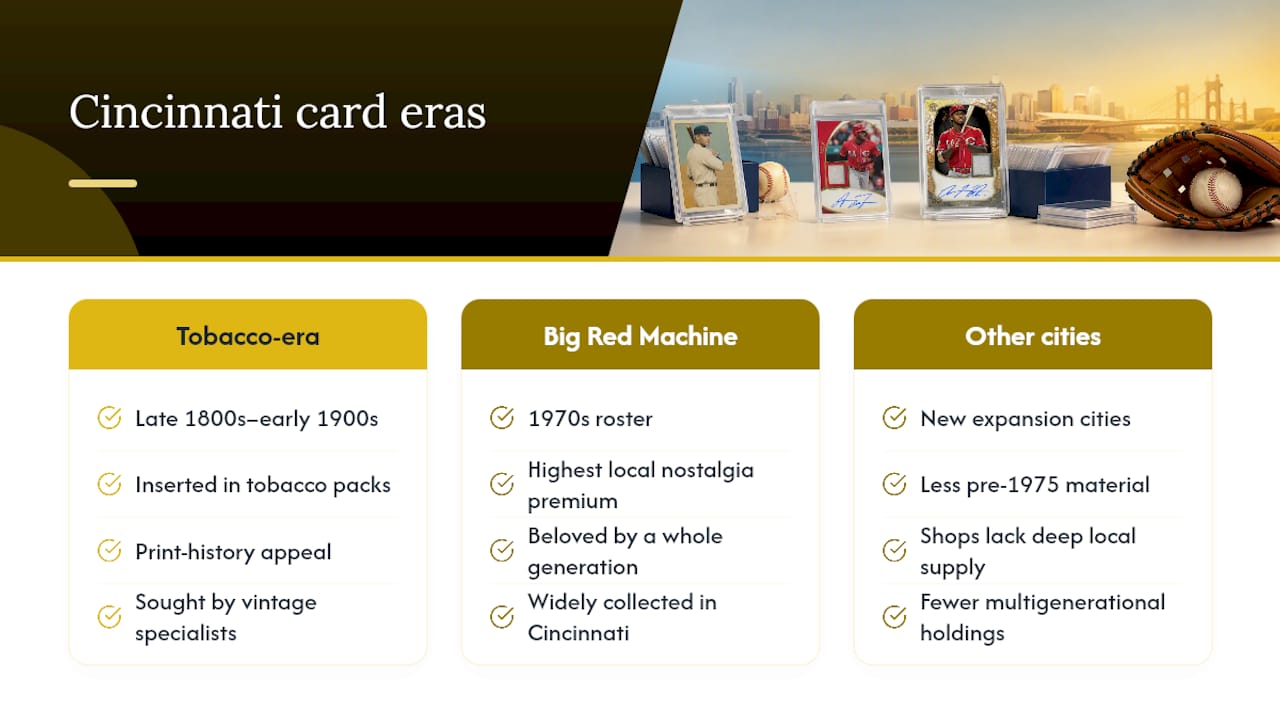
Cincinnati’s place in baseball card history runs deeper than most collectors realize. As home to the oldest professional franchise in the sport, the city has been part of the hobby’s story since cardboard collecting began in the late 1800s, when tobacco companies first inserted player cards into their packaging.
That long history is exactly why shops like Ideal Baseball Cards can stock inventory dating back to the early 1900s. Few American cities can offer that kind of continuous local supply, since it reflects generations of Cincinnati families holding onto Reds memorabilia rather than shipping it off to national auction houses.
The Big Red Machine era of the 1970s remains the most collected chapter in Reds card history. Cards featuring that roster carry a premium tied not just to on-field performance but to nostalgia, since an entire generation of Cincinnati fans grew up idolizing that team. Older tobacco-era cards, meanwhile, appeal to a smaller but more serious set of vintage specialists who care as much about print history as playing career.
Understanding this layered history helps explain why Cincinnati shops carry such a distinct mix compared to shops in cities without a comparable baseball lineage. A shop in a newer expansion-team city simply doesn’t have the same depth of pre-1975 material sitting in local basements waiting to be sold.
Which Cincinnati Players Move the Card Market Today
Certain names consistently drive buying interest at Cincinnati shops and shows, and knowing them helps you understand pricing before you negotiate.
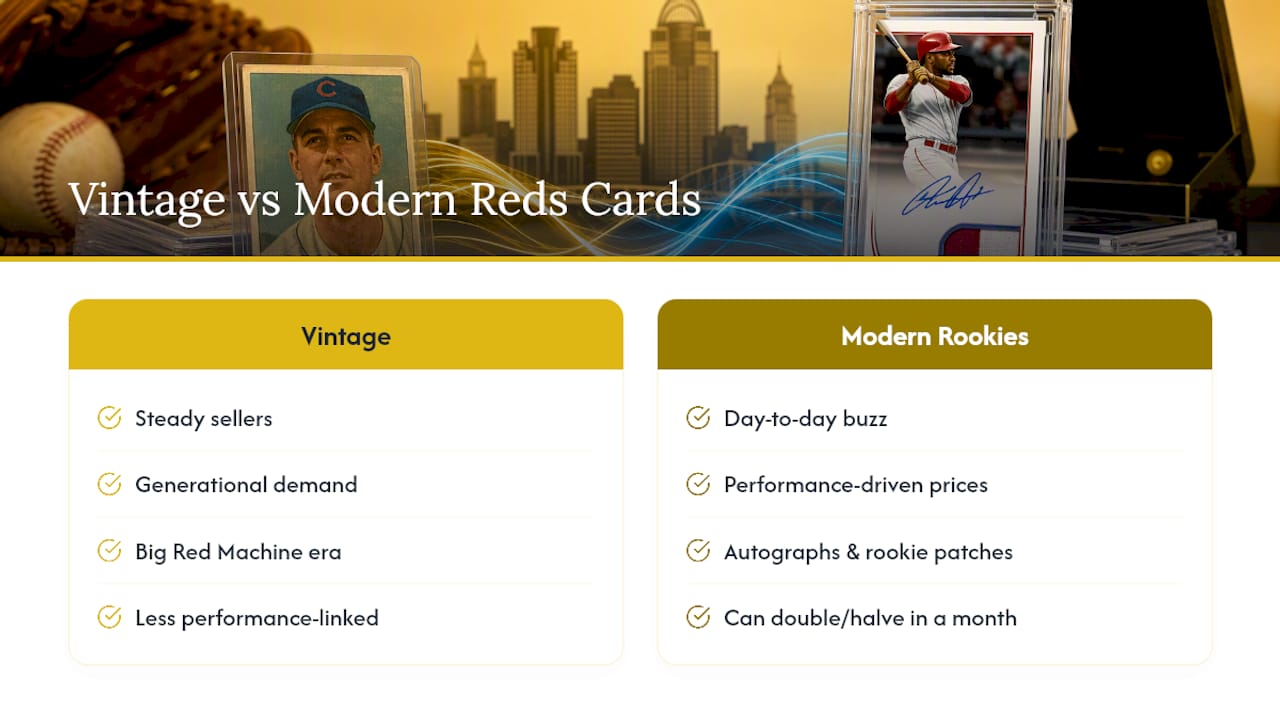
Legacy figures set the historical baseline. Cards featuring Big Red Machine era stars remain steady sellers precisely because that roster produced multiple Hall of Famers and one of the most beloved teams in franchise history. Vintage cards tied to that era hold value less through scarcity alone and more through sustained, generational demand.
On the modern side, current Reds rookies generate the most day-to-day buzz. Autograph and rookie patch cards for the team’s current young core show up constantly in local shop cases and show tables, and their prices move with performance in a way vintage cards never do. A hot rookie season can double a card’s asking price within a month; a slump can cut it just as fast. That volatility is part of what makes modern collecting different from vintage: you’re betting on a career still being written, not one already sealed in the record books.
Shops track this by watching checklists closely. Reference tools like the Trading Card Database’s Reds checklist let both dealers and collectors confirm which inserts, parallels, and autograph variations exist for a given rookie before money changes hands. National retailers like SportsMemorabilia also stock a range of Reds autographs and vintage cards, giving collectors a useful benchmark for what national pricing looks like compared to what a local shop offers.
Whether a card’s appeal comes from nostalgia or from a rookie’s current hot streak, the players people ask about most tend to define what’s actually moving through Cincinnati’s shop cases week to week.
What’s Trending in Cincinnati’s Collecting Community
Cincinnati’s collecting scene has grown noticeably more layered over the past several years, splitting into a few distinct niches rather than one general hobby crowd.
Vintage specialists remain a strong presence, drawn by the city’s unusually deep supply of pre-1975 material. These collectors tend to prize condition and provenance above all else, and they’re the ones most likely to work with a shop offering a free, no-obligation vintage review, a practice that lets a seller find out what an old collection is worth without any pressure to sell on the spot.
Modern rookie chasers make up a growing, younger segment, focused heavily on autographs, patches, and redemption cards tied to current Reds prospects. This group moves faster and checks release checklists constantly, since a single strong month on the field can shift a rookie card’s demand overnight.
A third niche, graded-slab collectors, has expanded as third-party grading has become more mainstream. These buyers care less about a card’s story and more about its certified grade, treating cards almost like a standardized asset class.
Local shops have adapted by carrying all three lanes side by side, which is part of why a single visit to a well-stocked Cincinnati shop can feel like browsing three different hobbies at once.
If You Prefer Buying Authenticated Rare Cards Online
Local shopping has real advantages, but it isn’t always practical when you’re chasing one specific card. An online store specializes in rare and unique sports trading cards, with a curated focus on rookie autographs, relics, and rare redemption cards, and offers free shipping on select items.
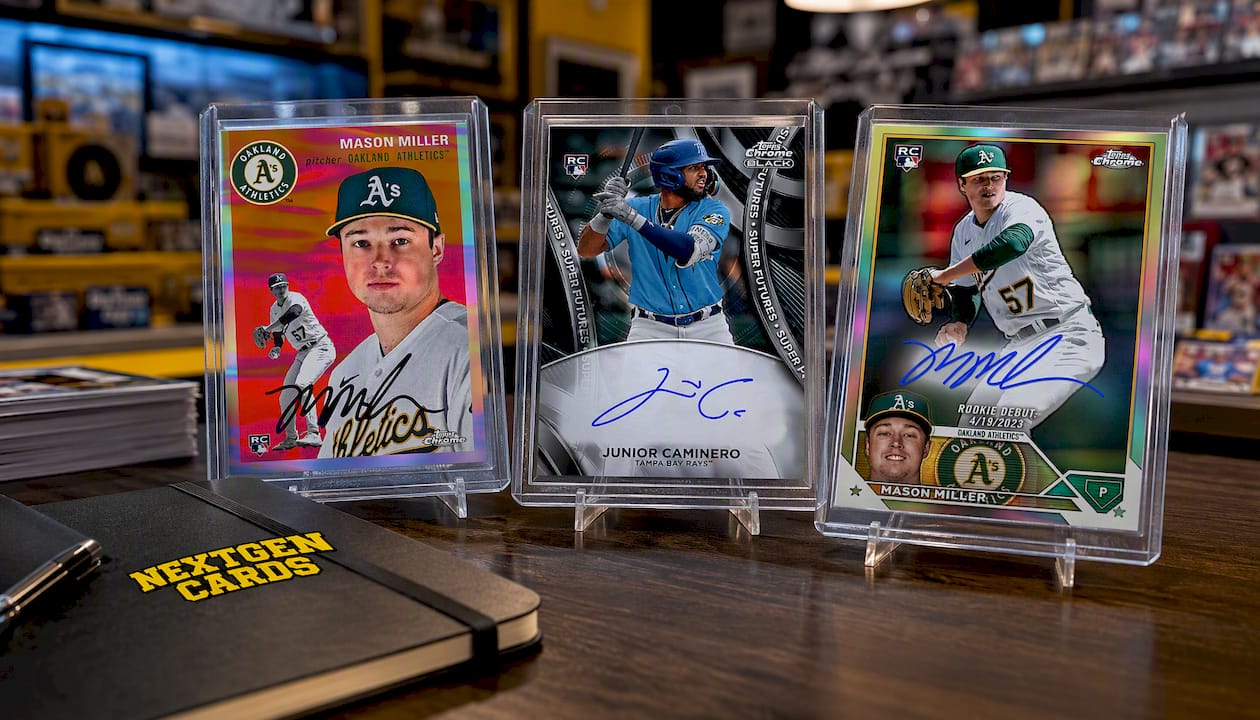
If you’re tracking a specific modern rookie, the 2023 Mason Miller Topps Chrome Platinum Anniversary Autograph Rookie Card shows the kind of scarce redemption card that’s difficult to guarantee finding in a physical shop visit. The catalog also includes rookie autographs and relics across current MLB talent, plus items like the 2024 Junior Caminero Topps Black Super Futures Signature Rookie Card and the 2023 Mason Miller Topps Chrome Update Series Chase Autograph Card.
Choose the online route when you need guaranteed provenance on a specific redemption card, when a local shop simply doesn’t stock what you’re after, or when nationwide shipping beats driving store to store hoping to get lucky. For a broader view on treating cards as long-term holdings, the investing framework at Ripbin is worth a read. When you’re ready to add a specific rare card to your collection, browse the full catalog and check current stock before it’s gone.
Why In-Person Shopping Still Matters for Collectors
Nothing replaces holding a card under a loupe and asking a shop owner why they graded it the way they did. That kind of relationship, built over repeat visits, is how you learn which local shops actually stand behind their pricing. My honest advice is a hybrid approach: use Cincinnati shops and shows for discovery and hands-on learning, then turn to a vetted source like Nextgencards when you need one specific authenticated rare card that local inventory can’t guarantee.
— Richard
Sources
Local shop directories list Ideal Baseball Cards as a community-trusted shop, while Cincinnati Magazine’s feature offers a deeper look at its vintage inventory. For remote appraisals, Eagle Cards outlines its free review process, and the Trading Card Database tracks current Reds checklists. Always call ahead or check a shop’s event page before visiting, since hours and show schedules change often.
- Ideal Baseball Cards — Card Shop in Cincinnati, Ohio
- Bridgetown’s Ideal Baseball Cards is a Retro Sports Gold Mine
- Eagle Cards | Buy & Sell Vintage Sports Cards | Cincinnati, OH
- 2024 Topps Baseball - Cincinnati Reds Checklist | Trading Card Database
FAQ
Is There a Card Shop in Cincinnati?
Yes. Cincinnati has several established shops, including Ideal Baseball Cards on Glenway Avenue, which is known locally for its large vintage inventory and rotating stock of singles, wax, and graded cards.
What Is the Hottest Baseball Card Right Now?
Demand shifts constantly with player performance, but current Reds rookie autograph and redemption cards, like the modern rookie cards found in curated online catalogs, tend to draw the most active buying interest.
Where Can I Go to See if My Baseball Cards Are Worth Money?
A local shop offering a free, no-obligation appraisal is your fastest option, and some vintage specialists also accept remote evaluations by photo or video if you can’t visit in person.
How Can I Sell My Baseball Cards?
Bring your collection to a reputable local shop for an in-person offer, consign them if you want a shot at a higher price over time, or work with a vintage buyer that offers remote evaluations if you’re not near a shop.
0 comments