

The 2026 Topps Chrome Baseball Sapphire Edition is an online-exclusive, 300-card parallel of the flagship Chrome set, built around glossy refractor stock instead of standard chrome. Each hobby box averages one on-card autograph numbered to 199 or less and roughly three Sapphire parallels, with Gold, Red, and one-of-one Padparadscha finishes anchoring the chase. Release lands August 26, 2026, and the biggest hits to watch are numbered parallels, Sapphire Selections autographs, and the Hidden Gems insert.
TL;DR:
- Most boxes will include at least one autograph numbered to 199 or less, and about three Sapphire parallels on average, with rarer Padparadscha 1/1s being highly limited.
- The Sapphire parallels span from Gold (/50), Orange and Black, to Red (/25 or /10), with Padparadscha being the rarest, often as a true 1-of-1.
- Autographs are split into rookie-heavy Sapphire Autographs and veteran-inclusive Sapphire Selections autographs, with the latter available only in Sapphire Edition.
- Variations include image swaps, short prints, award-themed cards, and special crossover designs, all with very low pull rates for branded short prints like Minions.
- Proper storage and early documentation of serial numbers, condition, and signatures are essential to protect value and facilitate grading for high-end Sapphire cards.
Table of Contents
- What Is the 2026 Topps Chrome Baseball Sapphire Edition Release?
- Which Sapphire Parallels Should You Chase?
- Sapphire Autographs vs. Sapphire Selections: Who Signs What?
- Hidden Gems and Other Sapphire-Exclusive Inserts
- Checklist Highlights: Rookies and Team Sets to Know
- What Variations and Short Prints Should Collectors Track?
- How Do You Protect and Authenticate Your Sapphire Hits?
- About NextGenCards: Publisher Background and Collector Resources
- Authentication and Grading Advice for Sapphire Edition Cards
- Tips for Storing and Preserving Chrome and Sapphire Cards
- Where Should You Sell Sapphire Chase Cards?
- A Collector’s Take on Sapphire Priorities
- Start Your Sapphire Collection With Nextgencards
- Sources
- FAQ
What Is the 2026 Topps Chrome Baseball Sapphire Edition Release?
Topps runs Sapphire Edition as an online-exclusive launch, typically distributed through EQL draws rather than open retail stock. Collectors register for an entry window, and successful draws get the right to purchase, which means the product rarely sits on shelves the way a blaster box does. Plan around the August 26, 2026 release date if you want a shot at buying at issue price instead of chasing it on the secondary market afterward.
The checklist runs 300 cards, mirroring the base Topps Chrome flagship set but printed on Sapphire’s signature ultra-glossy refractor stock. That shared numbering makes it easy to cross-reference a Sapphire pull against its flagship counterpart, which matters if you’re set-building across both releases.
Box configuration is straightforward:
- 8 packs per box
- 4 cards per pack
- 32 total cards per box
- 1 on-card autograph per box (numbered ≤199)
- Roughly 3 Sapphire parallels per box on average
Those figures come straight from checklist and box-configuration reporting, and they line up with what retail preview listings describe ahead of launch. Because Topps treats this as a premium, condensed release rather than a mass retail product, expect tighter print runs than a standard Chrome box, and don’t count on finding it at a big box retailer later in the year.
Which Sapphire Parallels Should You Chase?
Sapphire’s whole appeal comes down to its parallel ladder. The base Sapphire card already carries a distinct glossy finish, but the numbered tiers above it are where the real chase narratives live.
Expect a lineup that includes:
- Gold parallels, typically numbered in the /50 range
- Orange and Black parallels, mid-tier scarcity
- Red parallels, numbered lower, often /25 or /10
- Padparadscha parallels, the rarest standard tier, frequently issued as true 1-of-1s
Pro Tip: Don’t assume every Padparadscha card is a 1/1 across every player and set. Check the specific serial number stamped on the card itself rather than relying on the parallel name alone.
Statistic Callout: Boxes deliver roughly three Sapphire parallels on average, meaning most breaks land at least one card from the Gold or Red tier, with the ultra-low Padparadscha 1/1s reserved for a smaller share of overall production.
Serial numbers print directly on the card front or back, usually in a small font near the border, and that number is the first thing a grading company or buyer will check against population reports. A parallel numbered /5 with a clean, centered print sells differently than the same card with a soft corner or off-center border, so treat the numbering as only half the value story. The condition of the surface, especially on chrome stock prone to scuffing straight out of the pack, does the rest of the work when it comes to resale and grading outcomes.
Sapphire Autographs vs. Sapphire Selections: Who Signs What?
Sapphire Edition splits its autograph content into two distinct streams, and knowing the difference changes how you read a box break.
Sapphire Autographs skew rookie-heavy, tied to the same on-card autograph slot that anchors most boxes. These are the signatures collectors open a box hoping to hit, since they’re tied directly to the current rookie class and numbered to 199 or less per checklist reporting.
Sapphire Selections Autographs run as a product-exclusive mix of veterans and rookies, not available in the standard flagship Chrome release. This is the stream where you’ll find established stars alongside a handful of high-ceiling prospects, giving the product a broader autograph pool than a pure rookie-focused release.
Names to watch on the autograph side, based on published checklist reporting and current rookie-class buzz, include prospects and rookies already drawing attention across 2026 Topps products, similar to the kind of talent featured in cards like the 2026 Jacob Misiorowski autograph rookie and the 2026 JJ Wetherholt Bowman Chrome signature rookie, both drawing hobby interest ahead of the Sapphire release.
Numbering practices generally follow the flagship Chrome autograph program, with most signatures capped at 199 copies or fewer. Topps has used both on-card and sticker-signed formats across recent Chrome releases, so check the card’s back or accompanying checklist notes to confirm which method applies to a specific autograph before you buy or sell it as on-card exclusively.
When you pull an autograph hit, treat documentation as part of the collecting process, not an afterthought:
- Photograph the card under even lighting immediately after opening, front and back, including the serial number.
- Record the pack position and box code if the seller or breaker provides one.
- Note whether the signature appears on-card or on a sticker, since that distinction affects grading submissions.
- Store the card in a penny sleeve and semi-rigid holder before it changes hands even once.
Pro Tip: A quick phone photo taken the moment you pull a card is worth more than you think if a dispute ever comes up with a grading company or a buyer questioning authenticity later.
Hidden Gems and Other Sapphire-Exclusive Inserts
Hidden Gems returns as one of Sapphire’s signature product-exclusive inserts, continuing a chase concept that started with prior Bowman Sapphire releases. It’s not part of the flagship Chrome checklist, which is exactly why set builders and insert collectors treat it as a priority pull rather than a bonus card.
Beyond Hidden Gems, Sapphire typically carries a small slate of exclusive mini-inserts and short-print subsets that don’t appear anywhere in the standard Chrome release. These sit outside the 300-card base numbering, which means they won’t show up if you’re only tracking base card IDs off a checklist.
A few practical notes for tracking these:
- Product-exclusive inserts get prioritized by set collectors precisely because they can’t be pulled from any other 2026 Topps release
- They tend to carry their own numbering scheme separate from the base Sapphire checklist
- Keep a dedicated line item for insert hits in your personal spreadsheet or app, separate from your base and parallel tracking
Missing an insert hit in your records is an easy mistake once a box break produces a dozen or more distinct card types.
Checklist Highlights: Rookies and Team Sets to Know
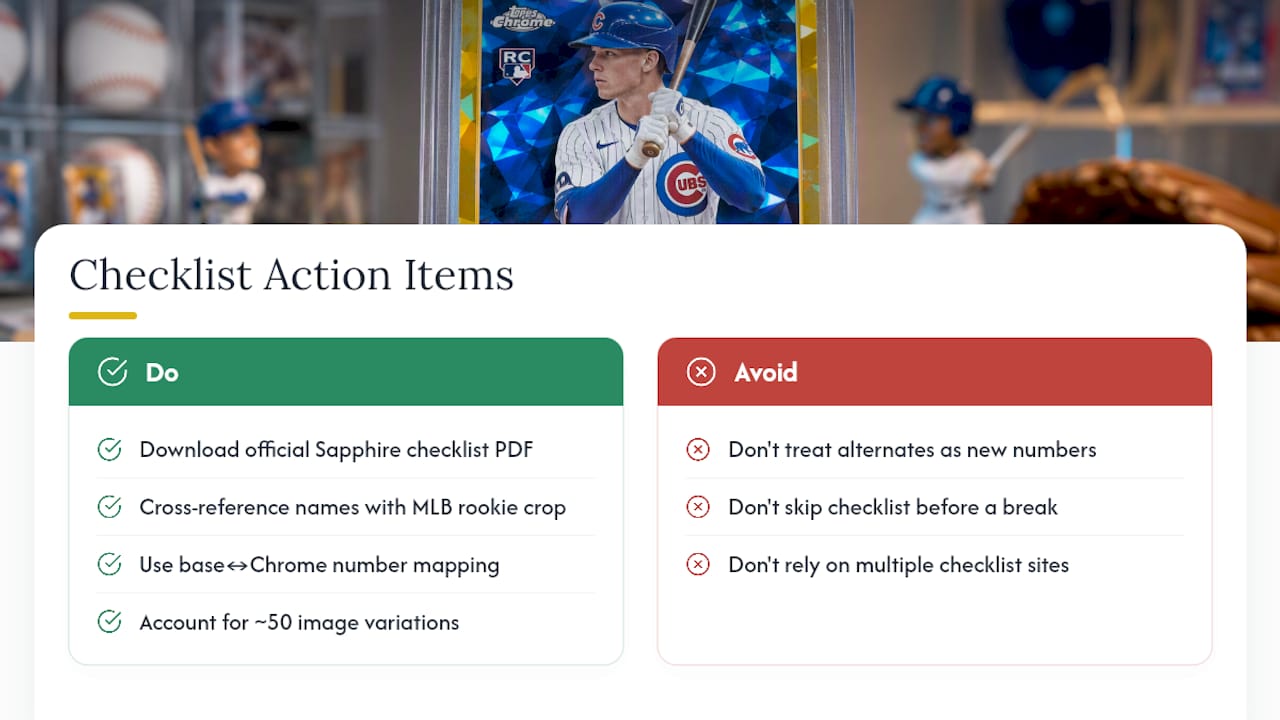
The 300-card base checklist maps directly onto the flagship Chrome set, so every card number you see in a Sapphire pull corresponds to the same player and design in standard Chrome, just on glossier stock. That direct mapping is what makes team-set building manageable even with a product this condensed.
One wrinkle worth knowing: roughly 50 image variations from the flagship checklist also received the Sapphire treatment. These aren’t separate card numbers, they’re alternate photos of the same player and card slot, which means a completed Sapphire team set sometimes requires tracking down a second version of a card you already own.
Checklist reporting on the release highlights notable rookies and veteran entries that collectors are already flagging as early chase targets, spanning both current rookie-class standouts and established veterans who round out team sets. If you’re planning a break or building toward full team sets, cross-reference names against the current MLB rookie crop the way you would with any high-profile rookie autograph, such as the 2024 Junior Caminero Bowman Chrome Green signature rookie or the 2024 Elly De La Cruz Reverence rookie patch autograph, both examples of the rookie-driven demand that carries into Sapphire products.
Downloading the official Sapphire checklist PDF before a break or purchase saves real time. It lists every card number, team, and player name in one place, which beats scrolling through multiple checklist sites while trying to verify a base card ID against a photo from a seller.
What Variations and Short Prints Should Collectors Track?
Sapphire Edition carries the same variation categories that run across the broader 2026 Topps Chrome Baseball release, printed on the glossier Sapphire stock. A published variations guide documents four main categories collectors should know before opening a box.
- Image Variations: alternate photography swapped in for a small percentage of a given player’s print run
- Super Short Prints: image variations printed in even smaller numbers than standard variations
- Award Winner Variations: cards commemorating a specific award or season accomplishment, usually tied to a particular player
- Special branded variations, including novelty crossover designs like Minions, which show up as intentionally short-printed inserts across hobby, jumbo, mega, and blaster configurations
Statistic Callout: The same variations guide reports very low pull rates for Minions and comparable branded short prints across most box types, making them among the hardest single cards to land in any given case.
Spotting a variation usually comes down to comparing the photo used on your card against the standard base version of the same number. Differences show up in the background, the player’s pose, or sometimes the uniform detail, and they’re easiest to confirm against a checklist site’s image gallery rather than memory alone. If you’re building toward a complete variation run, log each pull by card number and variation type the moment you open it, since these don’t always get flagged clearly on resale listings.
How Do You Protect and Authenticate Your Sapphire Hits?
Chrome and Sapphire stock scratches and scuffs far more easily than standard cardboard, which makes condition management part of the collecting process from the moment a pack opens.
- Inspect surfaces under angled light immediately after pulling a card, since chrome scratches often only show up when light hits the surface at a specific angle.
- Check centering front and back before sleeving, because off-center prints are common on foil-heavy stock and significantly affect grading outcomes.
- Examine corners and edges for the soft “chrome peel” that happens when cards rub against each other loose in a pack.
- Document numbered parallels and 1/1s with clear photos of the serial number itself, not just the card front, before you sleeve or ship anything.
- Decide on grading early for numbered autographs and Padparadscha 1/1s, since submission turnaround times vary and a card sitting ungraded longer carries more handling risk.
PSA, BGS, and SGC remain the three grading companies most buyers recognize for high-value chrome cards, and each has slightly different standards for how they treat surface flaws on refractor stock. A card with a visible print line might grade fine at one company and get flagged at another, so check recent population reports for comparable Sapphire cards before choosing where to submit.
Pro Tip: If you’re buying a sealed Sapphire box rather than opening your own, confirm the seller’s return policy and shipping insurance before paying. A resealed or previously searched box is one of the more common complaints collectors report on high-end chrome products, and a clear return window protects you if something looks off on arrival.
Tools like GoCollect, CovrPrice, and GPAnalysis can help you track how comparable numbered parallels and autographs have sold recently, which is useful context before you decide whether to grade, hold, or sell a hit.
About NextGenCards: Publisher Background and Collector Resources
Nextgencards specializes in rare and unique sports trading cards, with a curated inventory built around rookie autographs, patch and relic cards, and physical redemption cards for serious collectors rather than casual buyers. The catalog leans heavily into current rookie-class talent and iconic veteran names, giving Sapphire-era collectors a direct source for the kind of high-profile autograph and redemption cards that complement a Sapphire chase.
Every product page on the site lists condition, numbering, and redemption terms clearly, and select items ship free, which matters when you’re already budgeting for a Sapphire box or a graded submission. For collectors chasing specific rookie names off the Sapphire checklist, Nextgencards functions as a practical next stop for locating the autograph or redemption card that pairs with what you just pulled.
Authentication and Grading Advice for Sapphire Edition Cards
Grading a Sapphire card follows the same basic submission process as any other Topps Chrome product, but the glossy surface raises the stakes on pre-submission inspection. Before you send anything to PSA, BGS, or SGC, clean your hands and workspace, and never touch the card surface directly with bare fingers, since oils show up under grading-company lighting far more visibly on refractor stock than on matte cardboard.
Numbered autographs and parallels benefit from a pre-submission photo log matching the serial number to the card, which protects you if a shipment gets lost or a dispute comes up during transit. Most grading companies also offer a bulk or “value” tier for lower-cost submissions, but a numbered 1/1 or a sub-/25 autograph usually justifies a faster, higher-cost tier given how much a grade can shift resale confidence on a card that scarce.
Cross-check comparable population numbers before submitting. If a particular parallel tier already has a thin population report from prior Sapphire releases, that scarcity context is worth knowing before you decide how much to invest in grading fees relative to the card’s likely market. A /10 parallel that’s genuinely one of only a handful ever graded carries a different calculus than a /199 autograph with dozens of graded copies already on record.
Skip authentication only if you’re confident in a card’s chain of custody, ideally a factory-sealed box you opened yourself, and stay cautious with loose singles bought outside authenticated marketplaces.
Tips for Storing and Preserving Chrome and Sapphire Cards
Chrome stock behaves differently than standard cardboard, and Sapphire’s extra glossy finish makes the surface even more prone to fine scratching. Store every pulled card in a penny sleeve immediately, then move to a semi-rigid holder before it travels anywhere, even across a room.
Avoid stacking loose chrome cards directly on top of each other without sleeves in between, since the friction from handling or shifting during shipping causes the fine surface scuffing collectors call “chrome peel.” Keep boxes and sleeved singles away from direct sunlight and humidity swings, both of which can affect the foil layer over time.
For numbered parallels and autographs you plan to hold long term, a magnetic one touch holder offers better protection than a basic card saver, particularly for anything you might submit for grading later. Toploaders work fine for short-term storage, but they’re not a substitute for a rigid holder if a card is traveling by mail or sitting in a collection you handle often.
Temperature matters more than most collectors realize. Storage areas prone to heat swings, like a garage or attic, can warp cardboard stock and affect how foil adheres to chrome cards over years of storage. A climate-stable closet or dedicated storage box beats convenience every time for anything numbered below /50.
Where Should You Sell Sapphire Chase Cards?
Selling a numbered Sapphire parallel or autograph works best when you match the platform to the card’s value tier. High-end numbered hits, especially anything under /25 or a Padparadscha 1/1, tend to perform better through established auction platforms or dedicated sports card marketplaces where buyers already expect to pay a premium for scarcity and can verify grading credentials before bidding.
Mid-tier parallels and common autographs move well through general marketplace listings, provided you photograph the serial number clearly and disclose the exact numbering in the listing title. Vague listings that just say “Sapphire parallel” without specifying the tier or number tend to sit longer and sell for less than comparable cards with full details up front.
Before listing anything, check recent sold prices for the exact parallel tier and player rather than relying on active listing prices, which often run higher than what cards actually close for. A tracking tool that aggregates recent sales data gives a more realistic read on where your card fits than scanning a handful of active auctions.
Timing matters too. Listing shortly after a strong on-field performance from the featured player, or right around the product’s initial release window, generally draws more attention than listing months later once initial hype settles. Factor shipping costs into your price for anything graded, since a slabbed card in a protective mailer costs noticeably more to ship safely than a raw sleeved single.
A Collector’s Take on Sapphire Priorities
Most coverage of a new Chrome parallel product spends too much energy speculating about resale value and not enough on what actually makes a box worth opening. The real story with 2026 Topps Chrome Baseball Sapphire Edition is the checklist overlap with flagship Chrome combined with a genuinely distinct autograph pool through Sapphire Selections. That second point gets underplayed. A product-exclusive veteran autograph stream sitting alongside a rookie-heavy on-card slot gives this release two separate reasons to chase a box, not one.
Where conventional advice falls short is treating every numbered parallel as equally worth grading. A /199 autograph and a /5 Red parallel are not the same investment of time or submission fees, and collectors who grade everything indiscriminately end up with slower turnaround and higher costs for marginal gain. Prioritize documentation and condition inspection the moment a box opens, before you’ve even decided what to grade. That single habit protects more value than any market-timing strategy tied to a rookie’s early-season stats.
— Richard
Start Your Sapphire Collection With Nextgencards
Beyond the box break itself, building out a Sapphire-era collection often means filling gaps with rookie autographs and redemption cards you didn’t pull yourself. Nextgencards gives you a direct path to specific names without relying on breaks, waitlists, or repeated box purchases to land the exact rookie or veteran signature you’re chasing.
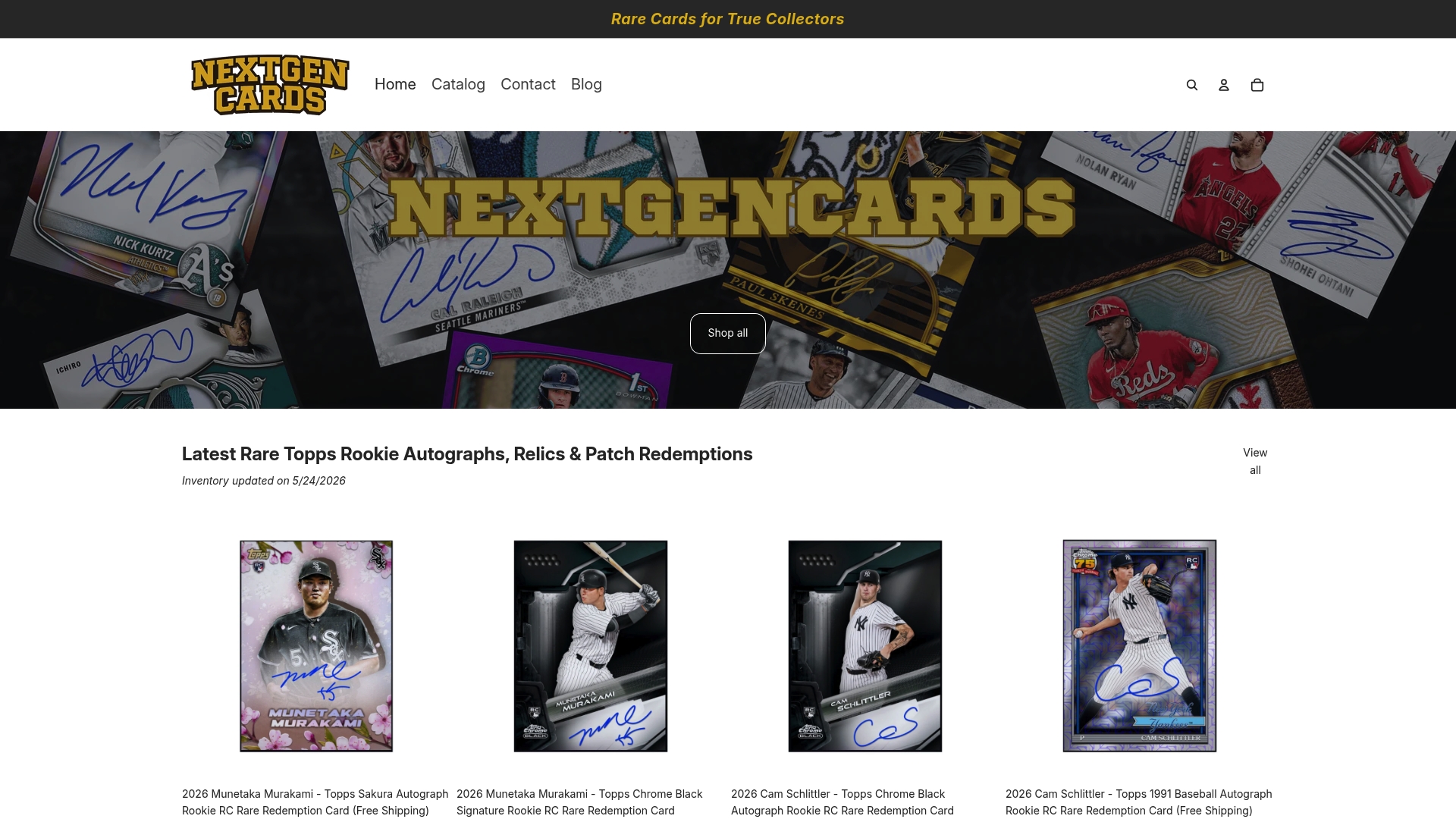
The catalog includes standout picks like the 2024 Skenes/Cole/Strasburg triple autograph redemption, the 2026 Jacob Misiorowski 1991 Topps autograph rookie, and a full rookie autographs and relics collection for collectors building around this year’s checklist names. Every listing shows condition and redemption terms up front, and select items ship free. Browse the current inventory or reach out about specific wants and consignments tied to your Sapphire checklist.
Sources
For the most reliable product details, start with the official Topps Sapphire Edition page for launch mechanics and product specs. Beckett’s checklist and team-set breakdown covers box configuration in detail, while ChecklistInsider’s set guide and the hosted checklist PDF give you fast, downloadable verification for card IDs and team sets.
- 2026 Sports Card Release Dates and Calendar for Upcoming Sets
- 2026 Topps Chrome Sapphire Baseball Checklist, Set Info, Boxes
FAQ
Is Topps Chrome Sapphire Worth It?
Sapphire delivers a distinct glossy finish, a condensed 300-card checklist, and product-exclusive autograph and insert content not found in flagship Chrome, which makes it appealing to collectors chasing scarcity rather than volume. Whether it’s “worth it” depends on your budget and whether you value numbered parallels and exclusive autographs over the broader base checklist of standard Chrome.
What Is the Difference Between Topps Chrome and Topps Chrome Sapphire?
Standard Topps Chrome uses traditional chrome refractor stock across a larger checklist, while Sapphire Edition prints a 300-card checklist that mirrors the flagship set on a more reflective, glossier Sapphire finish. Sapphire also adds exclusive parallel tiers like Padparadscha and its own autograph stream, Sapphire Selections, not available in the standard release.
What Is the Topps Chrome Sapphire Edition Box?
A Sapphire Edition hobby box contains 8 packs with 4 cards per pack, for 32 total cards per box, and averages one on-card autograph numbered to 199 or less along with roughly three Sapphire parallels. It’s sold primarily through online-exclusive channels, often via EQL draw rather than standard retail stock.
How Much Will Topps Chrome Sapphire Be?
Pricing for the 2026 release wasn’t confirmed at the time of writing, and prior Sapphire releases have shown notable variability at launch depending on retailer and presale demand. Treat any early presale price you see as an estimate rather than a fixed MSRP until Topps confirms official pricing closer to the August 26, 2026 release date.
Where Can You Buy the 2026 Topps Chrome Baseball Sapphire Edition?
Sapphire Edition is typically an online-exclusive release, often distributed through EQL draw entries rather than open retail stock, so check the official Topps store around the release date for registration details. For rookie autographs and redemption cards tied to the same checklist, Nextgencards offers a direct alternative to relying solely on box breaks.
Recommended
- Rarity & Value Guide: How the 2026 Paul Skenes Topps Chrome Update Blue Raywave Autograph Rookie RC Shines – Next Gen Cards LLC
- Collector’s Guide to the 2026 Konnor Griffin Topps Bowman Chrome Refractor Prospect Signature RC Rare Redemption Card – Next Gen Cards LLC
- 2026 Cal Raleigh – Topps Chrome Autograph Rookie RC Physical Redemption Card Unveiled – Next Gen Cards LLC
- Buying Guide: Unlocking the 2026 Kevin McGonigle Topps Bowman Green Chrome Prospect Signature Rookie RC Rare Redemption Card – Next Gen Cards LLC
0 comments