

The Cooper Flagg rookie cards that matter most are the 2025-26 Topps Flagship #201, the Topps Chrome #251, on-card autograph parallels, low-serial numbered variants (/25 and /99), patch/relic autos, and 1-of-1 designations. These are the editions serious collectors and investors track because they combine set prestige, scarcity, and the strongest secondary-market liquidity.
Here is why each type earns its place:
- Topps Flagship #201 and Chrome #251: The primary rookie references for Flagg. Collectors use these card numbers as the fastest verification method when browsing listings.
- On-card autographs and low-serial parallels (/25, /99): Scarcity drives premium pricing. Chrome refractors and on-card autos have held the strongest demand through market corrections.
- Patch/relic autos and 1-of-1s: The highest-tier examples. Flagg’s Bowman Chrome University Auto SuperFractor 1/1 sold for nearly $100,000 in June 2025, setting the ceiling for the entire market.
Knowing which edition you are looking at directly affects what you should pay or ask. The sections below give you the visual cues, grading context, and market data to make that call confidently.
Table of Contents
- Cooper Flagg rookie card examples: a visual guide to each edition
- What each Cooper Flagg card type actually means for your collection
- How grading changes what a Cooper Flagg card is worth
- What Cooper Flagg rookie cards are actually selling for right now
- Where to find clear photos, sold prices, and trustworthy listings
- Smart collector strategy and mistakes to avoid with Flagg rookies
- Key Takeaways
- Why these specific Flagg examples deserve your attention
- Authenticated Cooper Flagg rookies available from Nextgencards
- Best places to verify listings, prices, and grading
Cooper Flagg rookie card examples: a visual guide to each edition
Identifying a Flagg rookie card from a photo comes down to four things: the card number on the back, the RC designation, the serial-number stamp, and the autograph placement. Here is what each major edition looks like and what to confirm visually.
Topps Flagship #201 (base RC): Standard card stock with the RC shield on the front. The card number “#201” appears on the back lower right. Raw copies have traded in the $3–$8 range, while PSA 10 slabs have sold between $92 and $106 in recent sales.
Topps Flagship #201 Holo Foil: Same card number, but the front surface carries a rainbow foil finish that catches light distinctly. PSA 10 copies have sold for several hundred dollars, making this one of the most visually striking and price-differentiated parallels in the flagship set.
Topps Chrome #251 (Chrome base RC): Glossy chromium stock with the RC shield. Chrome typically commands a premium over flagship base. Search listings using “#251” plus the set abbreviation to filter out mislabeled copies.
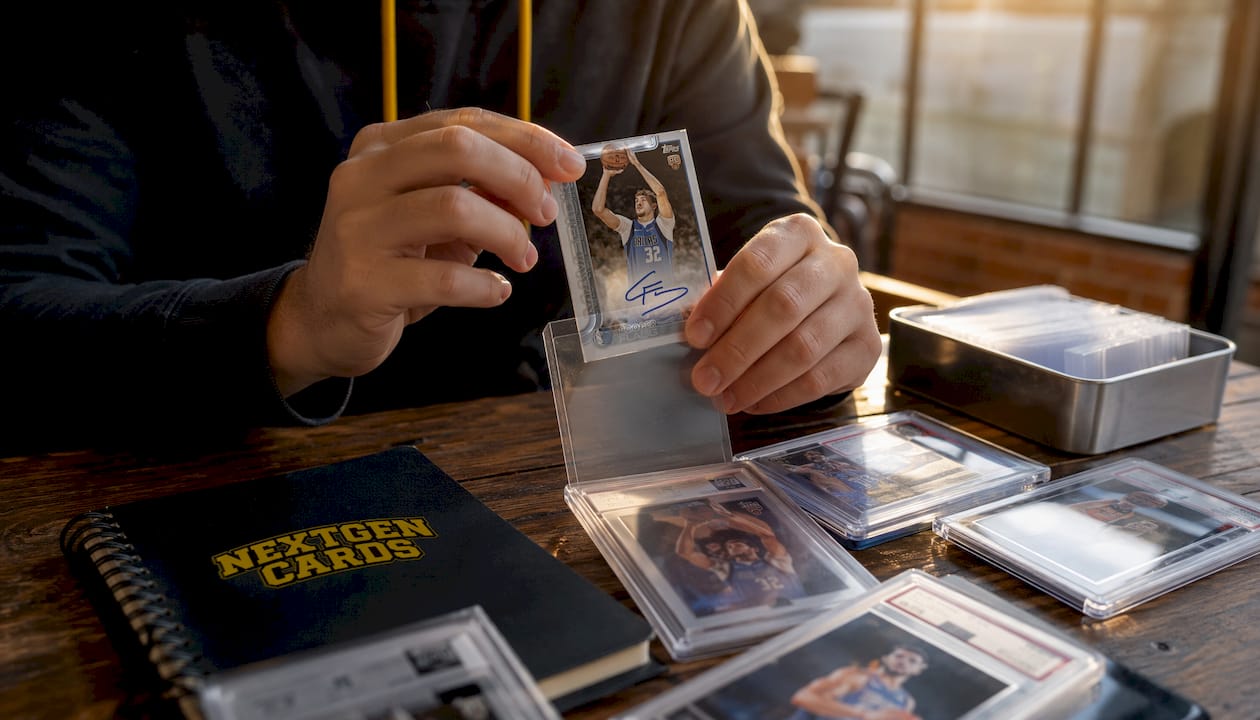
Numbered parallel (e.g., /25 or /68): A stamped serial number on the card back, usually in gold or colored foil, reading something like “12/25.” The stamp placement varies by set but is always on the back. Confirm the stamp is crisp and not smudged before paying a premium.
On-card autograph RC: Flagg’s signature appears directly on the card surface, not on a separate sticker affixed over the card. The ink sits within the card’s finish rather than on top of it.
Patch/relic auto: A fabric swatch embedded in a window cut into the card face, with an autograph either on-card or via sticker. The Topps Flagship Rookie Jersey Patch redemption is one of the most-watched examples in this category.
Pro Tip: To distinguish a sticker auto from an on-card auto in a listing photo, look at the edges of the signature area. A sticker auto shows a faint rectangular border or a slight gloss difference where the label was applied. On-card autos have no border, and the ink integrates with the card’s surface texture.
Quick visual checklist for any Flagg rookie listing:
- Card number visible on the back (#201 flagship, #251 Chrome, #1 Bowman)
- RC shield or “Rookie Card” designation present
- Serial-number stamp legible and matching the listing title
- Autograph placement confirmed (on-card vs. sticker)
- Card back shows correct set year (2025-26)
What each Cooper Flagg card type actually means for your collection
Understanding the terminology in a listing title tells you the scarcity and value tier before you even look at the price.
- Base RC: The standard, unlimited-print rookie card. Accessible and liquid, but not scarce. The Topps Flagship #201 base is the default entry point for new collectors.
- Flagship vs. Chrome: Flagship uses standard card stock; Chrome uses chromium-coated stock that photographs more vividly and historically commands a secondary-market premium. Chrome refractors and on-card autos have shown the strongest price retention.
- Refractor/prism parallels: Chrome-specific finishes (base Refractor, Gold Refractor, Prizm) that add visual pop and a modest scarcity bump over base Chrome.
- Numbered serial parallels (/499, /99, /25, /10, 1/1): Each card is stamped with its individual number out of the total print run. Lower print runs mean higher scarcity and, typically, higher prices. The 2025 Bowman set alone tracks 192 Cooper Flagg card variations, including Chrome Mojo Refractors and numbered color parallels.
- On-card autograph vs. sticker autograph: On-card autos are signed directly on the card surface and are generally preferred by collectors. Sticker autos use a pre-signed label applied during production and are considered lower-tier.
- Patch/relic: A game-used or event-worn fabric swatch embedded in the card. Patch autos combine the relic with an autograph, making them among the highest-demand hits.
- Redemption card: A physical card redeemed through the manufacturer (Topps) for the actual autograph or patch card once it is produced. Listings will note “redemption” in the title. The Topps Chrome Series 1 autograph redemption is a prime example.
- Pre-NBA vs. NBA-licensed: Bowman University Chrome and similar pre-NBA products sit in a separate value tier from officially NBA-licensed Topps Chrome and Prizm releases. Both have collector demand, but NBA-licensed cards carry the official branding that many investors prefer.
- Topps NOW: Print-on-demand moment cards tied to specific performances. Print runs are posted after the sales window closes and are often large, making these plentiful compared with hobby parallels. They serve as affordable milestone snapshots rather than primary investment targets.
How grading changes what a Cooper Flagg card is worth
A PSA 10 or BGS 9.5 slab on a Cooper Flagg rookie card is not just a cosmetic upgrade. It is a scarcity multiplier.
The Topps Flagship #201 base card illustrates this clearly. Raw copies have sold in the $3–$8 range. A PSA 9 sells in the $13–$23 range. A PSA 10 of the same card has sold between $92 and $106. That gap reflects both condition scarcity and the confidence a certified grade gives buyers. On the Holo Foil #201, a PSA 10 has sold between $500 and $860, while a PSA 9 sits in the $69–$127 range.
How to verify a slabbed card before buying:
- Locate the certification number on the label (front or back of the slab).
- Enter that number directly into the PSA, BGS, or SGC online lookup tool.
- Confirm the card description, grade, and population count match what the seller is showing.
- Photo-match the card image in the grader’s database to the seller’s photos, checking corners, centering, and surface.
- Verify the label font, color, and hologram match current grader standards. Tampered labels often show slight color shifts or misaligned text.
Population reports matter because they tell you how many copies of a specific card exist at a given grade. A PSA 10 with a population of five is a different asset than one with a population of 200. Low-population PSA 10s on low-serial parallels attract the most serious collector money.
Red flags to watch: mismatched cert numbers between the label and the grader database, photos that do not show the full card back, labels with unusual font weight, and slabs where the card appears to shift inside the case (a sign of a cracked-and-resealed slab).
What Cooper Flagg rookie cards are actually selling for right now
The market for Flagg cards shows a clear split between tiers, and knowing which tier you are buying into sets realistic expectations.
- Budget base (raw Topps Flagship #201): Recent eBay sales cluster in the $3–$8 range for raw copies. Accessible, but supply is high.
- Mid-tier graded base: PSA 8 copies of the flagship #201 have sold in the $8–$17 range; PSA 9 copies in the $13–$23 range.
- Holo Foil parallel (PSA 9): $69–$127, with earlier sales closer to $180 before the market corrected.
- PSA 10 flagship base: $92–$106 in recent sales.
- PSA 10 Holo Foil: $500–$860, reflecting the combination of grade scarcity and parallel premium.
- Chrome autographs and numbered parallels: The Topps Chrome market puts autographs and low-numbered parallels in the $300–$5,000+ range, with 1/1 cards drawing offers exceeding $100,000.
- Pre-NBA Bowman University Chrome: A separate tier. The base Bowman #1 raw copy sold for a few dollars, while the Chrome Auto SuperFractor 1/1 achieved a record-high price for the player.
The market bifurcation is real. High-end autographs and low-numbered parallels continue to attract investor demand. Mid-tier base cards face price pressure as supply from box breaks increases. Early refractor sales dropped from around $500 at release to closer to $300 within days, a pattern that reflects supply entering the market quickly. For autographs and numbered parallels, the outlook is stronger because true scarcity limits supply regardless of how many boxes are opened.
Pro Tip: Topps NOW moment cards for Flagg carry large print runs posted after the sales window closes. They are useful low-cost snapshots of milestones but are not primary investment targets. Focus premium dollars on hobby parallels with confirmed print runs.
Where to find clear photos, sold prices, and trustworthy listings
Good research takes less than ten minutes when you know where to look.
- eBay completed/sold listings: Filter by “Sold Items” and search using the exact card number (#201, #251, #1) plus the set name. This shows actual transaction prices, not asking prices. Asking prices on active listings can be wildly inflated.
- PSA Population Report: Visit PSA’s website, search by set and card number, and check how many copies exist at each grade. A low PSA 10 population on a numbered parallel is a meaningful data point.
- Sports Card Investor price guides: Tracks recent sales with date stamps, useful for spotting price trends over weeks or months.
- Sports Cards Pro price guides: Aggregates eBay sold data by grade, giving a quick snapshot of the PSA 5 through PSA 10 range for a specific card.
- Topps product pages: Confirm official card numbers, set names, and parallel structures directly from the manufacturer to avoid mislabeled listings.
- Hobby community forums (Reddit r/basketballcards): Useful for early-warning signals on demand spikes or design anomalies, but always corroborate with actual sold data before acting on community chatter.
Pro Tip: Always search by card number rather than player name alone. Mislabeled listings are common, and filtering by “#201” or “#251” cuts through the noise fast. Before paying a premium on any numbered card, ask the seller for a clear photo of the serial stamp on the back.
Buying a slabbed card remotely? Request photos of the full card back, the cert number on the label, and the slab edges. Then run the cert number in the grader’s database yourself before completing the purchase.
Smart collector strategy and mistakes to avoid with Flagg rookies
The collectors who come out ahead on Flagg cards are not the ones who bought the most. They are the ones who bought the right cards at the right time.
Anchor on liquidity first. A Chrome Refractor or a well-documented low-serial parallel is easier to sell than a sticker auto on a low-end product. Liquidity matters when you want to exit a position or upgrade your collection.
- Avoid panic-buying during hype spikes. Prices spiked at release and corrected quickly. A fair entry point for standard Topps Chrome rookies sits closer to the $200–$300 range; early sales above $400–$500 were driven by release hype.
- Use a multi-year horizon. Rookie card prices often cool in the offseason as supply floods from box breaks, then climb again with renewed season interest. Buying dips is a documented pattern in this market.
- Prioritize on-card autos over sticker autos. On-card signatures carry a consistent collector premium and are easier to sell at a fair price.
- Check population reports before buying a graded card. A PSA 10 with a population of 200 is a different investment than one with a population of five.
- Do not chase every numbered insert. The 2025 Bowman set alone has 192 tracked Flagg variations. Spreading budget across too many low-end variants dilutes exposure without adding meaningful scarcity.
The most common mistake is overpaying for a sticker auto on a low-end product during peak hype. The second most common is buying a numbered card without verifying the serial stamp in the seller’s photos. Both are avoidable with a few minutes of due diligence.
Key Takeaways
The most valuable Cooper Flagg rookie cards combine on-card autographs, low serial numbers, and high grades — base copies are accessible entry points, but premium parallels and patch autos hold the strongest long-term collector demand.
| Point | Details |
|---|---|
| Priority card numbers | Topps Flagship #201 and Chrome #251 are the primary rookie references; always verify by card number. |
| Grade premium is significant | A PSA 10 Topps Flagship #201 sells in a notable multiple of raw prices, which remain accessible. |
| Holo Foil PSA 10 ceiling | PSA 10 Holo Foil #201 copies have sold between $500 and $860. |
| Market is bifurcated | High-end autos and low-serial parallels hold demand; mid-tier base cards face supply pressure. |
| Nextgencards inventory | Nextgencards carries authenticated Flagg Topps Flagship autograph, jersey patch, and Chrome Series 1 autograph redemptions with free shipping on select items. |
Why these specific Flagg examples deserve your attention
The Cooper Flagg rookie card market is one of the most active in basketball collectibles right now, and the volume of listings makes it easy to buy the wrong thing at the wrong price. What separates a sound purchase from an expensive mistake is knowing exactly which edition you are holding and what the grading population says about its scarcity.
Nextgencards has handled enough rare rookie autographs and patch cards to know that the details matter: the card number, the serial stamp, the autograph type, and the cert number on a slab. The Flagg cards featured in this guide are not theoretical examples. They reflect the editions that consistently generate collector interest and secondary-market activity. When Nextgencards vets a slabbed or raw high-value Flagg piece, the process includes cert verification, photo-matching against grader database images, and confirming the parallel designation matches the listing. That standard applies to every card in the inventory.
The collector who takes the time to learn these distinctions before buying is the one who builds a collection worth holding.
Authenticated Cooper Flagg rookies available from Nextgencards
Nextgencards carries a curated selection of authenticated Cooper Flagg rookie cards for collectors who want verified pieces without the research burden.
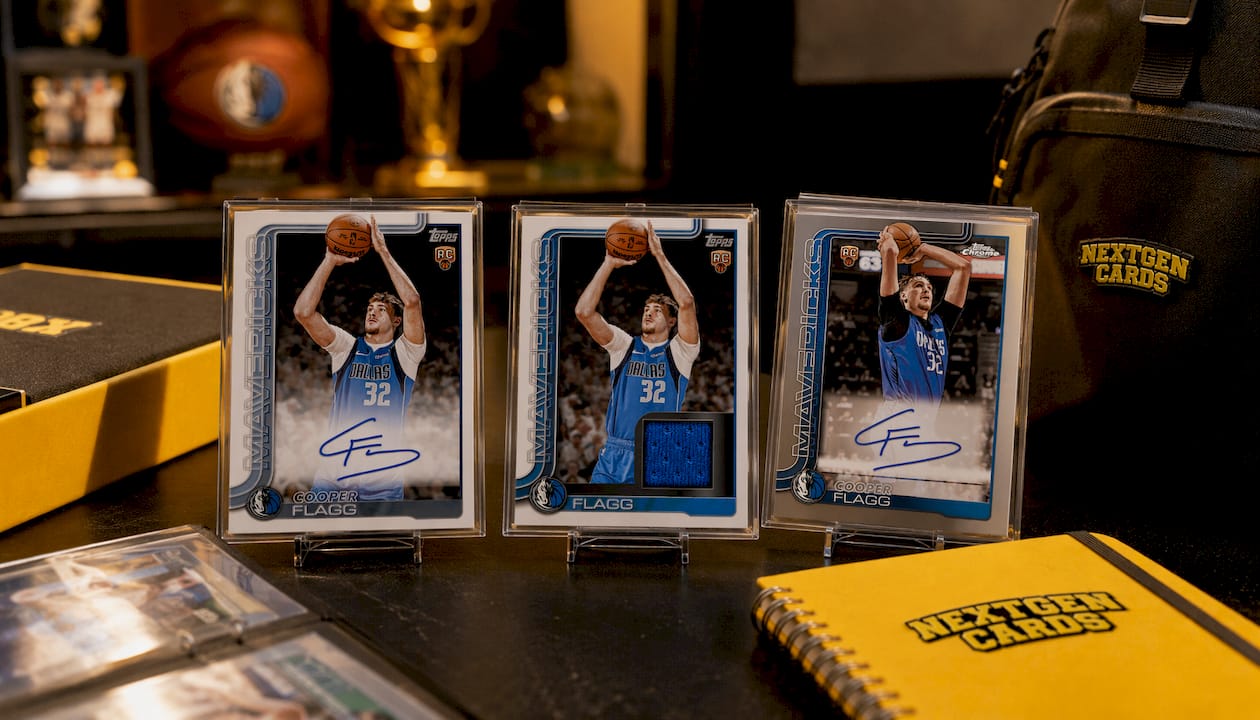
Three standout options currently in inventory:
- Topps Flagship Rookie RC Autograph: The on-card autograph redemption from the flagship set, authenticated and available with free shipping.
- Topps Flagship Jersey Patch RC: A patch/relic redemption card combining game-used fabric with the rookie designation, one of the most-watched editions in the current market.
- Topps Chrome Series 1 Autograph RC: The Chrome autograph redemption, ideal for collectors who prioritize the Chrome premium and long-term liquidity.
Every listing includes the cert number for slab verification. Before completing any purchase, run that number through the PSA, BGS, or SGC database to confirm grade and population. Browse the full rookie autographs and relics collection to see current availability and request additional photos of any card before checkout.
Best places to verify listings, prices, and grading
Use these resources together for a complete picture before any purchase.
- PSA Population Report: Search by set and card number to see how many copies exist at each grade. Essential for evaluating scarcity on numbered parallels.
- eBay Sold Listings: Filter by “Sold Items” for actual transaction data. Asking prices are not sale prices.
- Sports Card Investor: Date-stamped sales history for Bowman and other sets, useful for tracking price trends over time.
- Sports Cards Pro: Grade-by-grade price breakdowns for Topps Flagship #201, showing the full PSA 5 through PSA 10 range.
- Topps product pages: Confirm official card numbers and parallel structures to catch mislabeled listings before you buy.
- Nextgencards buying guide: The Chrome Series 1 autograph guide explains redemption timelines and what to expect after purchase.
For any high-value purchase, the verification sequence is: cert check in the grader database, photo-match the card front and back, confirm the serial stamp matches the listing title, and review the seller’s feedback history. Collectors who skip any of these steps are the ones who end up with problems. Take the five minutes. It is worth it.
This article is general collector information, not financial or investment advice. Verify current prices and grading populations through primary sources before making any purchase decision.
Recommended
- 2026 Cooper Flagg - Topps New Applicant Rookie Autograph Rare Card – Next Gen Cards LLC
- 2026 Cooper Flagg - Topps Flagship Rookie RC Autograph Rare Card – Next Gen Cards LLC
- 2026 Cooper Flagg - Topps Future Stars Autograph Rookie Rare RC Card – Next Gen Cards LLC
- 2026 Cooper Flagg - Topps Flagship Rookie Jersey Patch Rare RC Card – Next Gen Cards LLC
0 comments